 MineArchive
Cadeby Main Colliery disaster, 1912
A firedamp explosion at Cadeby Main Colliery in the early hours of 9 July 1912 killed 35 men outright, with three more later dying of their injuries; a second explosion that same day killed 53 members of the rescue party sent to recover the dead, bringing the total death toll to 91 — one of the worst mining disasters in British history.
| Date | 9 July 1912 |
|---|---|
| Mine | Cadeby Main Colliery |
| Region | South Yorkshire |
| Primary type | Explosion |
| Associated types | Rescue |
| Fatalities | 91 (35 men died in the first explosion, with a further 3 dying later of their injuries; a second explosion killed 53 members of the rescue party, bringing the total to 91.) |
| Context | During active mining |
Cause
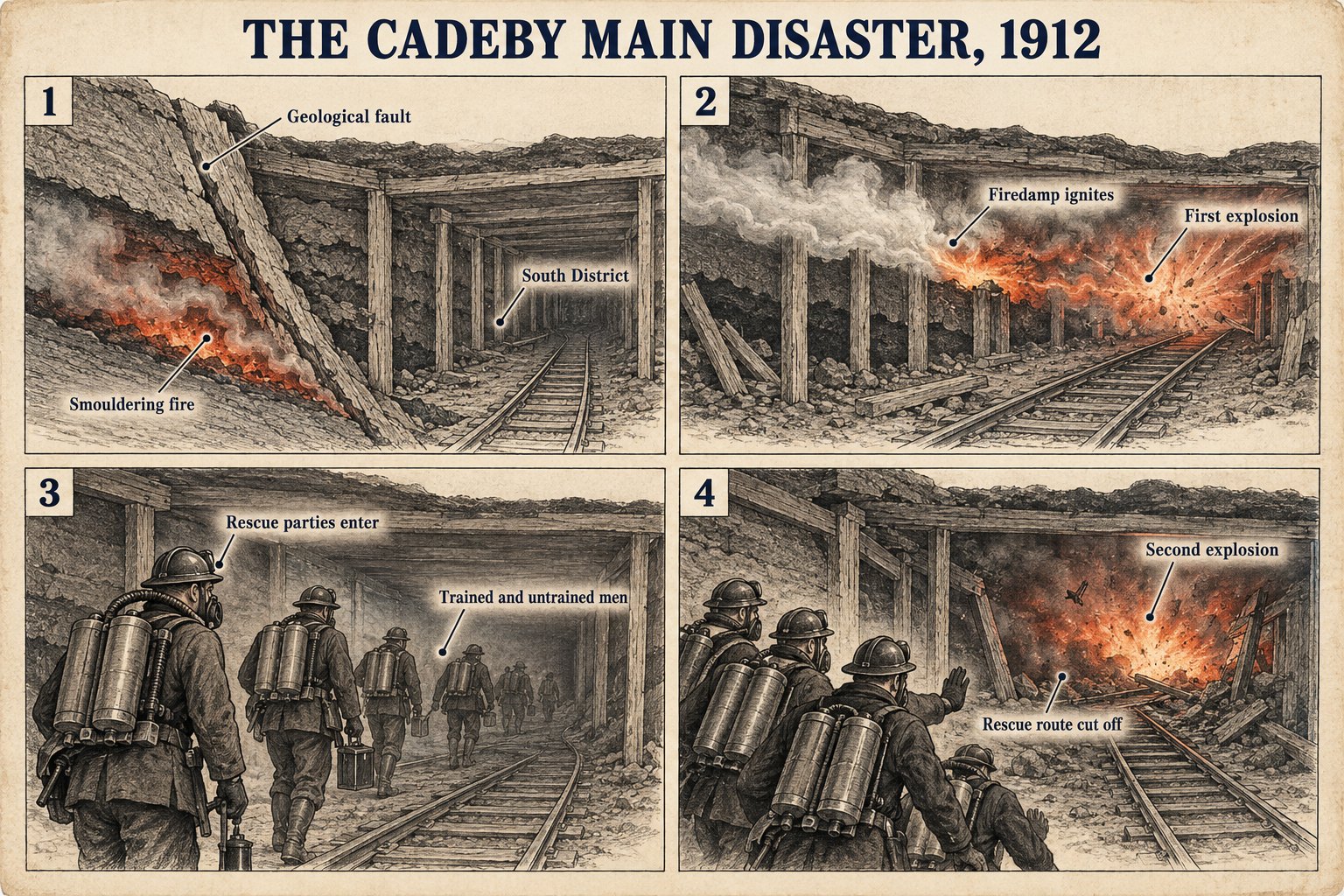
A smouldering underground fire near a geological fault, never properly extinguished since it first caused a small explosion in January 1912, ignited firedamp and triggered the first major explosion; the second explosion struck the same area later the same day while rescue parties were still working underground.
Contributing factors
The long-unextinguished fire near a geological fault created the conditions for the first explosion; the presence of a number of untrained, unauthorised volunteers alongside official rescue teams during the recovery operation is judged to have increased the death toll when the second explosion struck.
What happened
In the early hours of 9 July 1912, a firedamp explosion in the South District of Cadeby Main Colliery killed 35 of the 37 miners on the night repair shift, with three more later dying of their injuries. Rescue parties, including trained mines rescue teams and a number of untrained volunteers, went underground to search for and recover the dead. Later the same day, a second explosion struck the same area while the rescuers were still below ground, killing 53 of them outright. Only Sergeant Winch and a man named Lawrence survived from the combined Denaby and Cadeby rescue teams. In total, 91 men died — one of the worst single losses of life in British coal mining history.
Rescue & recovery
Rescue and recovery teams, drawn from trained mines rescue services alongside a number of untrained volunteers, entered the pit after the first explosion to search for survivors and recover the dead, and were themselves caught by the second explosion.
Investigation & inquiry
The Chief Inspector of Mines' report, published in May 1913, identified the long-unextinguished underground fire as the root cause of the disaster and criticised the rescue operation for allowing untrained, unauthorised men underground alongside official rescue teams, judging this had increased the death toll from the second explosion.
Legal & regulatory aftermath
The disaster was significant enough to be debated in the House of Commons on 2 July 1913.
Memorials & commemoration
A memorial to the disaster's victims stands at Denaby Cemetery, and a Cadeby Main Colliery Memorial Group continues to commemorate those who died.
Related terminology
Mining terms this disaster is structurally linked to, with the nature of the relationship.
- Coal (contextual relationship)
One of the worst single losses of life in British coal mining: 91 dead in all, including 53 of the rescue party killed by a second explosion while searching for the first victims. - Colliery (contextual relationship)
Named twice in this record, first in the summary: “A firedamp explosion at Cadeby Main Colliery in the early hours of 9 July 1912 killed 35 men outright, with three…” - Firedamp (direct cause)
A firedamp explosion, ignited by a long-unextinguished underground fire, caused both blasts. - HM Chief Inspector of Mines (contextual relationship)
Named in this record’s investigation: “The Chief Inspector of Mines' report, published in May 1913, identified the long-unextinguished…”
Sources
- (primary) Cadeby Main Colliery Disaster (Hansard, 2 July 1913) — UK Parliament (Hansard)
- (secondary) Cadeby Main Colliery Explosions 1912 — Northern Mine Research Society
- (secondary) Cadeby Main pit disaster — Wikipedia
- (secondary) Cadeby Pit Disaster 1912 - The Story of the Disaster — Conisbrough and Denaby Main Local History
Record created: 21 August 2026 · Last researched: 21 August 2026