 MineArchive
Blantyre Colliery Explosion, 1879
A second firedamp explosion at Dixon's Blantyre No. 1 pit, less than two years after the catastrophic 1877 disaster at the same colliery group, killed 28 men and boys.
| Date | 2 July 1879 |
|---|---|
| Mine | Blantyre Colliery |
| Region | South Lanarkshire |
| Primary type | Explosion |
| Associated types | Gas / Asphyxiation |
| Fatalities | 28 |
| Context | During active mining |
Cause
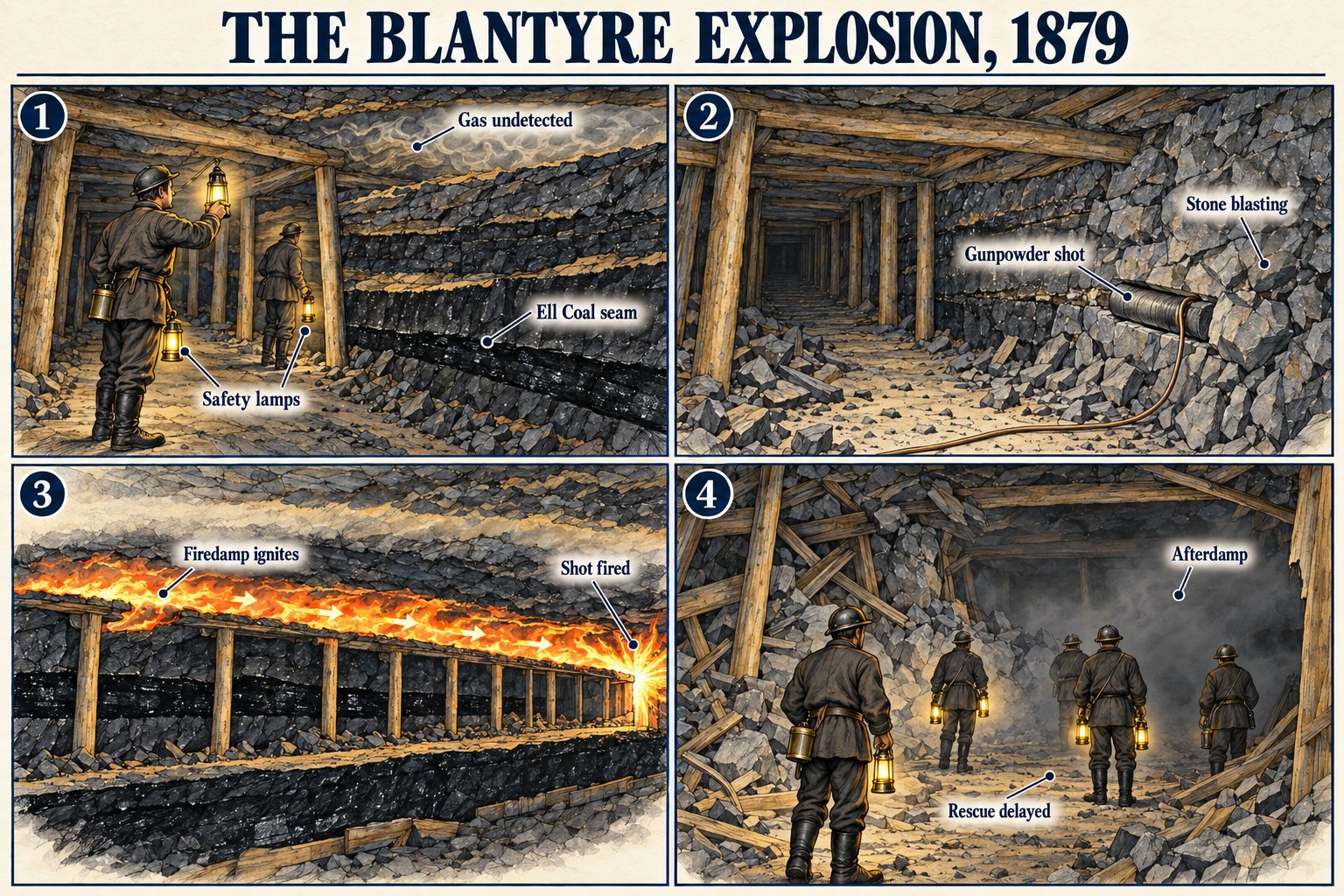
A firedamp explosion in the shallower Ell Coal seam, ignited while miners were using gunpowder to blast stone -- despite safety improvements made in the wake of the 1877 disaster.
Contributing factors
By 1879 only approved Clanny and Davy safety lamps were permitted at the colliery following the 1877 inquiry's recommendations, and gas had not been detected in the affected workings since 19 May that year; the inquiry nonetheless found accumulated gas had gone undetected before the blast.
What happened
The explosion struck the Ell Coal seam while shot-firing was under way. It did not cover a wide area of the workings, and men working at the far end of the level survived; one survivor, Charles Lafferty, described being thrown violently against the coal face and struggling to breathe through thick gas before losing consciousness. Twenty-eight men and boys were killed, with a further four initially listed missing.
Rescue & recovery
Rescue parties faced heavy afterdamp in the confined workings, hampering recovery of the dead.
Investigation & inquiry
The Mines Inspector's 1879 report found the explosion had been triggered by shot-firing igniting gas that had accumulated undetected, despite the improved safety-lamp regime introduced after 1877 -- a reminder that lamp reform alone could not eliminate the underlying risk of gas building up in a working seam between checks.
Related terminology
Mining terms this disaster is structurally linked to, with the nature of the relationship.
- Afterdamp (contextual relationship)
Named in this record’s rescue and recovery: “Rescue parties faced heavy afterdamp in the confined workings, hampering recovery of the dead.” - Firedamp (contextual relationship)
Named twice in this record, first in the summary: “A second firedamp explosion at Dixon's Blantyre No. 1 pit, less than two years after…” - Level (contextual relationship)
Named in this record’s narrative: “…a wide area of the workings, and men working at the far end of the level survived; one survivor, Charles Lafferty, described being thrown…” - Safety Lamp (contextual relationship)
Named twice in this record, first in the contributing factors: “By 1879 only approved Clanny and Davy safety lamps were permitted at the colliery following the 1877 inquiry's…” - Shot-firing (contextual relationship)
Named twice in this record, first in the narrative: “The explosion struck the Ell Coal seam while shot-firing was under way. It did not cover a wide area of the workings, and men…”
Sources
- (secondary) Blantyre Colliery Explosion - Blantyre - 1879 — Northern Mine Research Society
- (secondary) Blantyre mining disaster — Wikipedia
Record created: 30 August 2026 · Last researched: 30 August 2026