 MineArchive

Oaks Colliery disaster memorials
| Category | Art |
|---|---|
| Dates | Explosions 12 and 13 December 1866; Ardsley memorial erected 1879 by one account; rescuers' memorial commissioned 1913, unveiled February 1914; bronze repaired and replaced 22 October 1998; Ibbeson's memorial dated 2016, unveiled 7 May 2017. |
Three memorials in Barnsley remember the Oaks Colliery explosions of December 1866, still counted England's worst colliery disaster. They are a churchyard monument at Ardsley, the rescuers' memorial of 1913 and Graham Ibbeson's statue of 2016.
The mining history in this record
On 12 December 1866 an explosion tore through the Oaks Colliery near Barnsley while 340 men and boys were underground, destroying both cages; of those below at the time, only six survived. The next morning, with more than a hundred rescuers in the pit, signs of another explosion were seen. All but 28 got out before a second, violent blast killed those still underground, among them the mining engineer Parkin Jeffcock, who was leading the rescue, and a third explosion later that day left the mine on fire. Early on the third day the signal bell rang at the bottom of No. 1 shaft. On temporary headgear two volunteers, John Edward Mammatt and Thomas William Embleton, went down and brought up the one surviving rescuer.
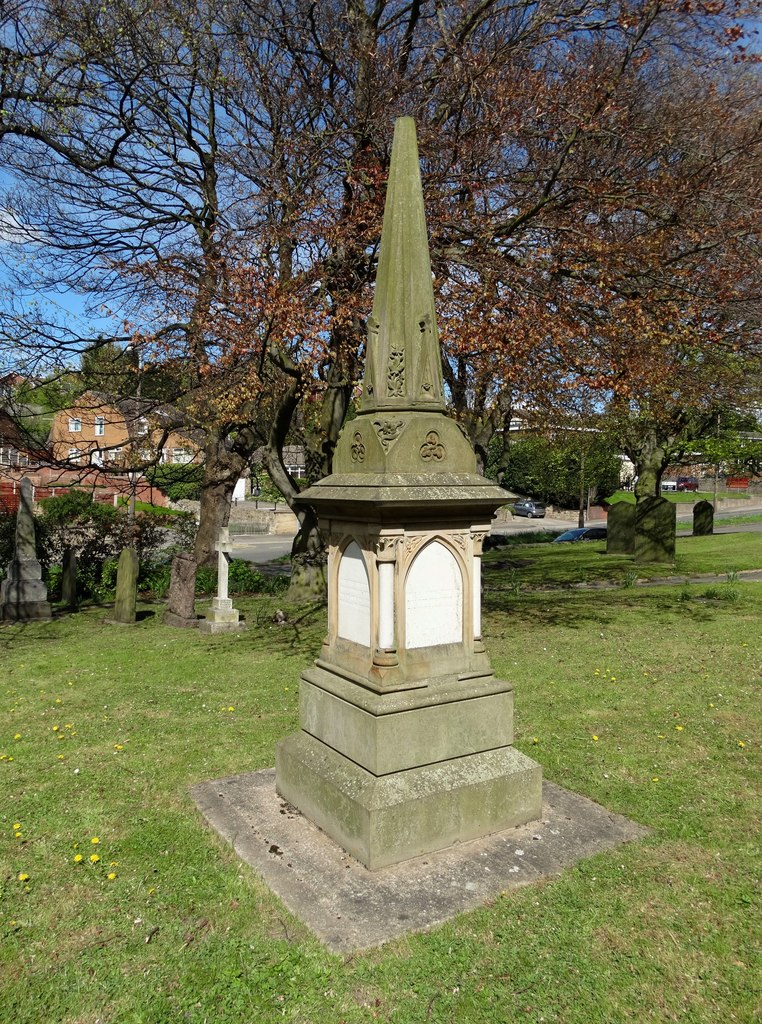
The first memorial was raised by public subscription in the churchyard of Christ Church, Ardsley: a sandstone pedestal about 3.6 metres high, with four inscribed marble faces, marble corner pillars and a small obelisk. It records the deaths of 354 men and boys in the explosions of 12 and 13 December, 35 of whom are buried there, and carries three scripture verses on the uncertainty of the hour of death. Miners' graves lie around it.
A memorial to the rescuers came much later. Early hopes of one in Locke Park came to nothing, and in 1913 Samuel Joshua Cooper, the Barnsley businessman and collector who founded the Cooper Gallery, paid for it himself. It stands on Doncaster Road at Kendray: a tall ashlar obelisk with, in front, a bronze copy of Marius Jean Antonin Mercié's Gloria Victis. Athene, winged and in a gilded cuirass, carries a dying soldier who holds a broken sword, with an owl at her feet. Its plaque honours Jeffcock and the other rescuers who died on 13 December, and the bravery of Mammatt and Embleton. The architects were Wade and Turner and the stonemason Peter Dalby. Cooper died in July 1913, and the memorial was not unveiled until February 1914.
People
Parkin Jeffcock, the mining engineer who led the rescue and died in it; John Edward Mammatt and Thomas William Embleton, who brought up the last survivor; Samuel Joshua Cooper, who paid for the rescuers' memorial; Marius Jean Antonin Mercié, sculptor of Gloria Victis; Graham Ibbeson, sculptor of the 2016 memorial.
Legacy today
The rescuers' memorial is listed Grade II. After an attempted theft its bronze was repaired, the cuirass regilded by Sheffield Hallam University's sculpture workshops, and the group was put back on its plinth on 22 October 1998. For the 150th anniversary a third memorial was raised by public donation and unveiled on 7 May 2017: Graham Ibbeson's bronze of a woman carrying a baby, coal streaming from her back, standing above a miner who lies on his side in a narrow seam, his pick under his head. A frieze of people walking is etched on the back, with the years 1866 to 2016 in steps of twenty-five. It belongs to Barnsley council.
Recorded claims
Individual factual claims, each tagged with how solidly it's grounded and attached to the source(s) that support it. Where sources disagree, both are kept.
- A monument to those killed in the disaster was erected at Christ Church, Ardsley, in 1879. (documented fact, disputed) 1
- The Ardsley memorial dates from the 1860s. (unverified claim, disputed) 2
- The Ardsley monument records the deaths of 354 men and boys in the explosion of 12 and 13 December 1866, 35 of whom are buried there. (documented fact) 2
- The rescuers' memorial was erected in 1913, privately funded by Samuel Joshua Cooper. (documented fact) 3,4,5
- Its bronze group is a copy of Marius Jean Antonin Mercié's Gloria Victis. (documented fact) 3,4,5
- The rescuers' memorial was installed by the end of 1913 and unveiled in February 1914, after Cooper's death in July 1913. (documented fact) 3,5
- The rescuers' memorial is listed Grade II. (documented fact) 3,4
- 340 men and boys were underground at the first explosion on 12 December 1866, and only six of them survived. (documented fact) 3,5
- Graham Ibbeson's Oaks Colliery Disaster 1866 Memorial, funded by public subscription, was unveiled on 7 May 2017. (documented fact) 6
Mines
- Oaks Colliery — South Yorkshire
All three memorials commemorate the Oaks Colliery explosions of 12 and 13 December 1866: the dead at Ardsley, the rescuers at Kendray, and the disaster as a whole in Graham Ibbeson's 2016 statue.
Disasters
- Oaks Colliery explosion, 1866 — 12-13 December 1866
The three memorials commemorate the dead and the rescuers of the 1866 explosions.
Real-world mining concepts used here
Ashlar, Cage, Colliery, Headgear, Shaft
Related Culture records
- Two Trains of Pleasure (1859)
Another culture record of the Oaks Colliery.
Sources
- (secondary) Oaks explosion — Wikipedia
- (secondary) Oaks Colliery Disaster Memorial, Ardsley (PMSA National Recording Project) — Public Art Research Archive, Sheffield Hallam University
- (secondary) Oaks Colliery Disaster Rescuers' Memorial (PMSA National Recording Project) — Public Art Research Archive, Sheffield Hallam University
- (primary) Oaks Colliery Disaster Memorial (list entry 1151149) — Historic England
- (secondary) Oaks Colliery Disaster Memorial, Stairfoot, Barnsley — British Listed Buildings
- (secondary) Oaks Colliery Disaster 1866 Memorial (Graham Ibbeson, 2016) — Art UK
Record created: 29 November 2026 · Last researched: 29 November 2026