 MineArchive
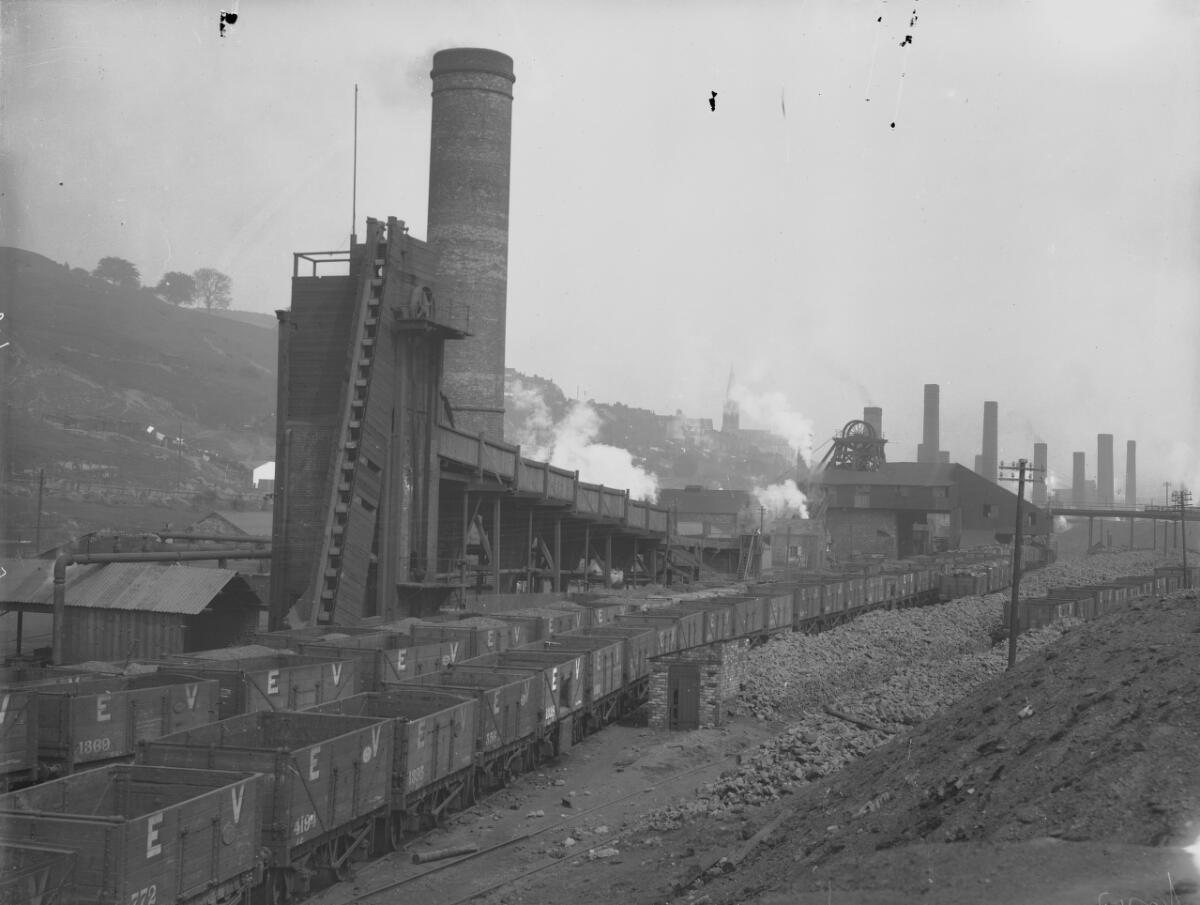
Victoria Colliery, Ebbw Vale
| Also known as | Victoria Pits, Victoria No. 5 Pit |
|---|---|
| Location | Victoria, Ebbw Vale, Blaenau Gwent — 51.7650, -3.2034 (exact) |
| Commodities | Coal, Ironstone |
| Type | Coal |
| Worked | 1838–1929 |
| Maximum depth | 230 yards (No. 6 pit, Spotted Vein) |
| Operators | Monmouthshire Iron and Coal Company (?–1848), Ebbw Vale Steel, Iron and Coal Company (1848–?), Partridge Jones and John Paton |
Overview
The coal and ironstone pits of the Victoria ironworks below Ebbw Vale, sunk from 1838, where eleven men fell to their deaths in 1848 and nineteen died in an explosion in 1871; its No. 5 pit was renamed the Prince of Wales in 1918, and coal working ended in 1929.
History
The Victoria pits were sunk in the Ebbw valley below Ebbw Vale for the Victoria ironworks of the Monmouthshire Iron and Coal Company, a speculative venture backed from the Bath region, on mineral ground leased from Benjamin Hall. Works and pits, wound by water-balance engines, were completed in 1838, but the venture failed, and in 1848 the property was sold for £55,000 to Darby and Brown, the owners of Ebbw Vale. The pits raised both coal and ironstone: the No. 1 shaft, given by Welsh Coal Mines as 690 feet deep and completed in 1846, worked the Old Coal and Red veins, and No. 6, 230 yards deep, worked the Spotted Vein of ore with the Old Coal. In all there were seven shafts to the surface. Nos. 1 and 8 were converted to steam winding by the Ebbw Vale company around 1853.
Eleven men fell to their deaths down the No. 6 pit in June 1848, and an explosion in No. 1 killed nineteen in March 1871 (see Disasters, below). No. 1 was reopened in 1882 with a steam fan and the ironstone workings were given up. In 1896 the colliery had 363 men on the Big Vein, Byddeg, Old Coal and Old Woman's Coal, and 463 by 1908. No. 6 closed in 1894; in 1914 the colliery closed and was redeveloped as the upcast for the deepened No. 5 pit. In March 1918 the Prince of Wales visited No. 5, went underground and agreed to its renaming as the Prince of Wales Colliery; it had 998 men that year and 1,089 in 1923 on the Black Vein and Gwarycae seams. Partridge Jones and John Paton later owned it. Production ceased in 1929, and by 1945 eight men were kept for pumping and ventilation.
Geology
South Wales coalfield, Ebbw valley: coal and ironstone together, the Old Coal, Red and Spotted veins of ore, the Mydelog or Black Vein, Big Vein, Byddeg and Old Woman's Coal, and later the Black Vein and Gwarycae seams.
Workings
Seven shafts to the surface, Nos. 1 to 8 (No. 7 a staple), first wound by water balance; No. 5, deepened and modernised, renamed the Prince of Wales Colliery in 1918.
Closure
No. 6 closed in 1894 and No. 1 in 1914; coal production ceased in 1929, with eight men kept for pumping and ventilation in 1945.
What remains
Unknown.
Redevelopment
Unknown.
Nearby mines
- Waunllwyd Colliery — 1.0 miles (1.6 km) SE
- Cinder Pit, Blaina — 1.5 miles (2.3 km) NE
- Bedwellty Pits — 1.5 miles (2.4 km) SW
- Coalbrook Vale Colliery — 1.5 miles (2.4 km) NE
- Griffin No. 1 Colliery — 1.5 miles (2.4 km) E
Straight-line distance, within 9 miles (15 km). Show on the map.
Disasters & major incidents
-
Victoria Colliery shaft accident, Ebbw Vale, 1848
21 June 1848 · Winding / Shaft Accident · 11 fatalities
Eleven men and boys, the youngest 13, fell 85 yards to their deaths down the No. 6 pit of the Victoria ironworks, Ebbw Vale, on 21 June 1848, when the cage they had stepped into at the top lost its counterbalance. -
Victoria Colliery explosion, Ebbw Vale, 1871
2 March 1871 · Explosion · 19 fatalities
Gas fired at a naked light in No. 1 Victoria pit, Ebbw Vale, between three and four on the afternoon of 2 March 1871, killing nineteen of the 41 men in the Old Coal seam, among them a fireman who went down to look for his son.
What's uncertain
Points where sources disagree or the record could not be settled; both accounts are kept. All open questions in the archive.
- The No. 6 pit at Victoria was sunk in 1838. (disputed) 3
- The No. 1 shaft was sunk to 690 feet and completed in 1846; No. 6 was added in 1847. (disputed) 1
Recorded claims
Individual factual claims, each attached to the source(s) that support it below. Where sources disagree, both are kept.
- The Victoria pits were sunk by the Monmouthshire Iron and Coal Company to feed its ironworks at Victoria, and in 1848 passed to the Ebbw Vale owners. 1,2
- The No. 6 pit at Victoria was sunk in 1838. (disputed) 3
- The No. 1 shaft was sunk to 690 feet and completed in 1846; No. 6 was added in 1847. (disputed) 1
- In 1918 the Prince of Wales visited Victoria No. 5 pit and agreed to its renaming as the Prince of Wales Colliery. 1,3
- In 1923 the colliery employed 1,089 men. 1
- Production ceased in 1929. 1
- BGS holds plans of the Victoria Ebbw Vale pits Nos. 6 to 19 in the Four Feet or Big Vein. 4
Photographs & further reading
Welsh Coal Mines' page on the Victoria pits, with newspaper reports of the 1848 and 1871 disasters and a history of pits 1 to 8.
View sourceSources
- (secondary) Victoria Colliery Ebbw Vale (Welsh Coal Mines) — Welsh Coal Mines
- (secondary) Victoria Colliery No 6 Pit, Shaft Accident, 1848 (Northern Mine Research Society) — Northern Mine Research Society
- (secondary) The Ebbw Vale Steel, Iron & Coal Company (Amgueddfa Cymru - Museum Wales blog) — Amgueddfa Cymru - Museum Wales
- (primary) BGS mine plan: Ebbw Vale, Sirhowy and Victoria Ebbw Vale Nos 6-19, Four Feet (Big Vein) — British Geological Survey
Record created: 6 October 2026 · Last researched: 6 October 2026