 MineArchive
Tomnadashan Copper Mine
| Location | Southwest of Ardtalnaig, Loch Tay, Perth and Kinross — 56.5147, -4.1287 (exact) |
|---|---|
| Commodities | Copper, Gold |
| Type | Metal |
| Worked | 1841–1862 |
| Operators | John Campbell, Marquess of Breadalbane (1841–1862) |
Overview
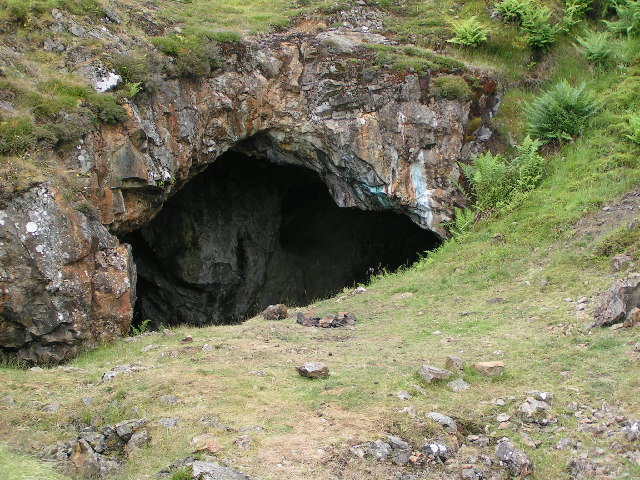
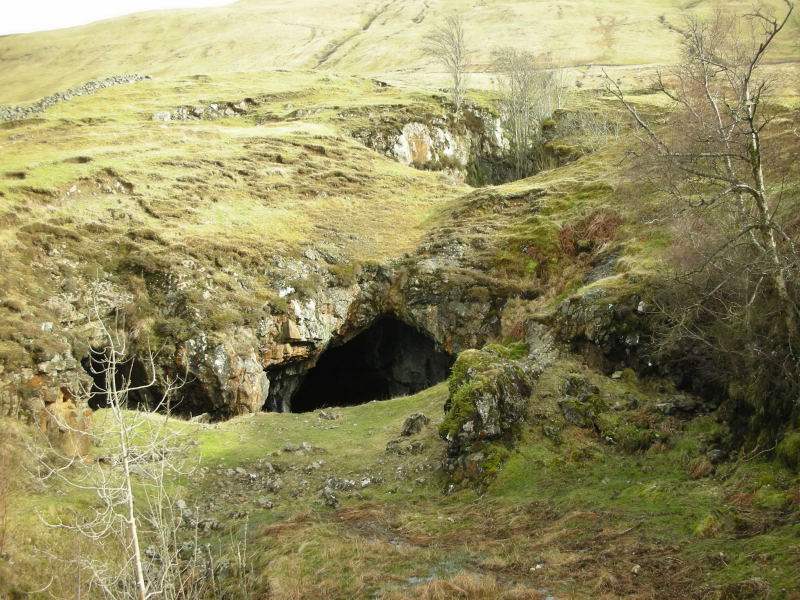
Tomnadashan, on the southern shore of Loch Tay in Perthshire, was a short-lived 19th-century copper venture developed by the Marquess of Breadalbane — remembered today less for its mining history than as the filming location for the Cave of Caerbannog in Monty Python and the Holy Grail.
History
Tomnadashan was developed by John Campbell, 5th Earl and 2nd Marquess of Breadalbane, whose interest in the pyrites deposit on his Loch Tay estate dates to 1838, when he consulted the Glasgow chemist Thomas Thomson about extracting sulphur from it. The German geologist F. Odernheimer, engaged as consultant from 1838, identified chalcopyrite, iron pyrites and grey copper ore at the site but warned in 1840 that 'no vein has been opened worth marking'; trial mining went ahead anyway. An adit was driven into the hillside in early 1841 by four miners recruited from Devon and Cornwall, followed by an open pit and a connecting shaft (locally called the 'sumpt') by 1843. Output was modest and irregular: the foreman, Roberts, working alongside fellow foreman Ewen MacGregor, reported around 1.5 tons of ore a fortnight, and by summer 1846 some 70 tons of 'rich' ore had been raised. In early 1846 the mine manager Daniel Dewar reported 14 men employed at the mine plus two boys breaking stones and sorting ore, falling to 12 men 'blasting and wheeling' by the end of 1847. By 1850, £4,267 had been spent on what the estate formally called the Ardtalnaig Mineral Trials, and in 1853 the first commercial shipment — 71 tons of high-grade copper ore — was sent to Swansea, earning the estate £99 net of transport costs. Breadalbane also pursued sulphur, and later sulphuric acid and superphosphate fertiliser manufacture, on site, and eventually a two-tier furnace to smelt the accumulated ore stockpile into copper matte, but none of these ventures was ever profitable; by 1861 a formal financial review still showed a net loss, and exploration had already ceased. The Earl died in 1862 and his trustees stripped and sold off the plant. In 1974, over a century after the mine's abandonment, the derelict adit was used by the Monty Python team as the filming location for the Cave of Caerbannog sequence in Monty Python and the Holy Grail, released the following year -- the lair of the film's Killer Rabbit of Caerbannog, defeated by King Arthur's knights with the Holy Hand Grenade of Antioch. The scene was shot using a real rabbit for close-ups, dyed red for the fight sequence with dye its owner was reportedly unable to fully wash out afterwards. Pythons Terry Jones and Michael Palin attempted to revisit the site for the film's 25th anniversary in 2000 but were unable to relocate it.
Geology
The deposit consisted of chalcopyrite, iron pyrites (mundic) and arsenic- and antimony-bearing grey copper ore hosted in porphyritic greenstone, with feldspar and quartz as the main gangue minerals. Distribution was very irregular rather than following a single rich vein — prospecting through the 1840s and 1850s repeatedly failed to locate one — and ore grades were generally well under the 8% copper needed to be directly saleable to English or Welsh smelters, so could not be worked economically without on-site processing.
Workings
The main adit, driven from 1841, extended south before splitting into south-east and south-west branches after about 14m; by 1843 the south-east branch had been extended beneath an open pit some 50m to the south, connected to the level below by a vertical shaft known as the 'sumpt'. In 1859 the managers Gustav Thost and Benjamin Gribble decided to work the deposit as an open working rather than continue following a vein underground, judging that no coherent lode was present. Devéria's 2001 fieldwork survey found the original adit entrance collapsed, but traced the open working, the choked sumpt, and — on the lochside plant site — the remains of the roasting/smelting furnace, sections of flue for the copper smelter, the sulphuric acid works and the fertiliser plant, and the stone terracing that supported them.
Closure
The venture never recovered its costs. An 1858 assessment put the running loss at £2,000–£3,000 a year, and a further review in August 1861 found the mining and processing operation still losing money even after James Napier's more efficient acid works had cut the annual deficit substantially; exploration had already been abandoned by then. Napier was dismissed 'at short notice' once the works were finished, and the metallurgist W. J. Henwood, manager of the Earl's Tyndrum mines, judged there was 'no great hope of success for further operations'. The Earl of Breadalbane died in 1862, and his trustees sold off everything of value from the site — ore, matte, equipment, iron, timber and brick — leaving only the stone structures now visible.
What remains
Tomnadashan's best-known feature today is the collapsed adit mouth used, in 1974, as the exterior of the Cave of Caerbannog in Monty Python and the Holy Grail (1975) — home to the killer rabbit, played on screen by both a real animal and a puppet. For the film's 25th anniversary, Michael Palin and Terry Jones returned to Loch Tay to be filmed in front of the cave for a DVD documentary but could not remember which site it was; the location was rediscovered and confirmed on a visit reported by The Courier in 2022. The mine remains a minor pilgrimage destination for fans, some of whom leave rabbit-themed props at the entrance. Stone terracing, sections of flue and the ruined remains of the smelting furnace and acid works survive on the lochside plant site below the mine, and a February 2022 visitor report described the main workings as still open, with copper staining visible on the rock and a sulphurous, wet tunnel at depth likely representing the mine's original drainage adit.
Related mines
- Tyndrum Mines — The same metallurgist, W. J. Henwood, managed the Earl of Breadalbane's interests at both mines.
Recorded claims
Individual factual claims, each attached to the source(s) that support it below. Where sources disagree, both are kept.
- Breadalbane's interest in Tomnadashan's pyrites deposit dates to 1838; an adit was driven into the hillside in early 1841 by miners recruited from Devon and Cornwall. By early 1846 the mine employed 14 men, plus two boys breaking stones and sorting ore, under manager Daniel Dewar — falling to 12 men by the end of 1847. The first commercial shipment, 71 tons of high-grade copper ore, was sent to Swansea in 1853 and earned the estate £99 net of transport costs; this was a single shipment rather than the mine's total output, which continued on a smaller scale for another decade of smelting and chemical-manufacturing trials before the operation closed, heavily loss-making, following the Earl of Breadalbane's death in 1862. 1
- Beyond raw ore sales, Breadalbane pursued on-site processing: a sulphuric-acid and superphosphate-fertiliser plant built in 1857-58 under the chemist James Jefferis struggled to produce usable acid and was closed within a year, and a two-tier roasting-and-smelting furnace built in 1859-60 by manager Gustav Thost processed 327.85 tons of ore, cinder and lime over a twelve-week campaign to produce roughly 85 tons of copper matte assaying only 3-4% copper. The metallurgist James Napier then rebuilt the works as a combined acid-and-fertiliser plant in 1860-61, achieving a sulphur recovery to acid of around 74% — but a financial review that August still found the operation losing money, and Napier was dismissed once the works were wound down. 1
- The cave was used as the exterior of the Cave of Caerbannog — home to the killer rabbit — in Monty Python and the Holy Grail, released in 1975 and filmed on location in Scotland in 1974; the rabbit itself was played on screen by both a real animal and a puppet. 2,3
- For the film's 25th anniversary, Michael Palin and Terry Jones returned to be filmed in front of the cave for a DVD documentary but could not remember which location it was; the site was subsequently confirmed and revisited by a Courier journalist in 2022, and remains a minor pilgrimage destination for fans, some of whom leave rabbit-themed props at the entrance. 4,3
- A February 2022 visitor report described the main workings as still open and explorable, with copper staining visible on the rock, a rear pit and a second, muddier pit, and a sulphurous, wet tunnel at depth — likely the mine's original drainage adit — with a smell described as worse than the nearby Cae Coch sulphur mine. Devéria's 2001 archaeological survey found the original adit entrance collapsed but traced substantial surviving remains on the lochside plant site below, including the smelting furnace, sections of flue, and stone terracing from the acid and fertiliser works. 1,5
- A December 1844 estate survey plan of Tomnadashan's underground workings — showing the course of levels and galleries on the west side of the workings, including the upper sump and main level — survives in the British Geological Survey's mine plans catalogue (reference SP377), though the scan itself is not publicly available. 6
- The mine's derelict adit was used in 1974 as the filming location for the Cave of Caerbannog sequence in Monty Python and the Holy Grail (released 1975), the lair of the film's Killer Rabbit of Caerbannog. 7,8
- A real rabbit, dyed red for the fight scene, was used for filming; Monty Python members Terry Jones and Michael Palin attempted unsuccessfully to relocate the site for the film's 25th anniversary in 2000. 8
Photographs & further reading
A detailed account of the Monty Python and the Holy Grail filming connection.
View sourceSources
- (secondary) Tomnadashan—A re-examination of a 19th century copper mining and smelting operation in Perthshire, Scotland (Historical Metallurgy 35(2), 2001, 87-98) — Historical Metallurgy Society
- (secondary) Tomnadashan — Wikipedia
- (secondary) Rabbit of Caerbannog — Wikipedia
- (secondary) Monty Python: Quest to find ‘killer rabbit’ on banks of Loch Tay in Perthshire — The Courier
- (observational) Tomnadashan Copper Mine, Perth and Kinross - Feb 2022 — 28DaysLater.co.uk
- (primary) BGS Mine Plans catalogue: SP377, ‘Sketch Tomnadashan Mineral Trials, 2 Dec 1844’ — British Geological Survey
- (secondary) Tomnadashan Mine — Show Caves of Great Britain
- (observational) Tomnadashan Mine, Monty Python film location — Live Breathe Scotland
Record created: 20 August 2026 · Last researched: 29 August 2026