 MineArchive
Rubislaw Quarry
| Location | Rubislaw, Aberdeen, Aberdeenshire — 57.1394, -2.1461 (exact) |
|---|---|
| Commodity | Granite |
| Type | Quarry |
| Worked | 1740–1971 |
| Maximum depth | 466 feet (142m) |
Overview
One of the biggest man-made holes in Europe, and the source of the granite that gave Aberdeen its enduring nickname, the Granite City.
History
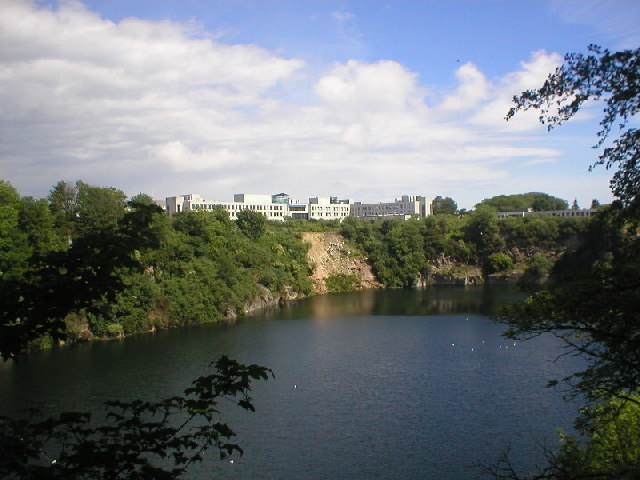
Quarrying began at Rubislaw, on the western edge of Aberdeen, in 1740. In 1778 Aberdeen City Council sold the site to a private businessman, having judged it unlikely to yield good building stone — an assessment that proved badly wrong. Over the following two centuries an estimated six million tonnes of granite were extracted from the quarry, and Rubislaw granite went on to face many of Aberdeen's most prestigious buildings, including Marischal College — the second-largest granite building in the world — designed by architects such as John Smith and Archibald Simpson, giving Aberdeen its lasting nickname of the Granite City. Rubislaw granite was valued well beyond Aberdeen too, used on London's Waterloo Bridge, the terrace of the Palace of Westminster, and the Forth Bridge. The quarry finally closed in 1971, by which time it had reached a depth of around 466 feet (142m) and a diameter of about 394 feet (120m), making it one of the largest man-made holes anywhere in Europe.
Geology
Rubislaw worked one of the finest and most consistent granite deposits in Scotland, part of the Aberdeen granite intrusion.
Workings
Granite was worked as a single enormous open pit, deepened continuously over more than two centuries of quarrying until closure in 1971.
Closure
The quarry closed in 1971 after more than 230 years of continuous working.
What remains
Since closure the void has filled with water and the site is not open to public access.
A vast, now-flooded quarry pit around 142m deep, with private redevelopment of surrounding land.
The flooded quarry is extremely deep and not open to public access; this entry describes history and general location only.
Recorded claims
Individual factual claims, each attached to the source(s) that support it below. Where sources disagree, both are kept.
- Quarrying at Rubislaw began in 1740; Aberdeen City Council sold the site in 1778 having wrongly judged it unlikely to yield good building stone. 1,2
- An estimated six million tonnes of granite were extracted from Rubislaw over more than two centuries, giving Aberdeen its nickname as the Granite City and supplying stone for Marischal College, Waterloo Bridge, the Palace of Westminster terrace, and the Forth Bridge. 1,3
- The quarry closed in 1971 at a depth of around 466 feet (142m) and diameter of about 394 feet (120m), one of the largest man-made holes in Europe; it has since flooded. 1
Sources
- (secondary) Rubislaw quarry — Wikipedia
- (secondary) The history of Rubislaw Quarry: A timeline of events — The Press and Journal
- (secondary) Rubislaw Quarry - Aberdeen — Doric Columns
Record created: 21 August 2026 · Last researched: 21 August 2026