 MineArchive
Mary Colliery, Lochore
| Location | Lochore Meadows Country Park, Ballingry, Fife — 56.1538, -3.3372 (exact) |
|---|---|
| Commodity | Coal |
| Type | Coal |
| Worked | 1902 (sinking)–24 September 1966 |
| Maximum depth | 333 fathoms (1908); No. 2 shaft about 280 fathoms |
| Operators | Fife Coal Company (1902–1946), National Coal Board (1947–1966) |
Overview
A Fife Coal Company colliery at Lochore sunk from 1902 to work the deep Lochore basin, the deepest in Fife in its day, whose second shaft of 1923 carries a reinforced-concrete headframe that survives in Lochore Meadows Country Park as a scheduled monument; the pit closed in 1966.
History
Mary Colliery was first sunk by the Fife Coal Company in 1902 on the Lochore estate, which the company had bought about 1900 together with the Lochore and Capledrae Cannel Coal Company, and was named after Mrs Mary Carlow, who cut the first sod. The No. 1 shaft was sunk about 1902-03 near the older workings of the Lochore and Wester Crosshill collieries and opened in 1904; the Scotsman described it in 1908 as the deepest in Scotland at 333 fathoms, while Fife Pits gives 300 fathoms. It employed 92 underground and 80 on the surface in 1904 under the manager John Allan, 414 and 120 in 1908, 747 and 154 in 1911 and 773 and 159 in 1928; Scotland Off the Beaten Track puts the workforce at nearly 800 at its height.
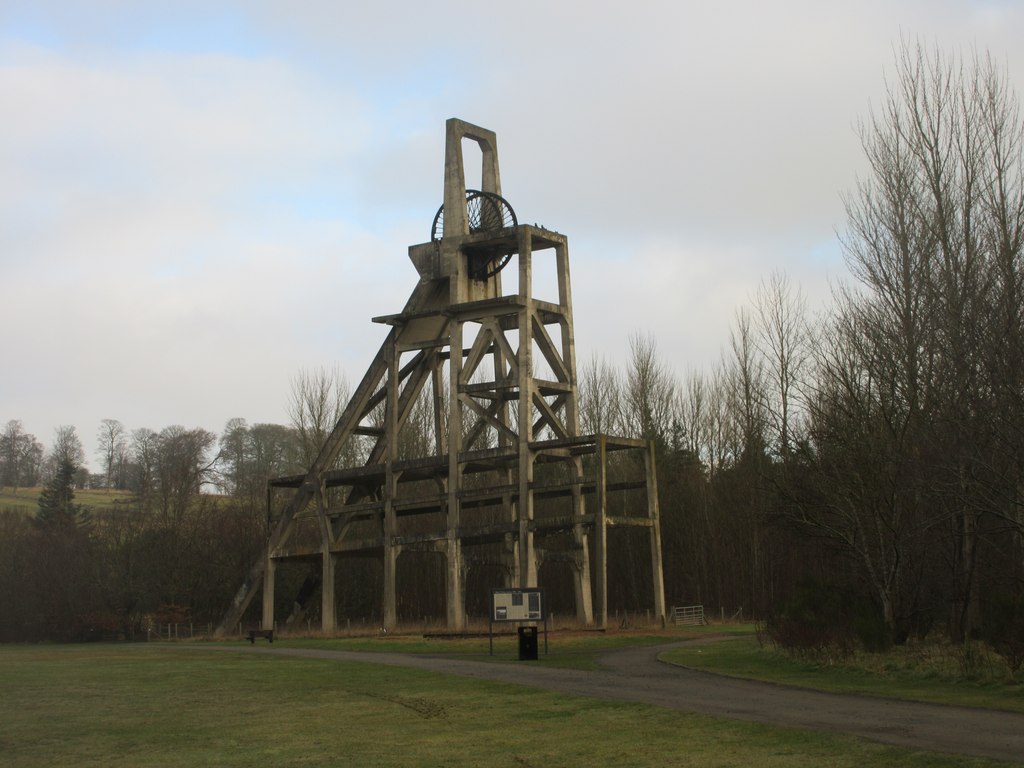
A second shaft, No. 2, was sunk in 1923 to about 280 fathoms, to help the ventilation and to work the deeper seams better, and carried a headframe of reinforced concrete and an electric winding engine; the frame is the only upstanding relic of the colliery. The colliery worked household and steam coals from the Jewel, Glassee, Dunfermline Splint, Five Feet, Mynheer and Main seams in 1928, the Jersey, Jewel, Glassee and Main in 1945 and, under the National Coal Board, gas, household, industrial and navigation coals from the Jersey, Kelty Main, Lochgelly Splint, Little Splint and Seven Foot; the NCB gave 496 underground and 181 on the surface and about 207,600 tons a year in 1947. The Mary Bowesbank Mine was driven just west of the main colliery in 1933 and appears to have been worked for only about two years. The mine's ventilation was partly in common with the Aitken pits at Kelty. Managers included James Roden (1912-18), Robert Stewart (1918-24), James B. Nelson (1928-30), George Hutchison (1932-37), Alex Clark (1938-53) and M. M. McGugan (1954-64).
A firedamp explosion in February 1908 killed three men (see Disasters, below). The colliery closed on 24 September 1966, ten years longer than first expected; Fife Pits gives August 1966. The surrounding ground, disfigured by coal workings, became one of the first major land reclamations, the Lochore Meadows Country Park, and the headframe, conserved in 1988-89, stands beside the first green of the golf course. It was scheduled in 2000 as one of the first reinforced-concrete headframes of a British colliery and one of the few visible relics of coal mining in central Fife.
Geology
Worked the deep Lochore basin: the Jewel, Glassee, Dunfermline Splint, Five Feet, Mynheer and Main seams in 1928, the Jersey, Jewel, Glassee and Main in 1945, and in the NCB years the Jersey, Kelty Main, Lochgelly Splint, Little Splint and Seven Foot, with blaes recorded in 1958; the five feet or navigation seam was worked from the foot of the No. 1 shaft in 1908, and the Mynheer seam 21 to 22 fathoms above it.
Workings
Two shafts, No. 1 sunk about 1902-03 and No. 2 in 1923, the latter with a reinforced-concrete headframe and an electric winding engine; the Mary Bowesbank Mine of 1933 lay just west of the colliery. Ventilation was partly in common with the Aitken pits at Kelty, reached by a road about a mile long.
Closure
The colliery closed on 24 September 1966 according to the scheduling record, August 1966 according to Fife Pits, having worked for over sixty years, ten more than initially anticipated.
What remains
The No. 2 headframe is preserved as a scheduled monument next to the first green of the golf course in Lochore Meadows Country Park; its electric winding engine is gone and no other surface features of the colliery stand.
The concrete headframe of the No. 2 shaft, conserved in 1988-89, is the only upstanding relic.
Redevelopment
The colliery ground and the waste around it were reclaimed in one of the first major land-reclamation schemes and became the Lochore Meadows Country Park.
Related mines
- Aitken Colliery — The Mary Colliery's ventilation was partly in common with the Aitken Nos. 1 and 2 pits at Kelty, and a road about a mile long led from the Mary to the Aitken.
Nearby mines
- Glencraig Colliery — 0.9 miles (1.4 km) SE
- Benarty Colliery — 1.2 miles (1.9 km) W
- Aitken Colliery — 1.5 miles (2.4 km) SW
- Lumphinnans XI and XII Colliery — 1.5 miles (2.4 km) S
- Lochgelly Colliery — 1.5 miles (2.5 km) S
Straight-line distance, within 9 miles (15 km). Show on the map.
Disasters & major incidents
-
Mary Colliery firedamp explosion, 1908
2 February 1908 · Explosion · 3 fatalities
Late on Sunday 2 February 1908 a series of four firedamp explosions in the Mynheer seam of the Fife Coal Company's Mary Pit at Lochore killed three young men, blown down the shaft from the seam bottom, and burned five others. The inquiry found the gas had been fired by a spark from the electric motor driving the fan.
What's uncertain
Points where sources disagree or the record could not be settled; both accounts are kept. All open questions in the archive.
- The No. 1 shaft was sunk to 300 fathoms according to Fife Pits and 333 fathoms according to a Scotsman report of 1908. (disputed) 2,3
Recorded claims
Individual factual claims, each attached to the source(s) that support it below. Where sources disagree, both are kept.
- The Mary Colliery was first sunk by the Fife Coal Company in 1902 and was named after Mrs Mary Carlow, who cut the first sod. 1
- The No. 1 shaft was sunk about 1902-03 and opened in 1904, and the No. 2 shaft was sunk in 1923 to about 280 fathoms. 2,1
- The No. 1 shaft was sunk to 300 fathoms according to Fife Pits and 333 fathoms according to a Scotsman report of 1908. (disputed) 2,3
- The reinforced-concrete headframe of the No. 2 shaft, worked by an electric winding engine, is one of the first reinforced-concrete headframes built for a British colliery and was scheduled in 2000. 1
- The colliery closed on 24 September 1966, after an active life of over sixty years. 2,1
- Employment at the Mary was 92 underground and 80 on the surface in 1904, 414 and 120 in 1908, 747 and 154 in 1911, 773 and 159 in 1928, 496 and 181 in 1947 and 318 and 66 in 1964. 2
- The National Coal Board gave the colliery's annual output in 1947 as about 207,600 tons. 2
- The Mary Bowesbank Mine was struck in 1933 just west of the main colliery and appears to have been worked for only about two years. 2
- The mine's ventilation was partly in common with the Aitken Nos. 1 and 2 pits at Kelty. 2
- The area disfigured by the colliery's workings became one of the first major land reclamations, forming Lochore Meadows Recreational Park, and the headframe was conserved in 1988-89. 1
- Canmore also lists the site as Lochore Colliery and Loch Ore. 4
Photographs & further reading
Owners, managers, manpower and coals worked at the Mary Colliery from 1904 to 1964.
View sourceThe scheduling record for the headframe, with a short history of the colliery and its significance.
View sourceThe national record of the colliery site, with aerial photographs and the shaft positions.
View sourceThe memorial board at the headframe and a Scotsman report of the February 1908 explosion.
View sourceSources
- (primary) Mary Colliery winding gear head frame, 775m NW of Lochore Castle (scheduled monument SM9016) — Historic Environment Scotland (via ancientmonuments.uk)
- (secondary) Fife Pits: Mary Nos. 1, 2 Pits, Lochore — Fife Pits
- (secondary) 47-Mary Pit Lochore (Mines Rescue) — Mines Rescue (healeyhero.co.uk)
- (secondary) Lochore, Mary Colliery (Canmore) — Canmore (Historic Environment Scotland)
Record created: 30 September 2026 · Last researched: 30 September 2026