 MineArchive
Killhope (Park Level Mine)
| Location | Upper Weardale, County Durham — 54.7350, -2.2350 (approximate) |
|---|---|
| Commodity | Lead |
| Type | Metal |
| Worked | Park Level Mine driven from 1853–1910 |
| Operators | W. B. Lead Company (1853–1883), Weardale Lead Company (1883–1910) |
| Status | Researched |
Overview
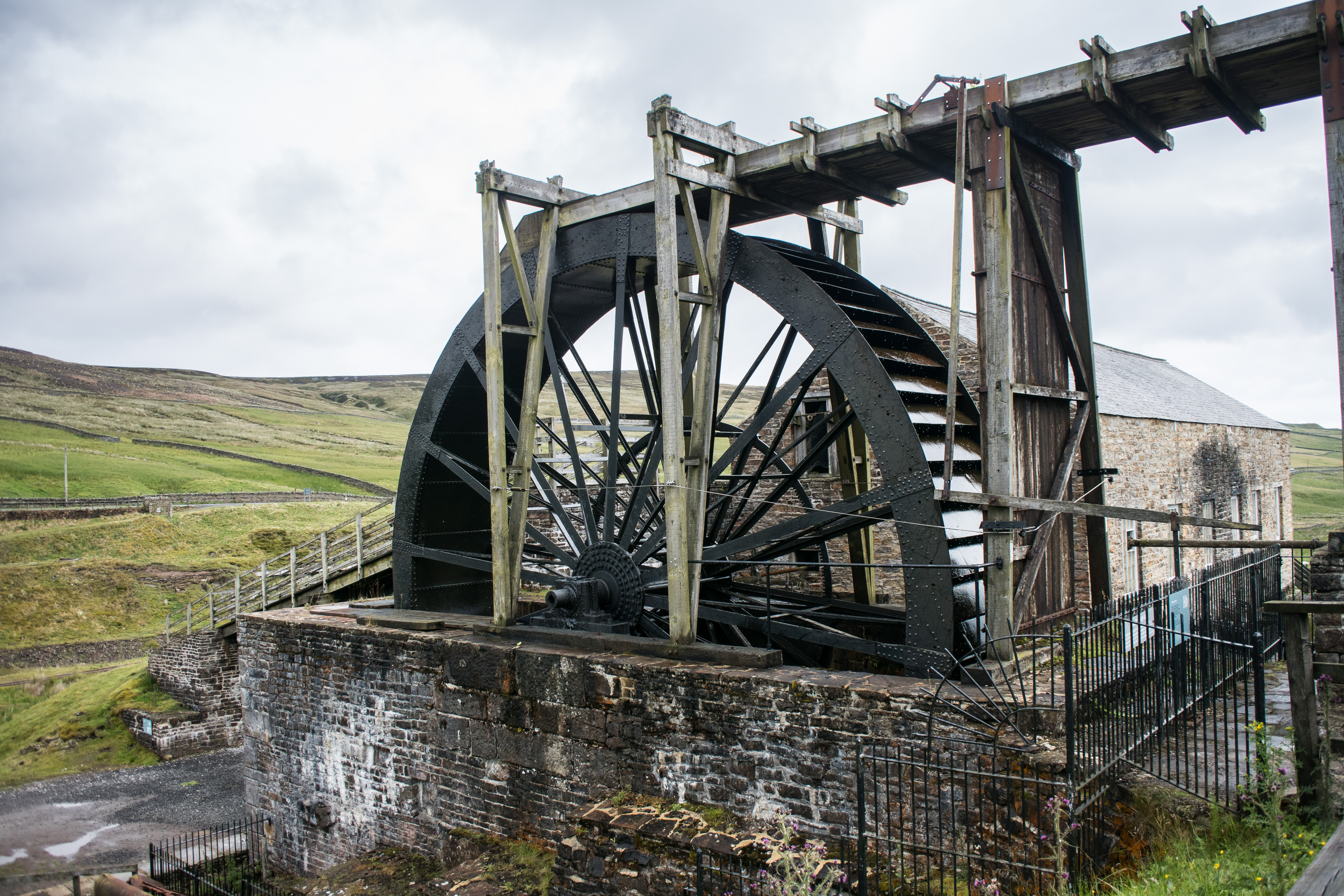
Killhope, high in Upper Weardale, was a working lead mine for barely sixty years before a collapse in the lead market ended it — but the ten-metre waterwheel built to power its ore mill has since made it one of the best-preserved lead-mining sites in Britain, now the North of England Lead Mining Museum.
History
The Park Level Mine at Killhope was driven from 1853 by the W. B. Lead Company, a firm established by the Blackett family, and went on to intersect eleven separate mineral veins in the surrounding fells. In 1878, soon after the mine reached its richest ground, a large water-powered ore mill was built at Park Level, driven by a metal waterwheel roughly ten metres in diameter and built by the Tyneside engineering firm of William Armstrong — still the largest working waterwheel in the north of England. The timing proved unfortunate: the price of lead collapsed soon after the mill opened, undermining the economics of lead mining across Weardale, and in 1883 W. B. Lead closed all its operations. The Weardale Lead company took over Park Level and continued working it on a reduced scale until 1910, when production finally ceased. Between them the two companies extracted around 31,200 tonnes of lead concentrate (W. B. Lead, to 1883) and a further 9,000 tonnes (Weardale Lead, 1884-1916) from the mine.
Geology
The mine worked lead veins of the northern Pennine orefield in Upper Weardale, a hydrothermal, non-magmatic mineralised system distinct from the granite-related lodes of Cornwall and Devon, intersecting eleven separate veins from the Park Level workings alone.
Geological setting: Hydrothermal Deposits (well documented example), Veins and Lodes (well documented example)
Workings
The Park Level Mine intersected eleven mineral veins; ore raised from the workings was processed at a mill built in 1878 and driven by a waterwheel roughly ten metres in diameter, built by the Tyneside firm of William Armstrong.
Closure
The collapse in lead prices soon after the 1878 mill opened undermined the economics of Weardale lead mining generally; W. B. Lead closed all its operations in 1883, and its successor Weardale Lead finally ceased production at Killhope in 1910.
What remains
Durham County Council acquired the site in 1980 and began restoration; the mineshop reopened to the public in 1984, the great waterwheel was restored to working order in 1991, and a reconstructed underground mine tour opened in 1996. The site now operates as Killhope, the North of England Lead Mining Museum.
The 1878 Park Level Mill survives with its restored waterwheel, alongside the mine's washing floors, the mineshop where miners lodged during the working week, and other mill buildings — one of the most complete surviving lead-mining landscapes in Britain.
Abandoned workings can be dangerous — unstable ground, uncapped shafts, flooding and bad air are common even where a site looks safe from the surface. This entry describes history and general location only; it is not an access guide.
Recorded claims
Individual factual claims, each attached to the source(s) that support it below. Where sources disagree, both are kept.
- The Park Level Mine intersected eleven mineral veins; W. B. Lead extracted around 31,200 tonnes of lead concentrate before 1883, and Weardale Lead a further 9,000 tonnes between 1884 and 1916. 1
- The 1878 ore mill was powered by a metal waterwheel roughly ten metres in diameter, built by the Tyneside firm of William Armstrong, and remains the largest working waterwheel in the north of England. 1,2
Images
Sources
- (secondary) North of England Lead Mining Museum — Wikipedia
- (secondary) Show Mines of Great Britain: Killhope Lead Mining Museum — Show Caves of the World
- (primary) KILLHOPE mine plans — British Geological Survey / Rio Tinto Zinc
Record created: 23 August 2026 · Last researched: 23 August 2026