 MineArchive
Grays Thurrock Chalk Pit
| Location | Grays, Chafford Hundred, Essex — 51.4860, 0.3160 (exact) |
|---|---|
| Commodity | Chalk |
| Type | Quarry |
| Worked | From late 18th century–Early 1920s |
Overview
One of a trio of great chalk quarries at Grays that fed Thurrock's 19th and 20th-century cement and lime industry — worked from the late 18th century until the early 1920s, and now a Site of Special Scientific Interest whose regrown scrub and grassland support the best concentration of chalk-loving invertebrates anywhere in Essex.
History
Grays was one of a cluster of large chalk quarries — alongside the neighbouring Lion Gorge and Warren Gorge workings, together now forming Chafford Gorges Nature Park — that grew up on the southern Essex bank of the Thames from the late 18th century to feed a substantial local lime and, later, cement industry. Chalk had been leased for burning into lime as early as 1738, and by the early 19th century horse-drawn trucks were already carrying chalk to kilns and lime on to riverside wharves for shipment; a tramway built through the adjoining Lion Gorge in the 19th century carried chalk south to the Lion Works, a Portland cement factory opened in 1874 that became, in 1900, the Wouldham Cement Company, later absorbed into British Portland Cement Manufacturers, Associated Portland Cement Manufacturers, and eventually Blue Circle Industries. At Grays itself, records show around 25ha of the pit had already been dug out by 1860, with the workings extending to some 40ha by the time active extraction ceased shortly after the First World War, in the early 1920s — part of a wider Thurrock chalk-cement industry that remained a major employer in the area until the last of the district's cement plants finally closed in 1976.
Geology
The pit exposes Upper Chalk of the district's Cretaceous chalk downland, the same formation quarried at scale across the whole Thurrock/Chafford Hundred area for lime burning and, later, Portland cement manufacture. Since extraction ceased, natural recolonisation of the bare chalk pit floor has produced a textbook succession from open chalk grassland through scrub to young and, in places, mature woodland — a process visible today across the site as a single, continuous habitat gradient.
Workings
An open chalk quarry, worked by hand and horse-drawn tram in its earlier years, its chalk burned locally for lime or, once the Lion Works opened nearby in 1874, hauled by tramway to be manufactured into Portland cement.
Closure
Active chalk extraction at Grays ceased shortly after the First World War, in the early 1920s; the wider Thurrock cement industry that the pit had once fed continued for decades afterward at other local works before the district's last cement plant closed in 1976.
What remains
Notified as a Site of Special Scientific Interest (17.27ha) in 1953 and again in 1993, Grays Thurrock Chalk Pit is today managed by Essex Wildlife Trust as part of Chafford Gorges Nature Park. Left to recolonise naturally rather than being restored or redeveloped, the old quarry floor now carries the best concentration and diversity of calcareous invertebrate fauna anywhere in Essex, including several nationally scarce beetles, moths and true flies, two spider species found nowhere else in the county, and the county's largest populations of round-leaved wintergreen and man orchid.
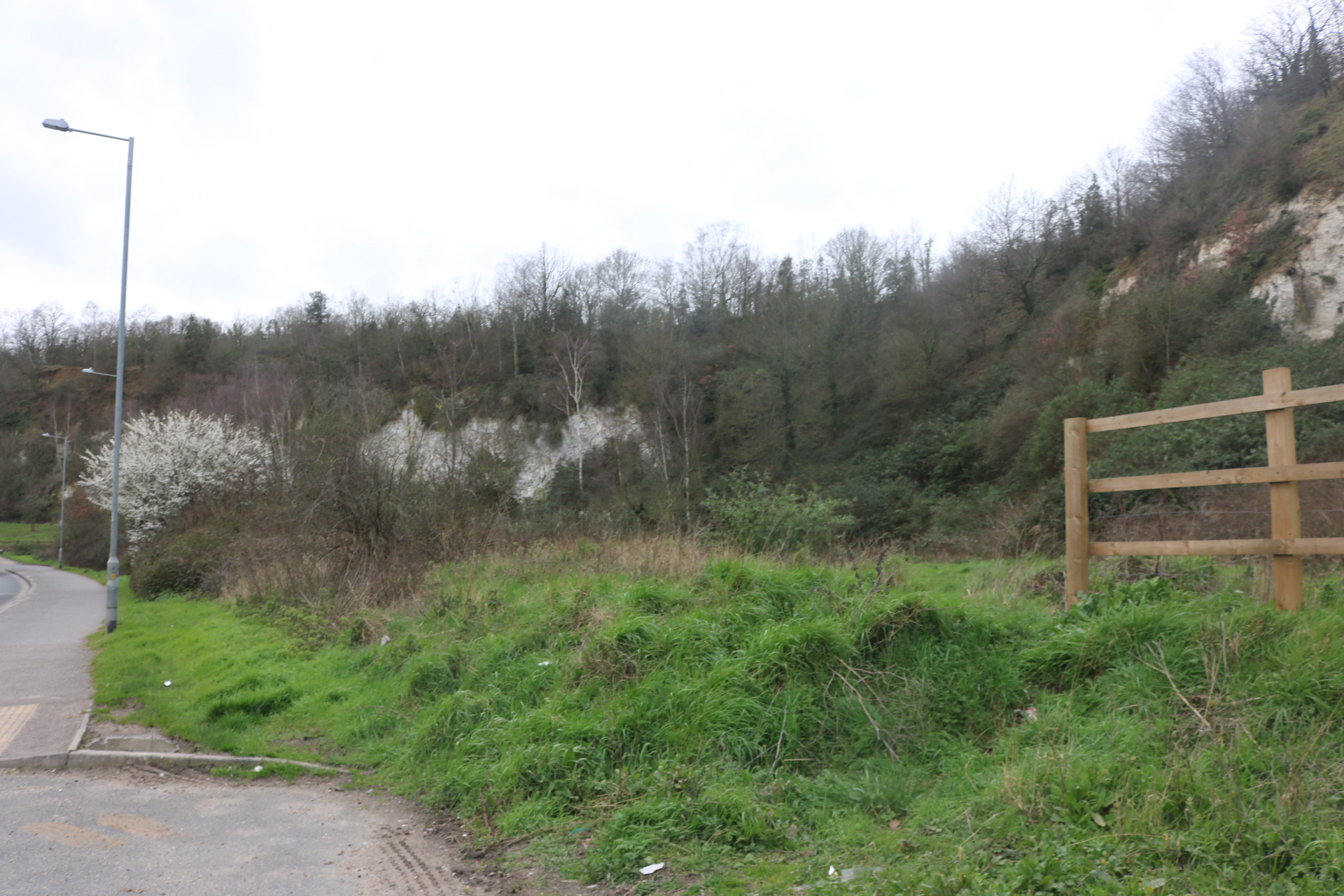
The disused quarry itself survives as the nature reserve's principal landscape feature — chalk cliffs and slopes now largely cloaked in scrub and woodland, with an area of open water where the quarry floor dips below the water table in its north-east corner.
Nearby mines
- Hangman's Wood Deneholes — 1.7 miles (2.7 km) E
- Eastern Quarry — 2.5 miles (4.0 km) S, Kent
- Purfleet Chalk Pits — 2.8 miles (4.6 km) W
Straight-line distance, within 9 miles (15 km). Show on the map.
Recorded claims
Individual factual claims, each attached to the source(s) that support it below. Where sources disagree, both are kept.
- Around 25ha of the quarry had been excavated by 1860, extending to about 40ha by the time active extraction ceased shortly after the First World War, in the early 1920s. 1
- The site holds the best concentration and diversity of calcareous invertebrate fauna in Essex, including the Red Data Book beetles Mordellistena humeralis and M. neuwaldeggiana, and the county's largest populations of round-leaved wintergreen and man orchid. 1
- Grays Thurrock Chalk Pit was first notified as a Site of Special Scientific Interest in 1953 and renotified in 1993, covering 17.27ha, and is managed by Essex Wildlife Trust as part of Chafford Gorges Nature Park. 1,2
- A 19th-century tramway carried chalk from the neighbouring Lion Gorge workings to the Lion Works, a Portland cement factory opened in 1874 that became the Wouldham Cement Company in 1900 and was later absorbed into Associated Portland Cement Manufacturers and Blue Circle Industries, part of a Thurrock cement industry that remained active until 1976. 2
Sources
- (primary) Grays Thurrock Chalk Pit SSSI citation — Natural England
- (secondary) Grays Thurrock Chalk Pit — Wikipedia
Record created: 26 August 2026 · Last researched: 26 August 2026