 MineArchive
Garths Ness Mine
| Location | Garths Ness, near Quendale, Dunrossness, Shetland Islands — 59.8852, -1.3515 (approximate) |
|---|---|
| Commodities | Copper, Iron |
| Type | Metal |
| Worked | c. 1800–1920s |
| Maximum depth | Unknown. |
| Operators | Alexander Crighton, Andrew Grieson |
Overview
Copper trials driven into a headland at the southern tip of Shetland, on an ore body that is mostly iron: a vertical lens of pyrrhotite up to six metres wide and thirty long with only small amounts of chalcopyrite in it. The deposit formed 580 million years ago at a black smoker on an ancient sea floor. It was worked briefly around 1800 by Alexander Crighton and the Laird of Quendale, who was kept paying for it by workmen hiding copper pennies in the assay samples to make the ore look richer. Attempts in the 1870s and the 1920s failed as well.
History
Shetland's metal ores have been used since early times — recent broch excavations have produced evidence of metalworking close by — but serious mining waited until the start of the 19th century, when shafts were sunk at Sandlodge in Sandwick. Garths Ness, near Quendale at the southern end of the Mainland, was the second attempt. Adits were driven for copper here, and along the same stretch of coast at Quendale and the Wick of Shunni. The working was begun about 1800 by Alexander Crighton and Andrew Grieson, Laird of Quendale, who hoped to win copper in paying quantities. It proved uneconomic, but for a while the laird was tricked into keeping it going by resourceful workmen who hid copper pennies in the assay samples so that the ore appeared richer than it was. Successive attempts in the 1870s and in the 1920s came to nothing either. What was left behind is largely iron sulphide, and the reddish staining it gives the rock is what marks the old workings on the headland today.
Geology
The ore body at Garths Ness formed 580 million years ago, when the schists and pelites here were sediments on the margin of an ancient ocean. Heat from magma deep below the sea floor drove superheated seawater through the crust, dissolving copper and iron out of the surrounding rocks; where that water vented on the sea bed it cooled quickly and the minerals precipitated as the chimney-like structures called black smokers, building massive ore mounds within the sediments. Deposits of this kind can carry economic concentrations of copper, zinc, lead, barite and gold. This one is mostly pyrrhotite, an iron sulphide, with some chalcopyrite, the copper-iron sulphide the miners were after. Close to the adits the body forms a vertical lens up to three to six metres wide and thirty metres long, with only small amounts of pyrite and chalcopyrite.
Geological setting: Hydrothermal Deposits (well documented example)
Workings
Adits driven into the ore body in a small inlet on the ness, which can be looked down into from above. Adits were driven for copper at two neighbouring places on the same coast, Quendale and the Wick of Shunni.
Closure
The first working, of about 1800, was given up as uneconomic. Attempts in the 1870s and in the 1920s failed too, and nothing has been worked here since.
What remains
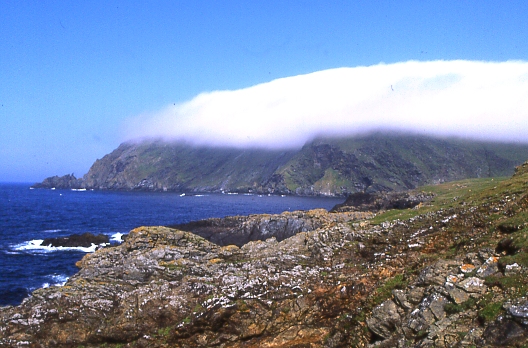
Reddish rock on the headland marks the old workings, in a small inlet reached on foot past the disused military buildings at the end of the Quendale road. The bay between Garths Ness and Fitful Head is where the tanker Braer went aground in January 1993.
The stained rock of the ore body and the adits driven into it, in the inlet on the ness.
Redevelopment
None; the ness is open ground at the southern end of the Shetland Mainland.
Nearby mines
- Sandlodge Mine — 7.7 km NE
Straight-line distance, within 15 km. Show on the map.
Recorded claims
Individual factual claims, each attached to the source(s) that support it below. Where sources disagree, both are kept.
- The ore body is largely pyrrhotite with some chalcopyrite, and formed at a black smoker on the sea floor 580 million years ago. 1
- Mined briefly around 1800 by Alexander Crighton and Andrew Grieson, Laird of Quendale. 1
- Workmen hid copper pennies in the assay samples so that the ore appeared richer, and the laird went on paying for the work. 1
- Further attempts were made in the 1870s and the 1920s, and both failed. 2
- Adits were driven for copper at Garths Ness at HU 364 113, where the ore body forms a vertical lens up to three to six metres wide and thirty metres long. 3
- Reddish rocks on the ness mark the former workings. 4
Photographs & further reading
How the ore body formed at a black smoker, what it contains, and the story of the pennies in the assay samples.
View sourceThe county-wide account of Shetland's copper workings, with grid references and the size of the Garths Ness ore body.
View sourceSources
- (secondary) Garths Ness: rocks as resources — Geopark Shetland
- (secondary) Metal ores and minerals — Shetland.org (Shetland UNESCO Global Geopark)
- (primary) Economic geology of Orkney and Shetland — British Geological Survey (BGS Earthwise)
- (observational) Garths Ness (photograph, 2005) — Geograph Britain and Ireland
Record created: 23 September 2026 · Last researched: 24 September 2026