 MineArchive
Chilmark Quarries
| Also known as | RAF Chilmark, Chilmark Stone Quarry |
|---|---|
| Location | Chilmark, Nadder Valley, Wiltshire — 51.0800, -2.0364 (approximate) |
| Commodity | Limestone |
| Type | Quarry |
| Worked | From the medieval period–c.2007 |
| Operators | Air Ministry / RAF (1936–1995) |
Overview
The quarry that built Salisbury Cathedral, later requisitioned whole by the Air Ministry to become one of Britain's largest wartime bomb stores — and, unusually for an ammunition depot, the only one of its kind to survive the war undamaged.
History
Limestone has been worked at Chilmark since medieval times, and reputedly since Roman times, with the stone changing from open quarrying to underground working during the Middle Ages as the best beds were followed inward. Chilmark stone built Salisbury Cathedral, a few miles down the Nadder valley, and Purbeckian limestone from the area is thought to have been used even earlier, in packing around the sarsens at Stonehenge and in Roman-period buildings nearby. Extraction continued on a shrinking scale into the 20th century as concrete displaced dressed stone in ordinary building work, and the quarry closed commercially in 1935. The following year the Air Ministry bought the quarry and mines outright, and the underground workings — naturally stable, needing few pillars thanks to the quality of the limestone, and with a level floor — became RAF Chilmark, one of the largest ammunition storage depots in southern England through the Second World War, and remarkably the only RAF ammunition depot to survive the war intact. The depot continued in military use until 1995. Small-scale stone extraction resumed after the site closed as a working quarry, ceasing again around 2007, before renewed quarrying began at Chilmark in March 2019.
Geology
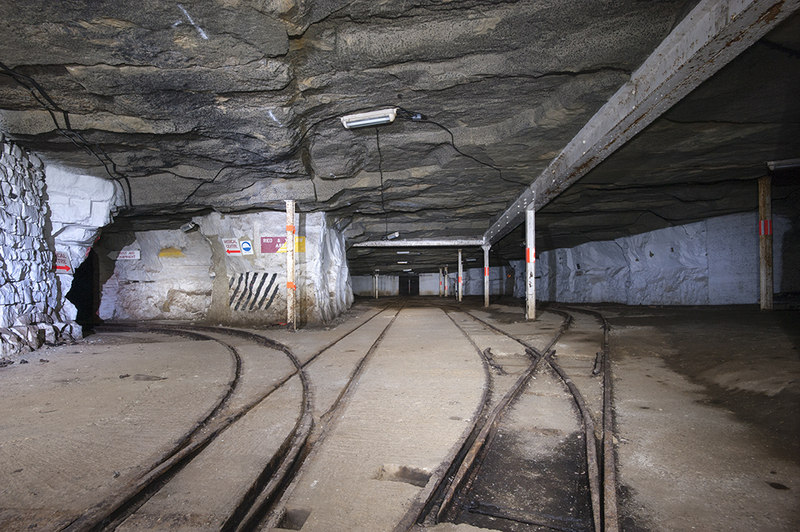
Chilmark stone is a Jurassic limestone from the Portland beds, prized for being easy to work when freshly quarried yet durable once exposed to weather, and it occasionally carries fossil ammonites and shells. Those same qualities — a stable, evenly-bedded limestone with a level floor and few natural fracture planes — made the underground workings unusually suited to reuse as a bomb store: fewer support pillars were needed than in most quarried rock, which meant more open floor area for stacking munitions safely apart.
Geological setting: Sedimentary Beds and Seams (well documented example)
Workings
Quarrying moved underground during the medieval period as workable stone near the surface was exhausted, developing into a system of galleries within the hillside rather than open pits. Narrow-gauge railways were laid through the workings to move stone, and later munitions, and sections of this trackwork survive in the disused workings above ground.
Closure
Commercial quarrying ended in 1935 as demand for dressed building stone fell away in favour of concrete; the site's military use as RAF Chilmark ran until 1995, after which small-scale stone extraction resumed and then ceased again around 2007, before renewed working began in 2019.
What remains
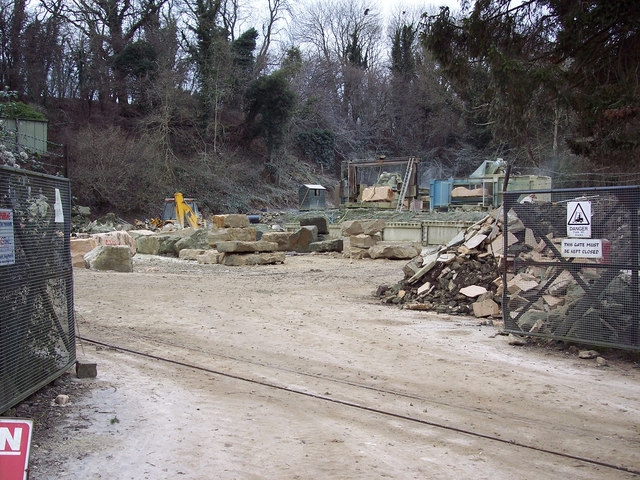
Part of the underground workings remain in industrial use by the reopened quarrying operation; other sections are disused and have become important as a bat hibernation site, recognised in the area's Site of Special Scientific Interest and Special Area of Conservation designations. Former RAF Chilmark buildings and narrow-gauge trackwork survive above ground, and the site has been repeatedly documented by exploration groups.
Former RAF Chilmark buildings, narrow-gauge railway trackwork, and quarry faces and spoil in the surrounding valley.
Redevelopment
Reopened as a working stone quarry from 2019; disused sections of the underground workings are protected for their bat roosts.
Recorded claims
Individual factual claims, each attached to the source(s) that support it below. Where sources disagree, both are kept.
- Chilmark stone built Salisbury Cathedral and is thought to have been used even earlier at Stonehenge and in Roman-period buildings in the area. 1
- Quarrying moved from open working to underground galleries during the medieval period as accessible surface stone was worked out. 1
- Commercial quarrying ended in 1935 as concrete displaced dressed stone in ordinary building work. 1
- The Air Ministry bought the quarry and mines in 1936; the naturally stable limestone, needing few support pillars and offering a level floor, made the underground workings unusually well suited to reuse as an ammunition depot, and RAF Chilmark became one of the largest such depots in southern England and the only one to survive the Second World War intact. 1,2
- RAF Chilmark remained in military use until 1995; renewed commercial quarrying began in 2019, and disused sections of the workings are now protected as a bat hibernation site under SSSI and Special Area of Conservation designations. 1
Sources
- (secondary) Chilmark Quarries — Wikipedia
- (observational) RAF Chilmark, Underground Ammunition Bunker, Wiltshire — The Urban Explorer
- (observational) RAF Chilmark, Chilmark, November 2016 — 28DaysLater
Record created: 24 August 2026 · Last researched: 24 August 2026