 MineArchive
Barrowmouth Gypsum and Alabaster Mine
| Location | Saltom Bay, below the cliffs south of Whitehaven, in St Bees parish, Cumbria — 54.5263, -3.6108 (exact) |
|---|---|
| Commodity | Gypsum |
| Type | Mineral |
| Worked | By 1794–1908 |
| Operators | Joseph Robinson & Co. Ltd (1888–1908, owner) |
Overview
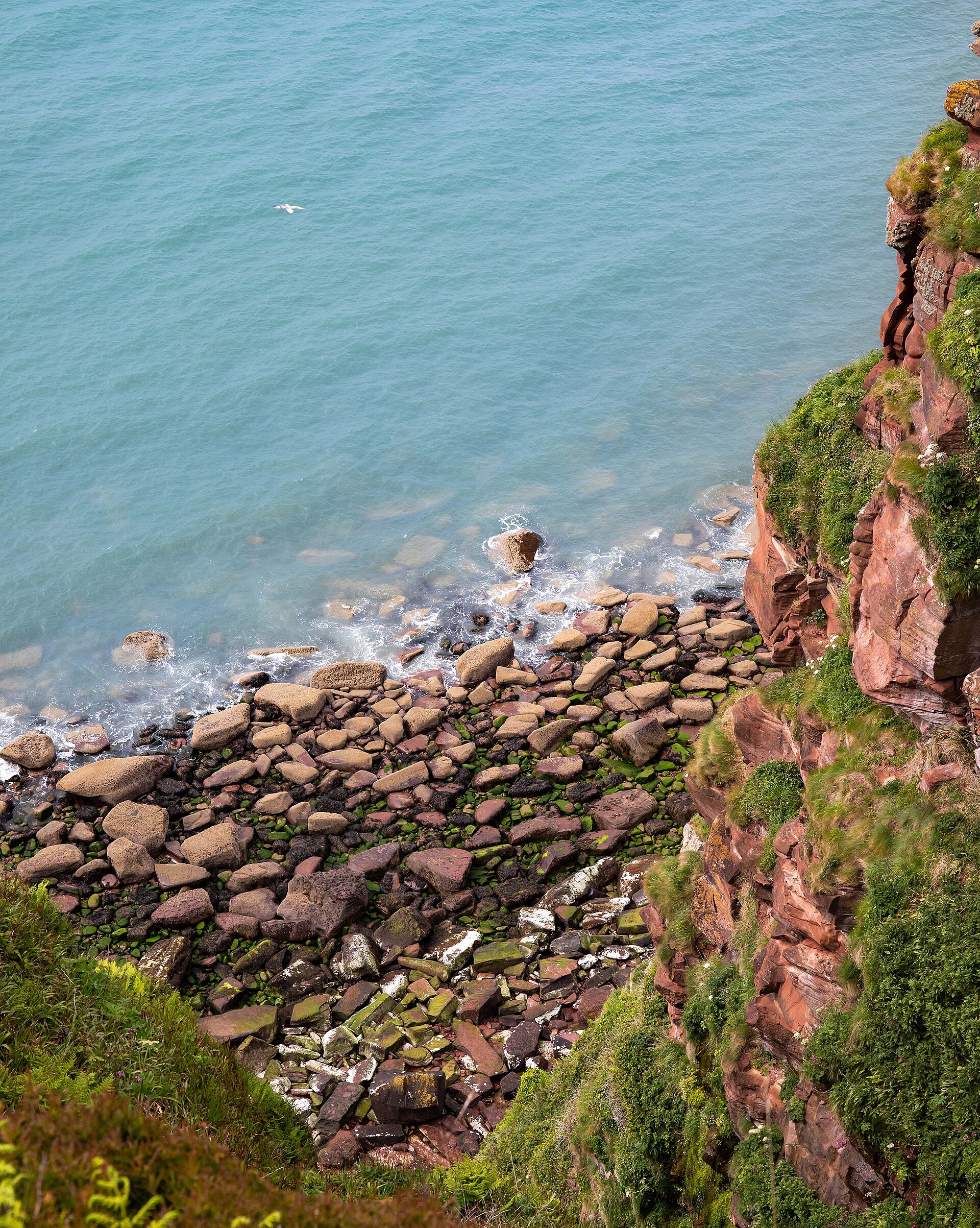
Gypsum and alabaster worked out of the cliff above Saltom Bay, where packhorses carried the stone up a winding path to the cliff top and the alabaster went to Whitehaven Pottery for ornaments and moulds. It is the only mine of its kind in north-west England and is a scheduled monument.
History
Nobody knows when mining began at Barrowmouth. The first reference to gypsum here is in Hutchinson's History of Cumberland of 1794, and through the first half of the nineteenth century John Hamilton was listed in the Cumberland Directory as an alabaster and gypsum merchant while his brother Billy mined the deposits. Sources of the 1860s describe alabaster levels driven straight into the hillside, the stone produced for ornamental work and for making moulds at the Whitehaven Pottery Works, and carried up to the cliff top by packhorse along a winding path. The Ordnance Survey map of 1863 shows three alabaster levels with five buildings and three small enclosures.
That enterprise closed in the early 1880s. In 1888 Joseph Robinson and Company started again: new adits were driven and the gypsum went up to the cliff top in trucks on an inclined plane worked by a steam winch, to be processed at a factory at Lingydale, some of the plaster going on into wallboards. The official returns show how small the operation was even then — four people employed in 1894, ten by 1905.
Flooding, roof collapses and contamination of the gypsum with anhydrite closed the mine in 1908.
Geology
A bed of gypsum up to nine metres thick, possibly the hydrated equivalent of the Fleswick Anhydrite, worked in the cliff above Saltom Bay. Some of it was fine-grained and compact enough to be alabaster, the form valued since the middle ages for carving. Anhydrite in the gypsum was one of the things that finished the mine, and the roof was unstable throughout.
Workings
Levels and adits driven straight into the hillside. In the earlier phase the stone went up to the cliff top by packhorse on a winding path; from 1888 it went up an inclined plane in trucks, hauled by a steam winch whose engine mounting survives as a large concrete block. The scheduled remains include buildings, levels, spoil heaps, enclosures and the inclined plane itself, which crosses a track on a stone-built bridge.
Closure
A combination of flooding, roof collapses and contamination with anhydrite led to closure in 1908.
What remains
Scheduled on 3 September 2004. Three roofless stone buildings stand between the foot of the inclined plane and the beach, the largest of two rooms; a fourth, shown near the beach on the 1925 map, appears to have gone to coastal erosion. A large working hollow is cut into the hillside, with heavily overgrown structures and enclosures on the plateau above the beach and the stone-lined entrance to a level among them. Traces of the packhorse track survive to the north of the hollow.
Buildings, levels, spoil heaps, enclosures, the inclined plane with its bridge and winch mounting, and the packhorse track — the whole scheduled as a monument.
Nearby mines
- Croft Pit, Whitehaven — 0.4 miles (0.7 km) E
- Ladysmith Pit — 0.4 miles (0.7 km) E
- Woodhouse Colliery — 0.5 miles (0.9 km) E
- Kells Pit, Whitehaven — 0.8 miles (1.3 km) NE
- Saltom Colliery — 1.1 miles (1.7 km) N
Straight-line distance, within 9 miles (15 km). Show on the map.
Recorded claims
Individual factual claims, each attached to the source(s) that support it below. Where sources disagree, both are kept.
- Through the first half of the nineteenth century John Hamilton was described in the Cumberland Directory as an alabaster and gypsum merchant, while his brother Billy mined the deposits. 1
- Documentary sources of the 1860s describe alabaster levels driven straight into the hillside, the alabaster produced for ornamental purposes only and for making moulds at the Whitehaven Pottery Works, and carried up a winding path to the cliff top by packhorse. 1
- The first enterprise closed in the early 1880s. In 1888 Joseph Robinson and Company Ltd started mining again: new adits or levels were driven and the gypsum taken to the cliff top in trucks on an inclined plane worked by a steam winch, then processed at a factory at nearby Lingydale, some of the plaster being made into wallboards. 1
- The official Lists of Mines return gypsum from Barrowmouth under Joseph Robinson and Company Ltd with four people employed in 1894, six in 1896, seven in 1900, eight in 1902 and ten in 1905. 2
- A combination of flooding, roof collapses and contamination with anhydrite led to the mine's closure in 1908. It was scheduled on 3 September 2004 as the only example in north-west England of a late eighteenth or early nineteenth-century gypsum and alabaster mine. 1
Photographs & further reading
The scheduling entry, with the documented history from Hutchinson's 1794 Cumberland to the 1908 closure, and a description of what survives on the ground.
View sourceThe official returns for the mine's second working, with its owner and its very small workforce, and a catalogue of abandonment plans.
View sourceSources
- (primary) Barrowmouth gypsum and alabaster mine at Saltom Bay (list entry 1021106) — Historic England, via Ancient Monuments
- (primary) Barrowmouth (Gypsum) — Durham Mining Museum
Record created: 11 September 2026 · Last researched: 11 September 2026