 MineArchive
Ancaster Stone Quarries
| Location | Ancaster, Lincolnshire — 52.9800, -0.5400 (approximate) |
|---|---|
| Commodity | Limestone |
| Type | Stone |
| Worked | From the Roman period–Still active |
Overview
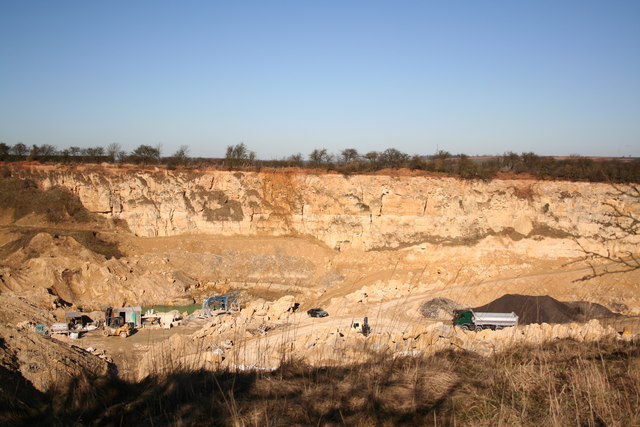
Ancaster, Lincolnshire, is the source of Ancaster Stone, a Middle Jurassic oolitic limestone of the Lincolnshire Limestone Formation quarried since at least the Roman period. It supplied medieval monastic building across the Fens, later travelled by river to build Wollaton Hall, and by the 19th century was being used at Windsor Castle and York railway station among others. Quarrying continues today at Ancaster under Goldholme Stone Ltd, producing dimension stone, walling and aggregate.
History
Archaeological investigation at Castle Quarry, Ancaster, ahead of a quarry extension found evidence of an Iron Age farming settlement, and a V-shaped ditch with a defended entrance consistent with a Roman marching-camp circuit, alongside Roman pottery sherds providing supporting dating context. Historic England's own Strategic Stone Study states the Lincolnshire Limestone 'has been quarried for building stone along the full length of its outcrop, at some localities, such as around Lincoln, Ancaster, Heydour and Stamford, since at least Roman times.'
By medieval times the stone was being carried by waterway — the Witham, Slea and Kyme Eau — to monastic sites including Crowland Abbey, Bardney, Ely and Ramsey. Quarries expanded through the 17th and 18th centuries to supply Ely and Peterborough cathedrals and the chapels of King's College and St John's College, Cambridge, along with buildings in Norfolk, Northamptonshire, Rutland and Suffolk. In the late 16th century the River Trent carried Ancaster stone to Nottingham to build Wollaton Hall, and by the 19th century, per Historic England's own account, 'the limestones quarried at Ancaster were used at Windsor Castle, for the original university buildings in Nottingham and in York railway station, to name but a few examples.' Other buildings built of Ancaster stone include Belton House, Harlaxton Manor, Mentmore Towers, St Pancras Station and Norwich Cathedral, and the sculptors Barbara Hepworth and Henry Moore both worked in the stone. Quarrying remains active in the Ancaster area today, and recently provided stone for the new facade of The Collection Museum in Lincoln.
Geology
Ancaster stone is drawn from the Lincolnshire Limestone Formation, part of the Inferior Oolite Group, Middle Jurassic in age, formed roughly 165 million years ago as a coarse-grained, creamy-white to yellow-orange, ooidal and bioclastic limestone. Three named beds are worked, in a local grading system sometimes called 'streaky bacon': the uppermost Ancaster Ragstone or Weatherbed, 2-3 metres thick, cross-bedded and pale yellow; the underlying Hard White, well-cemented and capable of a marble-like polished finish; and the lowest Freestone, less coarsely fossiliferous and historically prized for ashlar and carved church stonework, with the Hard White and Freestone beds together some 3-4 metres thick. Historic England notes explicitly that the thick ooidal limestone beds characteristic of the Great Oolite Group further south-west, around Bath and the Cotswolds, are not developed in Lincolnshire — Ancaster stone belongs to the older Inferior Oolite Group, a genuinely distinct formation within the same broader Jurassic limestone belt, not the same bed as Bath stone.
Workings
Unknown.
Closure
Unknown.
What remains
Quarrying continues today, run by Goldholme Stone Ltd, trading as Ancaster Architectural Stone, from Ancaster Quarry on Sleaford Road; the operation produces dimension stone, walling, gabion stone and aggregate at a comparatively small, specialist scale rather than large industrial quarrying.
Recorded claims
Individual factual claims, each attached to the source(s) that support it below. Where sources disagree, both are kept.
- Archaeological investigation at Castle Quarry, Ancaster, found a V-shaped ditch with a defended entrance consistent with a Roman marching-camp circuit, alongside Roman pottery sherds providing supporting dating context. 1
- Historic England's own Strategic Stone Study states that limestones quarried at Ancaster were used at Windsor Castle, in the original university buildings in Nottingham, and at York railway station. 2
- Three named beds are worked at Ancaster: the uppermost Weatherbed or Ragstone, the underlying Hard White, capable of a marble-like polish, and the lowest Freestone, historically prized for ashlar and carved stonework. 2
- The Lincolnshire Limestone worked at Ancaster belongs to the Inferior Oolite Group, distinct from the Great Oolite Group beds further south-west around Bath and the Cotswolds, which Historic England notes are not developed in Lincolnshire at all. 2
- Quarrying continues today at Ancaster Quarry, operated by Goldholme Stone Ltd, producing dimension stone, walling, gabion stone and aggregate. 3,4
Sources
- (primary) Possible Roman military ditch at Castle Quarry, Ancaster (MLI91791) — Lincolnshire Historic Environment Record
- (primary) Strategic Stone Study: Building Stones of England — Lincolnshire — Historic England (with the British Geological Survey)
- (secondary) Ancaster quarry re-opened by Goldholme company — Stone Specialist
- (secondary) Ancaster Quarry — Agg-Net (aggregates industry directory)
Record created: 26 August 2026 · Last researched: 26 August 2026