 MineArchive
Yew Tree Colliery Explosion, 1858
A firedamp explosion in Yew Tree Colliery's Crombuke mine, caused by a skipped safety inspection, killed 25 men and boys -- the worst mining disaster in Tyldesley's history.
| Date | 11 December 1858 |
|---|---|
| Mine | Yew Tree Colliery |
| Region | Lancashire |
| Primary type | Explosion |
| Associated types | Gas / Asphyxiation |
| Fatalities | 25 (Twenty-five men and boys died, aged between 11 and 35, including the assistant underlooker and the fireman himself.) |
| Context | During active mining |
Cause
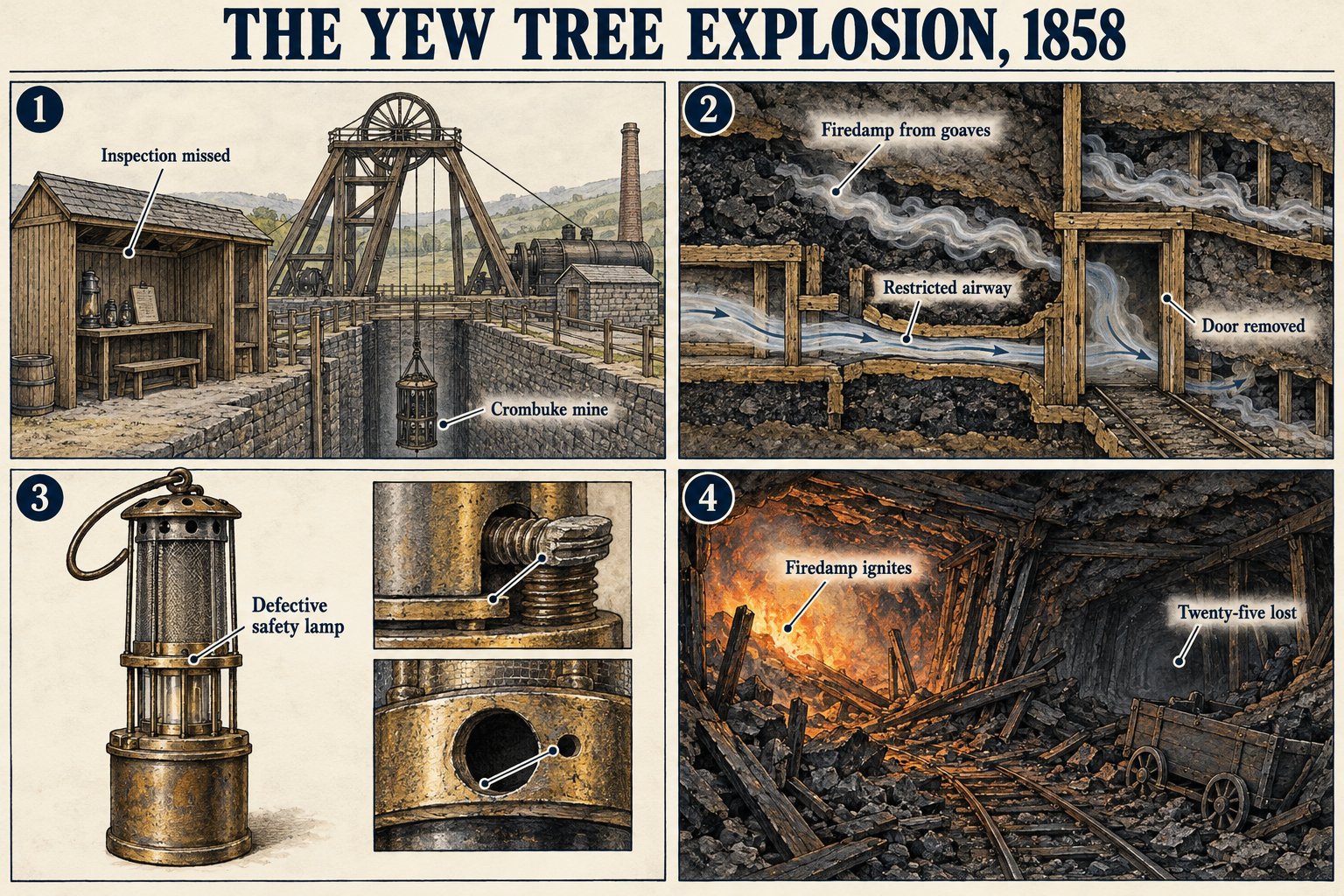
The fireman responsible for inspecting the workings before the shift failed to arrive on time, having stayed out late the previous evening celebrating a wage increase; the men were allowed down the pit without the inspection being carried out. Firedamp gas was later detected coming from the goaves, and ignited as the fireman and assistant underlooker went to investigate, very likely from a defective safety lamp.
What happened
On the morning of 11 December 1858, the fireman responsible for inspecting the Crombuke mine workings at Yew Tree Colliery before the shift failed to arrive at the pit in time, having been out late the previous evening celebrating an advance in wages; the men were nonetheless allowed down. A few hours later, a workman detected firedamp coming from the goaves (the colliery's worked-out waste areas) and fetched the assistant underlooker. He and the fireman, who had by then arrived, went to investigate and had almost reached the spot when the gas ignited. The assistant underlooker, the fireman and 23 colliers and drawers were killed; several bodies showed no burns at all, indicating that little gas had actually fired and that most of the dead had suffocated rather than burned. The workings by this time extended beneath the parish church of St George's, Tyldesley.
Investigation & inquiry
H.M. Inspector of Mines Joseph Dickinson investigated and found a catalogue of safety failures: the mine's ventilation design routed intake air through the goaves before it reached the working areas; the main airway had been reduced to only six feet wide in places; a door meant to separate intake from return air had been removed and never replaced; and the miners' safety lamps were found unlocked, with worn screws and oversized pricker holes that compromised their effectiveness. Dickinson concluded that a defective safety lamp had most likely ignited the gas, though no explosive shots had been fired that day.
Recorded claims
Individual factual claims, each attached to the source(s) that support it below. Where sources disagree, both are kept.
- H.M. Inspector of Mines Joseph Dickinson found the ventilation routed intake air through the goaves before reaching the working areas, the main airway reduced to six feet wide in places, a separating door removed and never replaced, and the miners' safety lamps unlocked with worn screws and oversized pricker holes; he concluded a defective safety lamp most likely ignited the gas. 1
- By 1858 the colliery's workings extended beneath the parish church of St George's, Tyldesley. 2
Related terminology
Mining terms this disaster is structurally linked to, with the nature of the relationship.
- Fireman (contextual relationship)
Named 5 times in this record, first in the cause: “The fireman responsible for inspecting the workings before the shift failed to…” - Goaf (contextual relationship)
Named 3 times in this record, first in the cause: “…being carried out. Firedamp gas was later detected coming from the goaves, and ignited as the fireman and assistant underlooker went to…” - Putter (contextual relationship)
Named in this record’s narrative: “…ignited. The assistant underlooker, the fireman and 23 colliers and drawers were killed; several bodies showed no burns at all, indicating that…” - Return Airway (contextual relationship)
Named twice in this record, first in the investigation: “…a catalogue of safety failures: the mine's ventilation design routed intake air through the goaves before it reached the working areas; the main…” - Safety Lamp (contextual relationship)
Named twice in this record, first in the cause: “…underlooker went to investigate, very likely from a defective safety lamp.”
Sources
- (secondary) Yew Tree Colliery Explosion, Tyldesley, 1858 — Northern Mine Research Society
- (secondary) Yew Tree Colliery — Wikipedia
Record created: 2 September 2026 · Last researched: 2 September 2026