 MineArchive
Wynnstay Colliery Explosion (1873)
Insufficiently bored and improperly rammed shot holes let gas from two shots ignite, killing seven men and boys -- the third of three fatal explosions to strike this colliery within a decade.
| Date | 24 April 1873 |
|---|---|
| Mine | Wynnstay Colliery |
| Region | Wrexham |
| Type | Explosion |
| Fatalities | 7 (Seven men and boys died: Griffith Hughes (35, fireman), Joshua Davis (34, collier), George Edwards (33, collier), Richard Thomas (22, collier), Edward Williams (27, collier), John Jones (16, filler) and Peter Darlington (18, roadman).) |
| Context | During active mining |
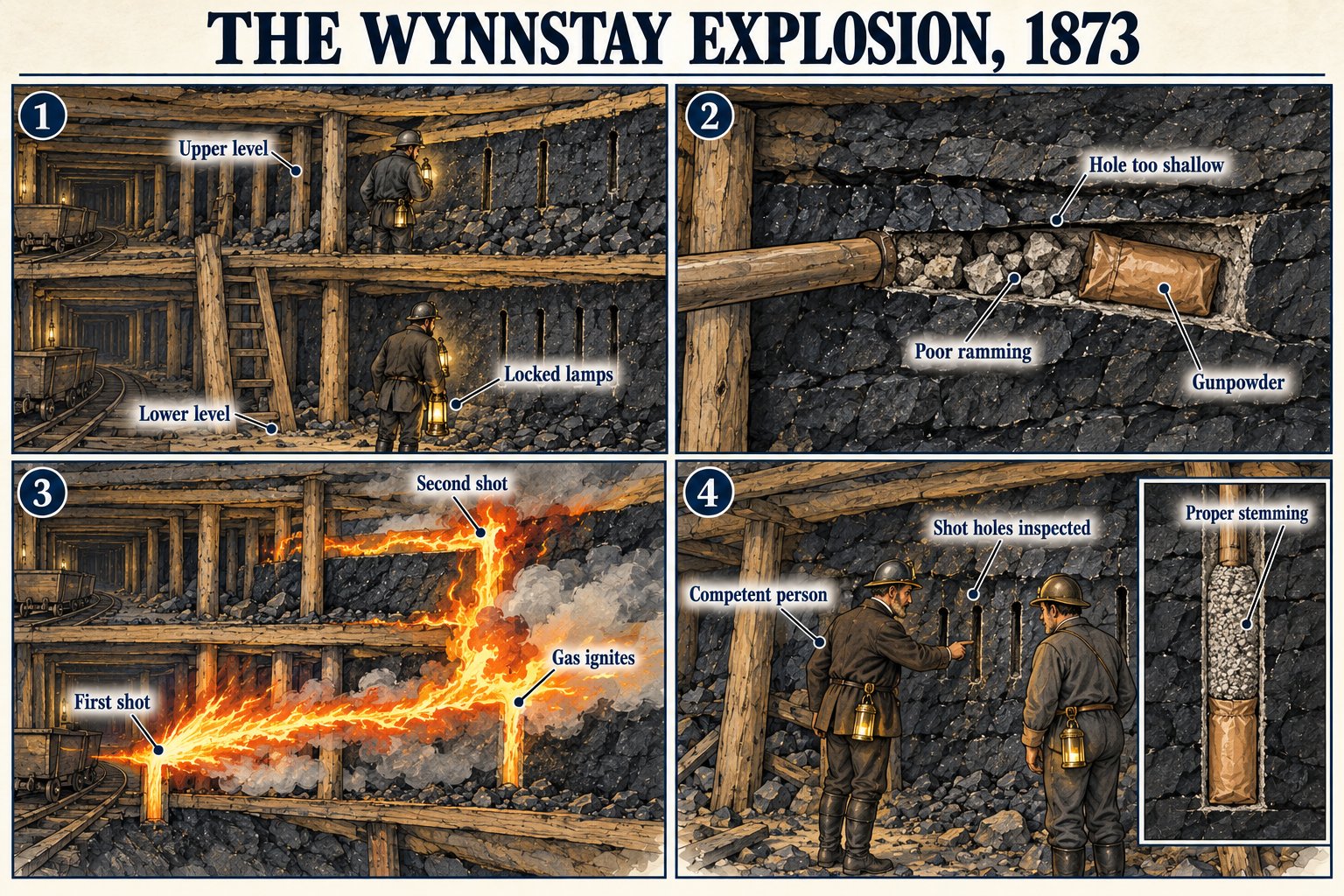
Cause
Shot holes were found to have been insufficiently bored and improperly rammed, allowing gas from two shots fired in sequence, at lower and upper levels, to ignite.
What happened
On 24 April 1873, an explosion at Wynnstay Colliery, Ruabon, killed seven men and boys: Griffith Hughes, 35, a fireman; Joshua Davis, 34, George Edwards, 33, Richard Thomas, 22, and Edward Williams, 27, all colliers; John Jones, 16, a filler; and Peter Darlington, 18, a roadman. The inquest verdict found the explosion arose from shot holes not having been sufficiently bored, with the ramming improperly secured; gas accumulation from two shots fired in sequence, at lower and upper levels, is thought to have contributed to the ignition. The colliery worked with locked safety lamps and used gunpowder for extraction after coal seams had been holed, under a designated fireman responsible for igniting shots. This was the third of three fatal explosions to strike Wynnstay within a single decade -- see also the already-published 1863 and 1868 explosions at the same colliery.
Investigation & inquiry
An inquest was held before Denbighshire Coroner B. H. Thelwall; Assistant Inspector of Mines Thomas Bell recommended that all shot holes be examined by a competent person before powder was inserted, to prevent a recurrence.
Recorded claims
Individual factual claims, each attached to the source(s) that support it below. Where sources disagree, both are kept.
- On 24 April 1873, insufficiently bored and improperly rammed shot holes let gas from two shots ignite, killing Griffith Hughes, Joshua Davis, George Edwards, Richard Thomas, Edward Williams, John Jones and Peter Darlington. 1
- An inquest before Denbighshire Coroner B. H. Thelwall found the explosion arose from insufficiently bored, improperly rammed shot holes; Assistant Inspector Thomas Bell recommended all shot holes be examined by a competent person before powder was inserted. 1
Related terminology
Mining terms this disaster is structurally linked to, with the nature of the relationship.
- Filler (contextual relationship)
Named in this record’s narrative: “…Thomas, 22, and Edward Williams, 27, all colliers; John Jones, 16, a filler; and Peter Darlington, 18, a roadman. The inquest verdict found the…” - Fireman (contextual relationship)
Named twice in this record, first in the narrative: “…Colliery, Ruabon, killed seven men and boys: Griffith Hughes, 35, a fireman; Joshua Davis, 34, George Edwards, 33, Richard Thomas, 22, and…” - HM Chief Inspector of Mines (contextual relationship)
Named in this record’s investigation: “…was held before Denbighshire Coroner B. H. Thelwall; Assistant Inspector of Mines Thomas Bell recommended that all shot holes be examined by a…” - Roadman (contextual relationship)
Named in this record’s narrative: “…all colliers; John Jones, 16, a filler; and Peter Darlington, 18, a roadman. The inquest verdict found the explosion arose from shot holes not…” - Safety Lamp (contextual relationship)
Named in this record’s narrative: “…to have contributed to the ignition. The colliery worked with locked safety lamps and used gunpowder for extraction after coal seams had been holed,…”
Sources
- (secondary) Wynstay Colliery Explosion - Ruabon - 1873 — Northern Mine Research Society
- (secondary) Wynstay disasters (death roll) — Welsh Coal Mines
Record created: 31 August 2026 · Last researched: 31 August 2026