 MineArchive
Wynnstay Colliery Explosion (1863)
A fireman firing a shot in an upbrow ignited accumulated gas, killing thirteen men and boys and injuring six more -- the first of three fatal explosions to strike this colliery within a decade.
| Date | 9 December 1863 |
|---|---|
| Mine | Wynnstay Colliery |
| Region | Wrexham |
| Primary type | Explosion |
| Associated types | Gas / Asphyxiation |
| Fatalities | 13 (Thirteen men and boys died: Thomas Williams (26), Edward Evans (40), Elias Jones (29), Benjamin Thomas (27), Thomas Davies (25), David Jones (41), Samuel Thellwall (13), Thomas Stephens (22), John Blower (40), William Jones (48), William Williams (17), John Davies (36), and one further victim not named in the source used.) |
| Context | During active mining |
Cause
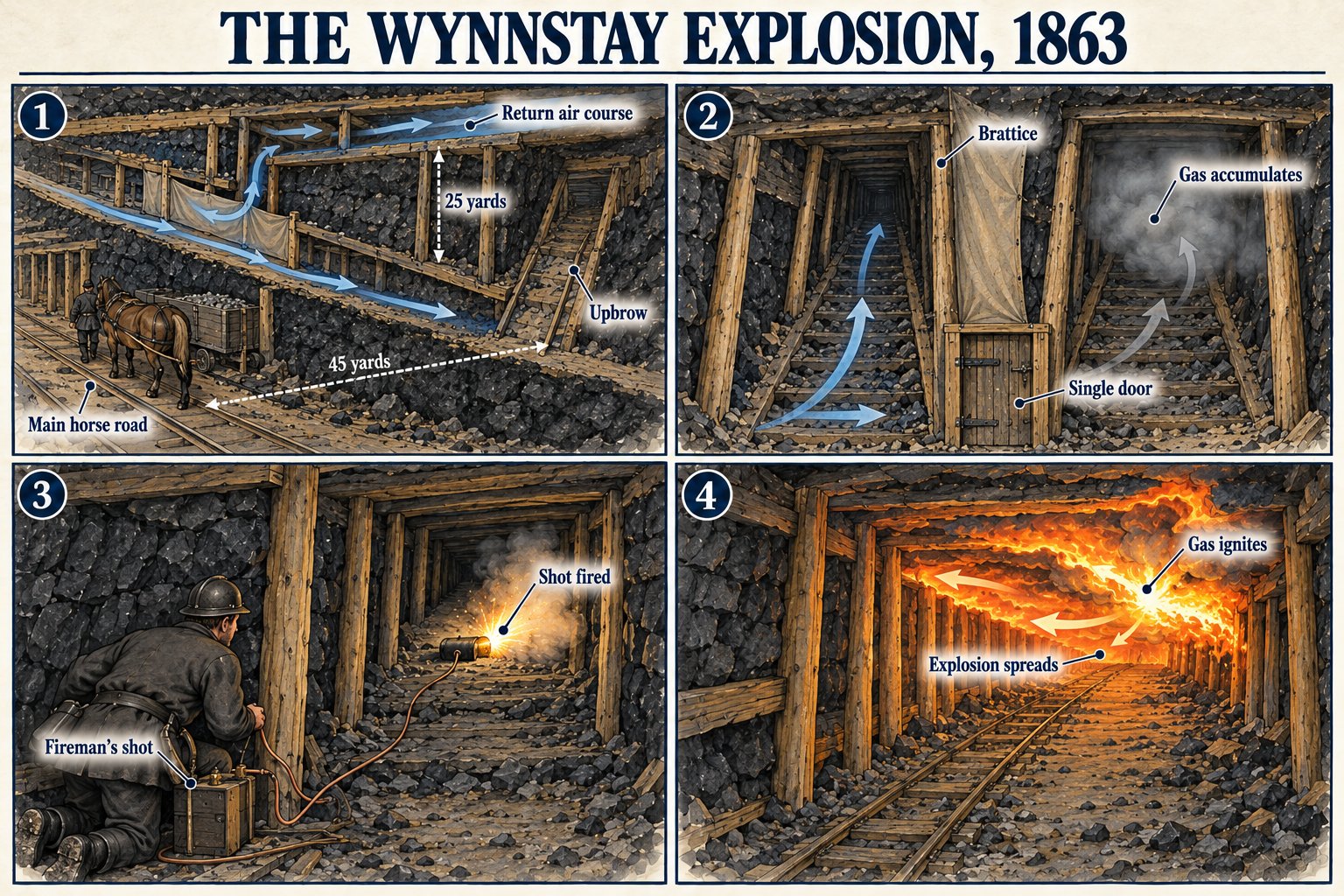
A fireman firing a shot in an upbrow, 25 yards from the return air course and 45 yards from the main horse road, ignited gas that had accumulated there.
What happened
On 9 December 1863, a fireman firing a shot in an upbrow at Wynnstay Colliery, Ruabon -- situated 25 yards from the return air course and 45 yards from the main horse road -- ignited gas that had accumulated in the workings, killing thirteen men and boys and injuring six more. Ventilation in the affected area depended on a split of air at the end of the horse road, carried behind brattice cloth into the level above, from which two upbrows were themselves ventilated by brattice; one of these upbrows, intended as a self-acting incline, had only a single door at its base separating the intake and return air currents. The colliery, the property of the New British Iron Company, was the first of three fatal explosions to strike Wynnstay within a single decade -- see also the already-published 1868 and 1873 explosions at the same colliery.
Investigation & inquiry
The incident was reported in the Mines Inspector's report for 1863 and in the Colliery Guardian of 12 December 1863.
Recorded claims
Individual factual claims, each attached to the source(s) that support it below. Where sources disagree, both are kept.
- On 9 December 1863, a fireman firing a shot in an upbrow ignited accumulated gas, killing thirteen men and boys and injuring six more. 1
- Ventilation in the affected workings depended on a single door separating intake and return air currents at the base of a self-acting incline upbrow. 2
Related terminology
Mining terms this disaster is structurally linked to, with the nature of the relationship.
- Brattice (contextual relationship)
Named twice in this record, first in the narrative: “…on a split of air at the end of the horse road, carried behind brattice cloth into the level above, from which two upbrows were themselves…” - Fireman (contextual relationship)
Named 3 times in this record, first in the summary: “A fireman firing a shot in an upbrow ignited accumulated gas, killing thirteen…” - Incline (contextual relationship)
Named in this record’s narrative: “…by brattice; one of these upbrows, intended as a self-acting incline, had only a single door at its base separating the intake and return…” - Level (contextual relationship)
Named in this record’s narrative: “…at the end of the horse road, carried behind brattice cloth into the level above, from which two upbrows were themselves ventilated by…” - Return Airway (contextual relationship)
Named 3 times in this record, first in the cause: “A fireman firing a shot in an upbrow, 25 yards from the return air course and 45 yards from the main horse road, ignited gas that had…”
Sources
- (secondary) Wynstay disasters (death roll) — Welsh Coal Mines
- (secondary) Wynstay Colliery Explosion - Ruabon - 1863 — Northern Mine Research Society
Record created: 31 August 2026 · Last researched: 31 August 2026