 MineArchive
Isabella Pit inundation, Workington, 1833
Four young miners drowned when water broke into the Isabella Pit of the Curwens' Workington Colliery in November 1833, two months after an explosion in the same pit had killed thirteen.
| Date | 8 November 1833 |
|---|---|
| Mine | Workington Colliery |
| Region | Cumbria |
| Type | Flooding / Inundation |
| Fatalities | 4 (Four: Joseph Batey, 24; William Gallantry, 13; George Nutter, 23, recently married; and Jonathan Wear, 20. One report calls Batey and Gallantry boys.) |
| Context | During active mining |
Location
Plotted at Workington Colliery. Recorded location. The large pin is the mine; the small round markers are the nearest mines on record. Click one for its page. View on full map
Cause
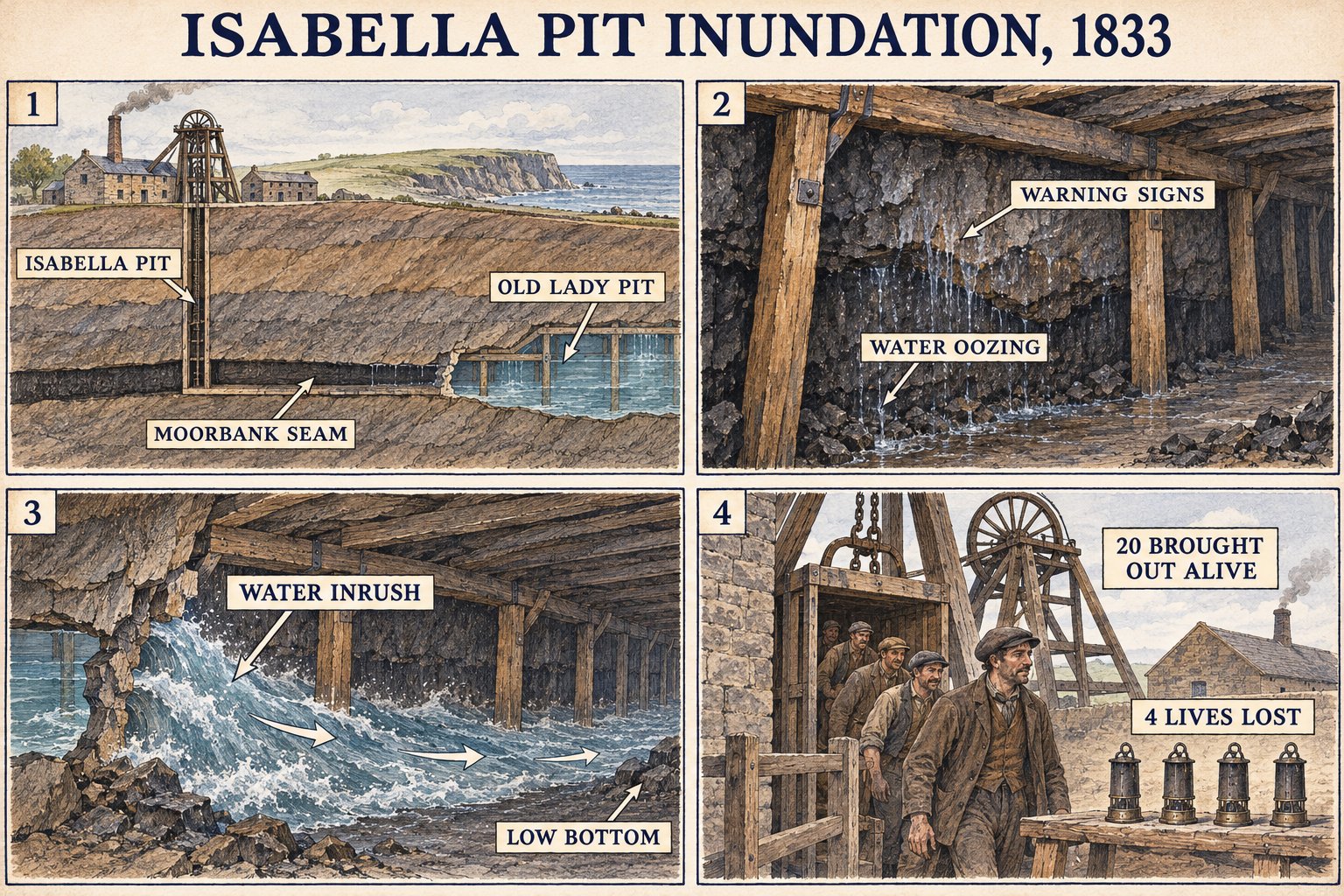
The workings had been driven close to old workings of the Lady Pit, abandoned some sixty years before when, it was said, the sea broke into them, and the water they held burst through into the Moorbank seam.
Contributing factors
Water had been oozing from the coal as the men neared the old pit, and more water than usual had been met for some weeks; the warnings were not heeded, and some colliers had long feared the danger.
What happened
In November 1833 the Isabella Pit of Workington Colliery, the Curwen family's colliery on the Cumberland coast, was flooded, two months after the September explosion in which thirteen had died. Four young miners were drowned: Joseph Batey, 24, William Gallantry, 13, George Nutter, 23, who had recently married, and Jonathan Wear, 20. The Cumberland Pacquet reported it under the heading of a dreadful occurrence at Workington with four lives lost, and The Times carried a report of a fatal colliery accident at Workington.
The water broke in at about ten on the morning of Friday 8 November, when the Lady and Isabella pits were both in full work, and ran with great force down to the Low Bottom. Upwards of thirty men were at work, and some escaped at once; the men in the Low Bottom had warning and got up to the Lady Pit shaft. Rumour in Whitehaven had thirty dead and the sea flooding the whole colliery.
Rescue & recovery
Twenty-two men were cut off in the Moorbank seam. The flood began to fall about noon, and by the afternoon men could go in to clear the rubbish; two were found alive about ten hours after the inrush, eighteen were brought out alive before Saturday morning, and the bodies of the four were found on the Saturday afternoon. The Earl of Lonsdale put any of his men and machinery at Henry Curwen's disposal.
Investigation & inquiry
An inquest before the coroner, W. Bragg, on the Monday returned a verdict of accidental death.
Memorials & commemoration
Workington's mining dead have no marker or memorial; seventeen men and boys died at the colliery within two months in 1833.
What's uncertain
Points where sources disagree or the record could not be settled; both accounts are kept. All open questions in the archive.
- The museum dates the inundation 20 November 1833. (disputed) 1,3
- The Cumberland Pacquet and Whitehaven Herald reported the four deaths on 12 November 1833. (disputed) 3
Recorded claims
Individual factual claims, each attached to the source(s) that support it below. Where sources disagree, both are kept.
- Four young miners were killed by flooding at the Workington Colliery in November 1833. 1,2,3
- The museum dates the inundation 20 November 1833. (disputed) 1,3
- The Cumberland Pacquet and Whitehaven Herald reported the four deaths on 12 November 1833. (disputed) 3
- The inundation was in the Isabella Pit, owned by Mr Curwen. 3
- The dead were Joseph Batey, William Gallantry, George Nutter and Jonathan Wear, aged 13 to 24. 1,3
- The water broke in at about ten o'clock on the morning of Friday 8 November 1833. 4,5
- The water came from old workings of the Lady Pit, abandoned about sixty years earlier when the sea was said to have broken into them. 4,5
- Of twenty-two men cut off in the Moorbank seam, eighteen were brought out alive before Saturday morning and the four dead were found on the Saturday afternoon. 4,6
- The inquest before W. Bragg, coroner, returned accidental death. 6
- The Earl of Lonsdale offered Mr Curwen any of his men and machinery, and Curwen's loss was put at about 2,000 pounds. 6
Related terminology
Mining terms this disaster is structurally linked to, with the nature of the relationship.
- Colliery (contextual relationship)
Named 5 times in this record, first in the summary: “…when water broke into the Isabella Pit of the Curwens' Workington Colliery in November 1833, two months after an explosion in the same pit had…” - Heading (contextual relationship)
Named in this record’s narrative: “…and Jonathan Wear, 20. The Cumberland Pacquet reported it under the heading of a dreadful occurrence at Workington with four lives lost, and The…” - Inrush (contextual relationship)
Named in this record’s rescue and recovery: “…to clear the rubbish; two were found alive about ten hours after the inrush, eighteen were brought out alive before Saturday morning, and the…” - Old Workings (contextual relationship)
Named in this record’s cause: “The workings had been driven close to old workings of the Lady Pit, abandoned some sixty years before when, it was…” - Shaft (contextual relationship)
Named in this record’s narrative: “…the men in the Low Bottom had warning and got up to the Lady Pit shaft. Rumour in Whitehaven had thirty dead and the sea flooding the whole…”
Sources
- (primary) Durham Mining Museum: Workington Colliery — Durham Mining Museum
- (secondary) Memorial service for 13 Workington miners killed in 19th century explosion — Cumbria Crack (20 September 2026)
- (primary) Durham Mining Museum: Colliery Disaster 1833 (Isabella Pit, Workington) — Durham Mining Museum
- (primary) Dreadful occurrence at Workington: four lives lost (Cumberland Pacquet, 12 November 1833) — Durham Mining Museum
- (primary) News (Whitehaven Herald, 12 November 1833) — Durham Mining Museum
- (primary) Fatal colliery accident at Workington (The Times, 30 November 1833, from the Carlisle Patriot) — Durham Mining Museum
Record created: 6 October 2026 · Last researched: 3 November 2026