 MineArchive
Windsor Colliery Shaft Accident, 1902
A working stage collapsed during shaft-sinking at Windsor Colliery, Abertridwr, dropping eight men into a flooded sump and drowning six of them.
| Date | 3 June 1902 |
|---|---|
| Mine | Windsor Colliery |
| Region | Caerphilly |
| Type | Winding / Shaft Accident |
| Fatalities | 6 (Six sinkers drowned: Griffith Wood (45), William Richards (34), William Davies (38), Samuel Matthews (23), Thomas Davies (26) and Edgar Brace (22). Two more men fell with them but escaped by clinging to floating debris.) |
| Context | During active mining |
Cause
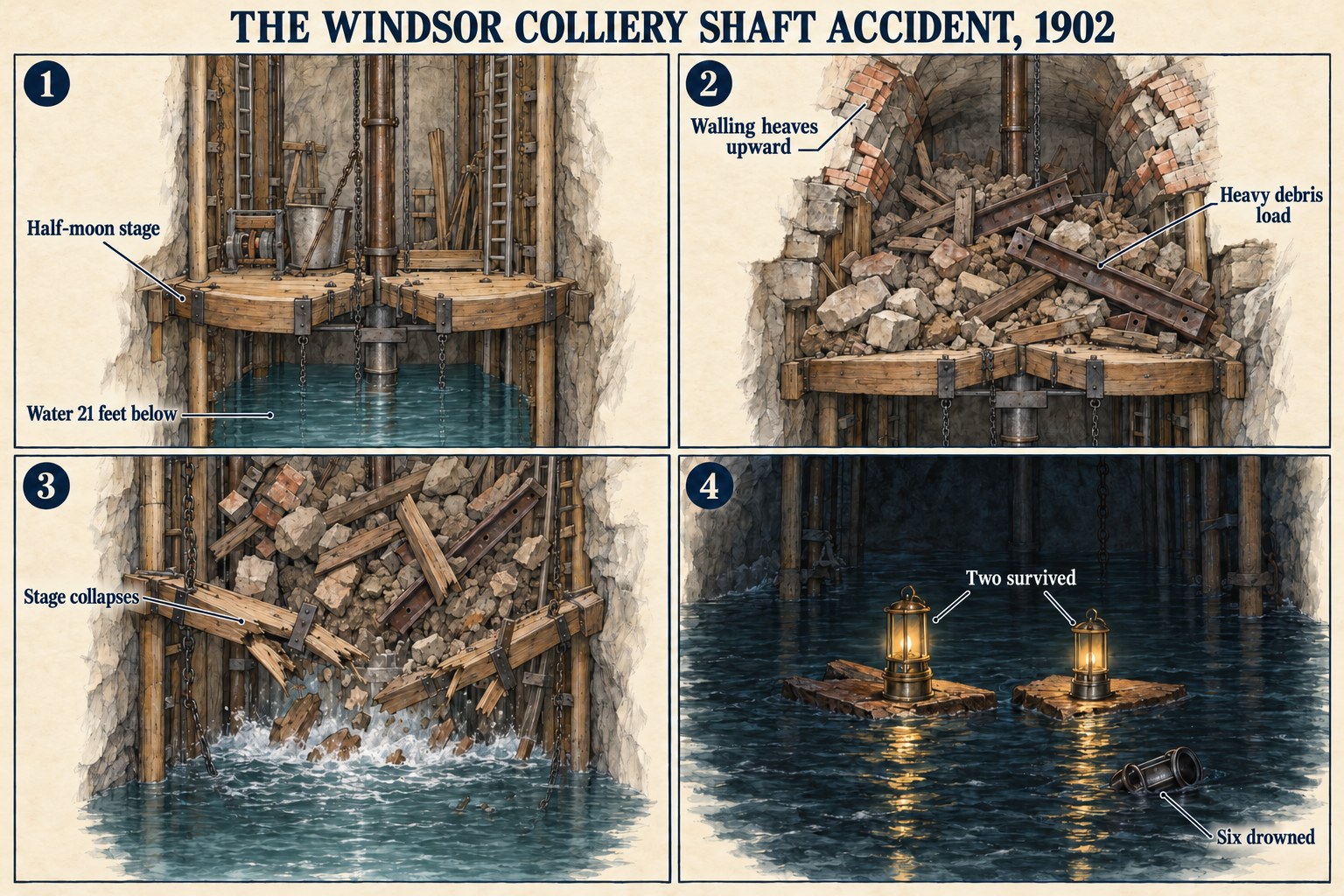
The working stage — a framework of pitch-pine beams bound with iron brackets, built in the shape of two half-moons — gave way after roughly 80 tons of rubbish and iron shaft supports fell onto it during walling construction. The collapse itself was caused primarily by the masonry at the mouths of the headings heaving upward by more than eight inches under ground pressure, and secondarily by the weight of debris that had built up on the stage.
What happened
On 3 June 1902, during the sinking of Windsor Colliery's shafts at Abertridwr, eight sinkers were working on a stage roughly 21 feet above water that had gathered in the shaft sump. The stage — built as two half-moon-shaped sections of pitch-pine framework bound with iron brackets — gave way after around 80 tons of rubbish and iron shaft supports fell onto it, sending all eight men down into the water below. Two escaped by clinging to floating debris until they could be rescued; the other six drowned: Griffith Wood, William Richards, William Davies, Samuel Matthews, Thomas Davies and Edgar Brace.
Investigation & inquiry
HM Inspector of Mines Gray examined the scene the day after the accident and found that the top of the shaft walling had been heaved upward by over eight inches — concluding the stage's collapse was caused principally by this upheaval of masonry at the mouths of the headings, and secondarily by the accumulated weight of debris that fell onto it. He specifically noted that the stage's timber itself was sound and that the accident could not be attributed to rot or poor maintenance. The coroner's jury returned a verdict of accidental drowning caused by the stage's collapse.
Memorials & commemoration
No dedicated memorial to this specific accident is known.
Recorded claims
Individual factual claims, each attached to the source(s) that support it below. Where sources disagree, both are kept.
- Six sinkers drowned when a working stage collapsed and they fell into the flooded shaft sump: Griffith Wood (45), William Richards (34), William Davies (38), Samuel Matthews (23), Thomas Davies (26) and Edgar Brace (22). 1
- The stage collapsed after roughly 80 tons of rubbish and iron shaft supports fell onto it, itself caused primarily by the masonry at the mouths of the headings heaving upward by over eight inches under ground pressure. 1
- HM Inspector of Mines Gray found the stage's own timber sound and not attributable to rot or poor maintenance, attributing the collapse instead to the ground movement and accumulated debris weight. 1
- The accident occurred during the colliery's original 1895-1902 shaft-sinking phase, before the pit itself opened for coal production later in 1902. 2
Related terminology
Mining terms this disaster is structurally linked to, with the nature of the relationship.
- Colliery (contextual relationship)
Named twice in this record, first in the summary: “A working stage collapsed during shaft-sinking at Windsor Colliery, Abertridwr, dropping eight men into a flooded sump and drowning six…” - HM Chief Inspector of Mines (contextual relationship)
Named in this record’s investigation: “HM Inspector of Mines Gray examined the scene the day after the accident and found that…” - Shaft (contextual relationship)
Named 4 times in this record, first in the cause: “…two half-moons — gave way after roughly 80 tons of rubbish and iron shaft supports fell onto it during walling construction. The collapse…” - Shaft Sinking (contextual relationship)
Named in this record’s narrative: “On 3 June 1902, during the sinking of Windsor Colliery's shafts at Abertridwr, eight sinkers were…” - Sump (contextual relationship)
Named twice in this record, first in the summary: “…at Windsor Colliery, Abertridwr, dropping eight men into a flooded sump and drowning six of them.”
Sources
- (primary) Windsor Colliery Shaft Accident — Abertridwr — 1902 — Northern Mine Research Society
- (secondary) Windsor Colliery Abertridwr — welshcoalmines.co.uk
Record created: 2 September 2026 · Last researched: 2 September 2026