 MineArchive
William Pit Explosion, 1839
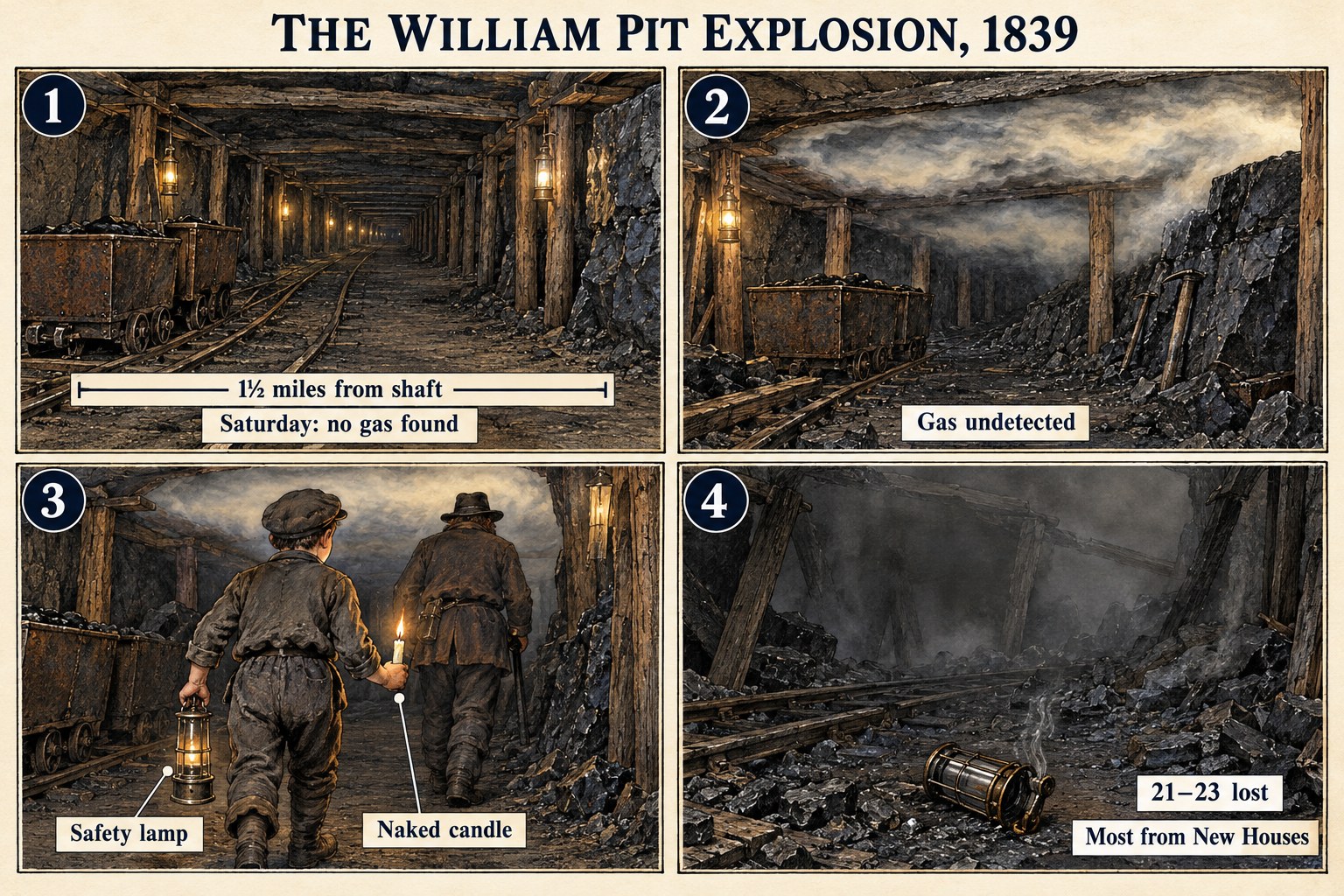
Firedamp that had gone undetected since the previous Saturday exploded when a boy carrying a naked candle followed the overman into workings a mile and a half from the shaft — killing between 21 and 23 men and boys, most from one small stretch of New Houses.
| Date | 18 February 1839 |
|---|---|
| Mine | William Pit |
| Region | Cumbria |
| Type | Explosion |
| Fatalities | 23 (Sources disagree on the exact toll: Cumbria Amenity Trust Mining History Society's colliery history gives 23 men and boys killed, while NMRS's dedicated account states nine men and twelve boys — 21 — and names 22 individuals: George Scott (60), William Davidson (41), Hugh Raney (46), Barney Cairn, William Smith (22), Felix McGinnis (33), Richard Harrison (43), John Tordiff (31), John Firth (33) and Thomas Gilmore (60) among the men, and John Fisher (10), William Doran (14), Richardson Shields (16), Michael Wheatley (13), John Dunn (11), William Atkinson (14), Robert Tear (12), James Tear (18), Christopher Pearson (14), John Ross (18), William McMullen (11) and Joseph Clark among the boys.) |
| Context | During active mining |
Cause
Firedamp that had accumulated undetected since the previous Saturday was ignited when a boy named Kennedy, carrying a naked candle in addition to his safety lamp, followed the overman Topping into a newly-inspected working.
What happened
At around 2am on 18 February 1839, an explosion tore through workings around a mile and a half from the shaft bottom, in the direction of Parton. The chief overman had examined the mine on the Saturday before and found no firedamp; on the Monday morning, the overman Topping inspected the same workings, declared them safe, and the men went to work. Gas that had accumulated in the intervening period went undetected until a boy, Kennedy, followed Topping into the last working carrying a naked candle alongside his safety lamp — the gas exploded at the flame. Kennedy and Topping were both badly scorched but survived; almost everyone else then in the pit was killed, with only one further man recovered alive. Most of the dead came from a small cluster of streets — New Houses, Tangier Street, Charles Street and Addison Alley — and among them were two pairs of family members: brothers Robert and James Tear, aged 12 and 18, and John Tordiff, who left a pregnant wife and four children.
Investigation & inquiry
Contemporary local reporting (the Cumberland Pacquet, 19 February 1839) described the accident as one that 'spread misery and distress throughout the whole of the neighbourhood', and one 'against which no human foresight or precaution could have effectually protected those who became its victims'.
Memorials & commemoration
No dedicated memorial to this specific explosion is known.
What's uncertain
Points where sources disagree or the record could not be settled; both accounts are kept. All open questions in the archive.
- NMRS names 22 individuals and states the toll as nine men and twelve boys (21); CATMHS's separate colliery history gives 23. Both figures are preserved rather than one being silently chosen. (disputed) 1,2
Recorded claims
Individual factual claims, each attached to the source(s) that support it below. Where sources disagree, both are kept.
- NMRS names 22 individuals and states the toll as nine men and twelve boys (21); CATMHS's separate colliery history gives 23. Both figures are preserved rather than one being silently chosen. (disputed) 1,2
- Firedamp that had accumulated undetected since the previous Saturday was ignited when a boy named Kennedy, carrying a naked candle in addition to his safety lamp, followed the overman Topping into a newly-inspected working. 1,2
- Kennedy and Topping, the two nearest the ignition, were both badly scorched but survived; only one further man in the pit was recovered alive. 2
Related terminology
Mining terms this disaster is structurally linked to, with the nature of the relationship.
- Firedamp (direct cause)
The explosion was caused by firedamp that had accumulated undetected over a weekend, ignited by a naked candle. - Overman (contextual relationship)
Named 4 times in this record, first in the summary: “…Saturday exploded when a boy carrying a naked candle followed the overman into workings a mile and a half from the shaft — killing between 21…” - Safety Lamp (contextual relationship)
Named twice in this record, first in the cause: “…when a boy named Kennedy, carrying a naked candle in addition to his safety lamp, followed the overman Topping into a newly-inspected working.” - Shaft (contextual relationship)
Named twice in this record, first in the summary: “…candle followed the overman into workings a mile and a half from the shaft — killing between 21 and 23 men and boys, most from one small…”
Sources
- (primary) William Pit Whitehaven — a history of the Whitehaven Collieries — Cumbria Amenity Trust Mining History Society (CATMHS)
- (primary) William Pit Explosion — Whitehaven — 1839 — Northern Mine Research Society
Record created: 2 September 2026 · Last researched: 2 September 2026