 MineArchive
Waunhir Slant runaway
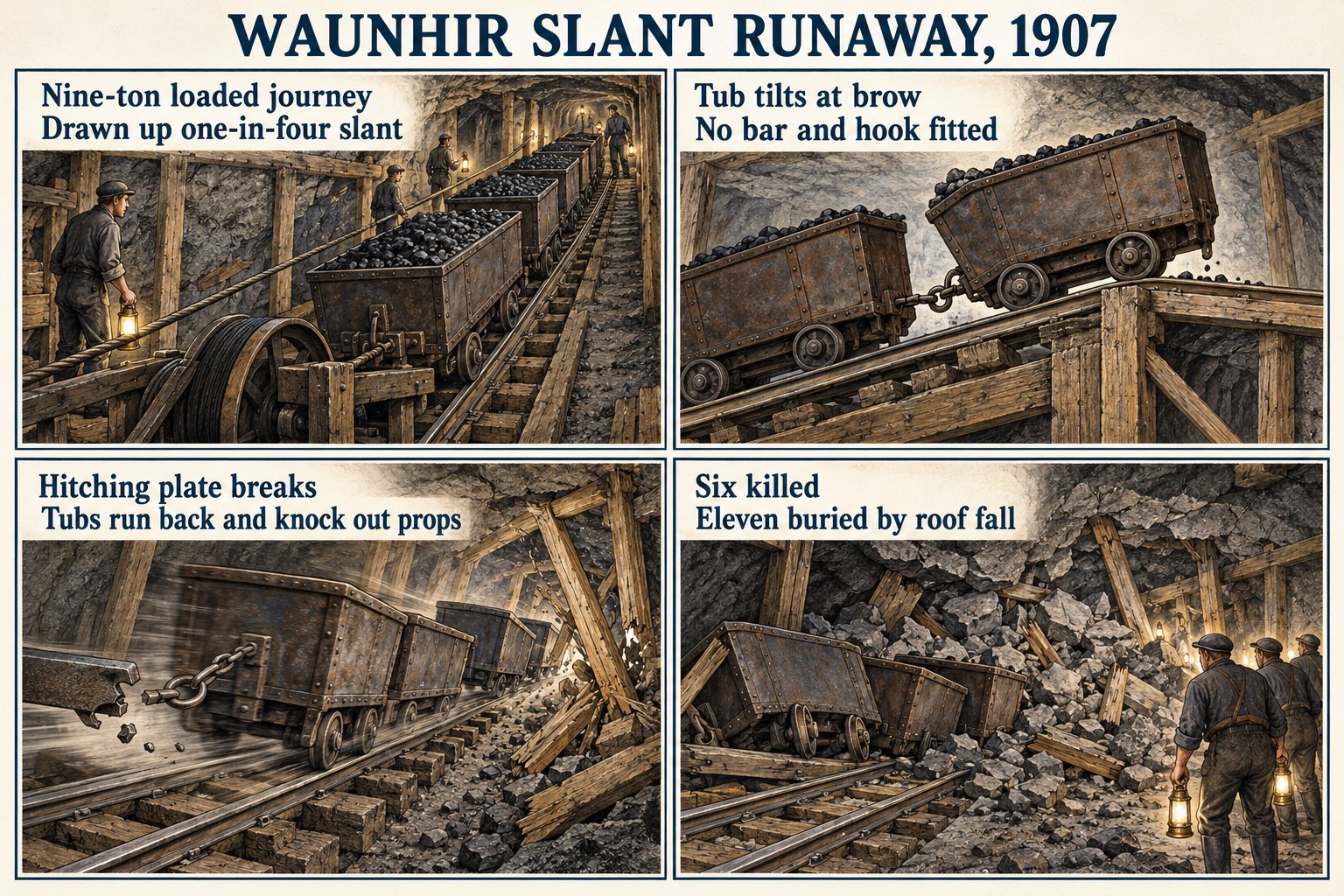
A journey of loaded tubs weighing about nine tons was being drawn up the Waunhir slant at Trimsaran when a tub tilted at the top of the brow and the hitching plate broke. The tubs ran back down the drift into the men walking out at the end of their shift, knocked out props at the bottom and brought down six yards of roof, burying eleven. Six were killed.
| Date | 16 February 1907 |
|---|---|
| Mine | Trimsaran Colliery |
| Region | Carmarthenshire |
| Type | Haulage / Transport |
| Fatalities | 6 (Six. The Northern Mine Research Society's account names six men but gives ages for only four; Welsh Coal Mines names the same six with ages for all, differing on several of them.) |
| Context | During active mining |
Cause
The hitching plate coupling the journey of loaded tubs broke as a tub tilted at the top of the brow. The plate was white steel secured by four rivets, and the strain on it was about 7.75 tons against a safe working load of about six.
Contributing factors
No bar and hook had been put on the journey. The rider, John Treherne, told the inquest that the one he should have used had gone up on the previous journey and been lost on the slant, that the nearest other was a hundred yards away, and that the men wanted to finish before one o'clock. There were only two bar hooks in the whole pit, and the manager agreed it would have been an advantage to have one at each parting. An engineer told the inquest that the hitching bar was continually strained by the angle it had to pass over at the top of the brow, and doubted whether inspection would have prevented the accident. A journey had run 130 yards down the slope at the same place about fifteen months earlier.
What happened
The colliery belonged to the Trimsharan Company Limited and was worked by a drift a hundred yards long dipping one in four, eleven feet high and five and a half feet wide, with six manholes along it. It had never had a fatal accident, despite working the most dangerous and thickest seam in the district.
On 16 February 1907 a journey of full tubs weighing nine tons was being drawn up the slant. As it reached the top one of the tubs tilted, by means the inquest could not establish, and the hitching plate broke. The remaining tubs careered back down the slant at exactly the moment the men were making their way to the surface at the end of the shift. Some were knocked down and killed outright. The trams ran to the bottom and knocked out props, bringing down six yards of roof and burying eleven men in the debris.
Rescue & recovery
Eleven men were buried by the fall of roof at the bottom of the slant and had to be dug out.
Investigation & inquiry
The inquest was held by Mr D. A. Sanders, with Mr Dwyer Lewis for the Mines Inspectorate. The jury returned a verdict of accidental death and found no person responsible, but recommended that the arrangements the inspector suggested be adopted, in particular the lowering of the angle at the top of the slant. The coroner told the jury that a previous inspector, Mr Robson, had tried to get rules established about hooks and bars and met a great deal of opposition.
Changes to practice & legislation
The inquest recommended lowering the angle at the top of the slant and, in effect, a bar and hook on every journey — the practice the previous inspector had failed to get written into rules.
What's uncertain
Points where sources disagree or the record could not be settled; both accounts are kept. All open questions in the archive.
- The two accounts name the same six men but differ on their details. Welsh Coal Mines gives Benjamin Davies, 32; Albert Henry Liley, 19; John Rees, 18; David Lodwig, 24; David Davies, 23; and Arthur Llewellyn Price, a collier's boy of 16. The Northern Mine Research Society gives Benjamin Davies, 30, of Waenyglyn; Albert Lilley, 18, of Kidwelly; John Rees, 16, of Capel; David Lodwick, 28, of Waenyglyn; David Davies of Pwll; and David Price of Trimsharan. (disputed) 1,2
Recorded claims
Individual factual claims, each attached to the source(s) that support it below. Where sources disagree, both are kept.
- The two accounts name the same six men but differ on their details. Welsh Coal Mines gives Benjamin Davies, 32; Albert Henry Liley, 19; John Rees, 18; David Lodwig, 24; David Davies, 23; and Arthur Llewellyn Price, a collier's boy of 16. The Northern Mine Research Society gives Benjamin Davies, 30, of Waenyglyn; Albert Lilley, 18, of Kidwelly; John Rees, 16, of Capel; David Lodwick, 28, of Waenyglyn; David Davies of Pwll; and David Price of Trimsharan. (disputed) 1,2
- The Northern Mine Research Society gives the date as 16 February 1907, citing the Colliery Guardian of 22 February. Welsh Coal Mines gives only the month. 1,2
- The inquest heard that the strain on the plate was about 7.75 tons and the total weight of the loaded wagons 8 tons 12 hundredweight, against a safe working load of about six tons. 2
Related terminology
Mining terms this disaster is structurally linked to, with the nature of the relationship.
- HM Chief Inspector of Mines (contextual relationship)
Named in this record’s investigation: “The inquest was held by Mr D. A. Sanders, with Mr Dwyer Lewis for the Mines Inspectorate. The jury returned a verdict of accidental death and found no person…” - Journey (contextual relationship)
Named 7 times in this record, first in the summary: “A journey of loaded tubs weighing about nine tons was being drawn up the…” - Roof Fall (contextual relationship)
Named in this record’s rescue and recovery: “Eleven men were buried by the fall of roof at the bottom of the slant and had to be dug out.” - Slant (contextual relationship)
Named 7 times in this record, first in the summary: “…loaded tubs weighing about nine tons was being drawn up the Waunhir slant at Trimsaran when a tub tilted at the top of the brow and the…” - Tub (contextual relationship)
Named 9 times in this record, first in the summary: “A journey of loaded tubs weighing about nine tons was being drawn up the Waunhir slant at…”
Photographs & further reading
This page doesn't try to reproduce everything — these are the best original sources found for this disaster.
The Northern Mine Research Society's account of the accident and the inquest, with the dimensions of the drift, the evidence of the rider and the manager about the missing bar and hook, and the jury's recommendations. Reached through the Internet Archive because the society's live site now redirects deep links to its home page.
View sourceSources
- (secondary) Trimsaran Colliery — Welsh Coal Mines
- (primary) Waunhir Trimsharan Colliery Accident, Kidwelly, 1907 — Northern Mine Research Society, via the Internet Archive
Record created: 11 September 2026 · Last researched: 11 September 2026