 MineArchive
Tudhoe Colliery Explosion
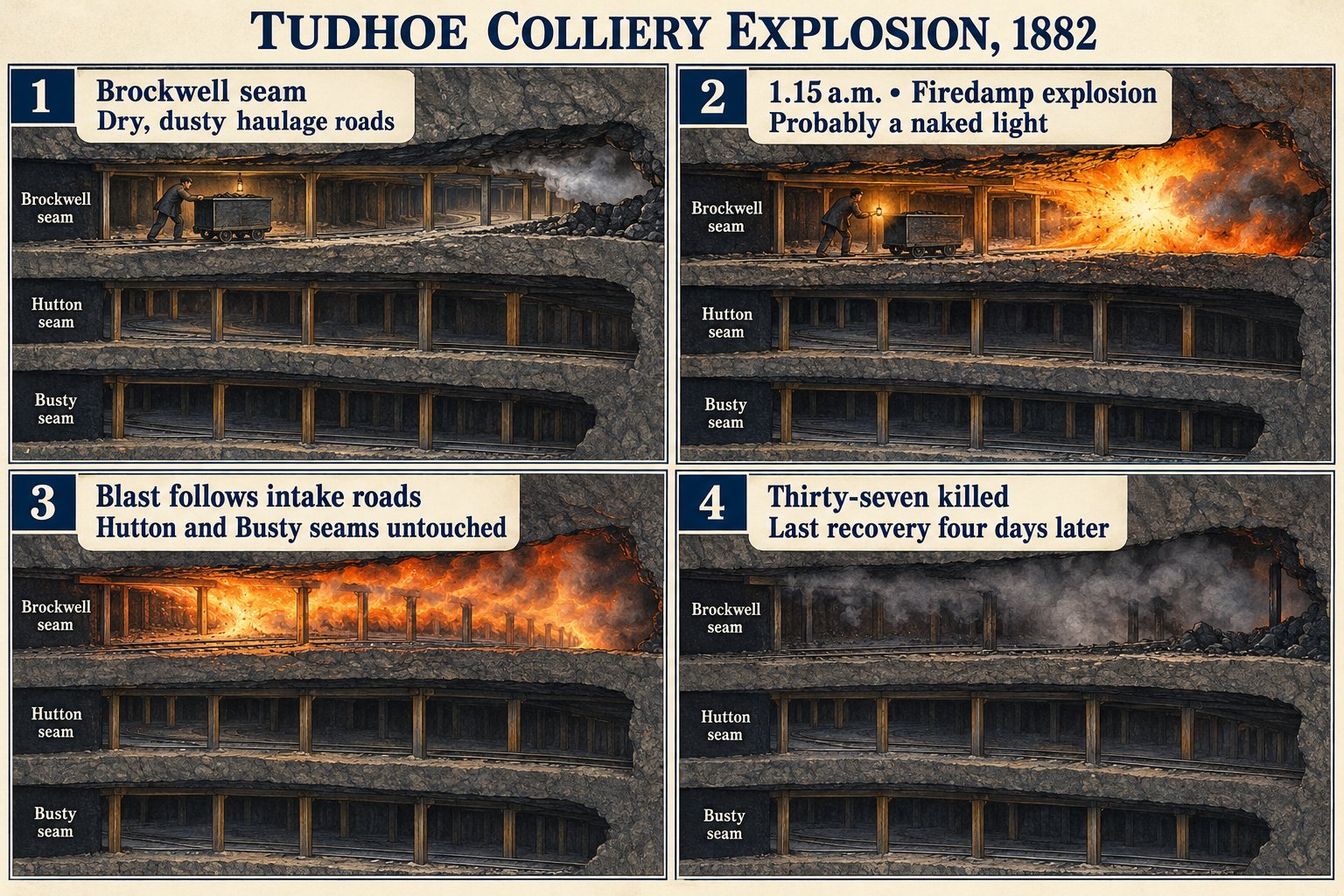
At about a quarter past one in the morning of 18 April 1882, firedamp exploded in the Brockwell Seam at Tudhoe Colliery, near Spennymoor in County Durham, killing 37 men and boys and seventy horses and ponies. It happened in the gap between the night shift and the fore shift, so those below were mostly repairers and stonemen. The blast ran the full length of the intake haulage roads, between landings some 2,500 yards apart, but was confined entirely to that one seam; the Hutton and Busty workings above it, from the same shafts, were untouched. The cause was recorded as ignition probably by a naked light.
| Date | 18 April 1882 |
|---|---|
| Mine | Tudhoe Colliery |
| Region | County Durham |
| Primary type | Explosion |
| Associated types | Gas / Asphyxiation |
| Fatalities | 37 (Aged between 15 and 66. One of the 37 was a man who went down after the explosion and was killed by afterdamp.) |
| Injuries | Seventy horses and ponies were also killed. |
| Context | During active mining |
Cause
An explosion of firedamp in the Brockwell Seam, the ignition probably caused by a naked light.
Contributing factors
The Brockwell was not a gassy seam — firedamp was seen only occasionally near the goaf edge — but the coal was dry and dusty and most of the engine haulage roads were dry too, and the explosion ran the length of them. Nothing had been reported wrong: the workmen’s own inspections under the 30th General Rule on 6, 7, 11, 12 and 13 April were satisfactory, a shift of deputy overmen had come out within two hours of the explosion reporting everything in its usual state, and the master-shifter in charge at the time survived to say his own examinations had revealed nothing to suspect.
What happened
Tudhoe was a colliery of about 1,700 people working three seams from three shafts. The Brockwell, 174 yards down, was the deepest, and by 1882 more than a thousand tons a day came off its one plane. It was not thought a dangerous seam: it made little gas, and the men’s own statutory inspections earlier that month had found nothing.
The explosion came at about 1.15 a.m. on 18 April, in the interval between the night shift coming up around midnight and the fore shift of hewers going down. Most of those below were repairers and stonemen. Flame and blast travelled from the East pit along the Sunderland Bridge haulage road and from the West pit along the West way, reaching both downcast shafts and running some distance up the Shieldfield, Croxdale and Coldstream branches — the two engine landings it reached are about 2,500 yards apart by the route it took. Timber was destroyed in both shafts, a brick wall was blown southward, tubs were driven inbye and a pump’s air vessel was forced along with them.
Thirty-seven men and boys died, the youngest 15 and the oldest 66, along with seventy horses and ponies. One of the 37 was not caught in the explosion at all: he went down afterwards and was killed by afterdamp.
Rescue & recovery
The East pit shaft was not badly damaged and men were able to get into the mine soon after the explosion. No fires had been started and no unusual difficulties were met underground, so the workings were explored quickly — but the pit was large, and the last body did not reach the surface until four days after the explosion. The physician who attended, John O’Hanlon of Tudhoe Grange, recorded a cause of death for each man as the bodies came out of the Brockwell seam: roughly half had died of burns and the rest of afterdamp, with one man killed by violence and afterdamp together.
Investigation & inquiry
The inquest opened at Tudhoe and was still sitting on 23 May 1882, with O’Hanlon giving his list of the dead and the manner of each death. The official finding on the cause was an explosion of firedamp, the ignition probably caused by a naked light.
The physical investigation was thinner than it should have been, and the writers of the standard contemporary account said so plainly: the explosion at West Stanley happened the night after Tudhoe and drew attention away from the explorations here, so comparatively few indications were recorded. What was established was where the explosion had reached — the downcast shafts, the engine landings in the Sunderland Bridge and West ways, and some distance into all the branches — and what it had not: the Hutton and Busty seams, worked from the same shafts at 90 and 134 yards, were unaffected and no one died in them.
Memorials & commemoration
A memorial to the dead stands in Tudhoe cemetery. Many of those killed were buried at St Charles’s Roman Catholic churchyard in Tudhoe Village and at Holy Innocents, Low Spennymoor. On the 140th anniversary in April 2022 a memorial service was held at St David’s Church, followed by a display of miners’ banners, children’s artwork from Tudhoe Colliery Primary School and mining memorabilia lent by the Durham Mining Museum.
Recorded claims
Individual factual claims, each attached to the source(s) that support it below. Where sources disagree, both are kept.
- Thirty-seven men and boys were killed, and seventy horses and ponies. One person who descended after the explosion lost his life by afterdamp. 1,2
- The cause was recorded as an explosion of firedamp, the ignition probably caused by a naked light. 2
- The explosion was entirely confined to the workings in the Brockwell Seam, on one plane, 174 yards deep. The Hutton at 90 yards and the Busty at 134 yards were being worked from the same shafts but were not affected, and no lives were lost in them. 1
- The explosion reached the downcast shafts and the engine landings in the Sunderland Bridge way of the East pit and the West way of the West pit — about 2,500 yards apart by the route it travelled — and extended some distance into all the branch ways. 1
- The workmen had examined the districts affected under the 30th General Rule of the Coal Mines Act on 6, 7, 11, 12 and 13 April and their report was satisfactory. A shift of deputy overmen came out of the pit within two hours of the explosion and stated everything was in its usual state, and the master-shifter in charge survived to say his examinations had revealed nothing to suggest an explosion possible. 1
- The circumstances were not investigated as fully as other cases of the period: the explosion at West Stanley occurred the night after Tudhoe and diverted attention from the explorations here, so comparatively few indications were observed. 1
- John O’Hanlon, a physician practising at Tudhoe Grange, recorded the cause of death for each man as the bodies were brought out of the Brockwell seam. Roughly half died of burns and the rest of afterdamp; one, Thomas Jefferson, died of violence and afterdamp. 3
- Those killed were aged between 15 and 66. 4,5
- The Davy safety lamp was principally used at the colliery, with some Clanny and Stephenson lamps also in use. Gunpowder was fired in the whole or first working and in stone work, but not in the pillar workings. 1
Related terminology
Mining terms this disaster is structurally linked to, with the nature of the relationship.
- Afterdamp (contextual relationship)
Named 3 times in this record, first in the narrative: “…in the explosion at all: he went down afterwards and was killed by afterdamp.” - Goaf (contextual relationship)
Named in this record’s contributing factors: “…was not a gassy seam — firedamp was seen only occasionally near the goaf edge — but the coal was dry and dusty and most of the engine haulage…” - Haulage (contextual relationship)
Named 3 times in this record, first in the summary: “…repairers and stonemen. The blast ran the full length of the intake haulage roads, between landings some 2,500 yards apart, but was confined…” - Hewer (contextual relationship)
Named in this record’s narrative: “…the night shift coming up around midnight and the fore shift of hewers going down. Most of those below were repairers and stonemen. Flame…” - Naked Light (contextual relationship)
Named 3 times in this record, first in the summary: “…were untouched. The cause was recorded as ignition probably by a naked light.”
Photographs & further reading
This page doesn't try to reproduce everything — these are the best original sources found for this disaster.
The casualty record, with the names, ages and occupations of all 37 who died and, for many of them, where they were buried.
View sourceThe contemporary technical account: the ventilation, the layout of the Brockwell workings, how far the explosion travelled and what the explorers found.
View sourceSources
- (primary) Tudhoe Colliery Explosion — Explosions in Coal Mines — Durham Mining Museum, reproducing the contemporary account
- (primary) Colliery Disaster 1882 — Tudhoe — Durham Mining Museum
- (primary) Tudhoe Colliery Inquest, 23 May 1882 — Durham Mining Museum
- (primary) Tudhoe Colliery — Durham Mining Museum
- (secondary) Service to remember Tudhoe Colliery disaster — South West Durham News
Record created: 8 September 2026 · Last researched: 8 September 2026