 MineArchive
Redding Colliery inrush, 1923
Water from long-abandoned 19th-century workings burst through a fault into Redding Colliery's No.23 pit before dawn on 25 September 1923, trapping 66 men underground and killing 40 of them in one of Scotland's worst mining disasters.
| Date | 25 September 1923 |
|---|---|
| Mine | Redding Colliery |
| Region | Falkirk |
| Type | Flooding / Inundation |
| Fatalities | 40 (Most of the 40 who died drowned; two died from exposure to blackdamp (irrespirable gas) and eleven died of cardiac failure brought on by exhaustion after prolonged efforts to escape through old workings.) |
| Context | During active mining |
Cause
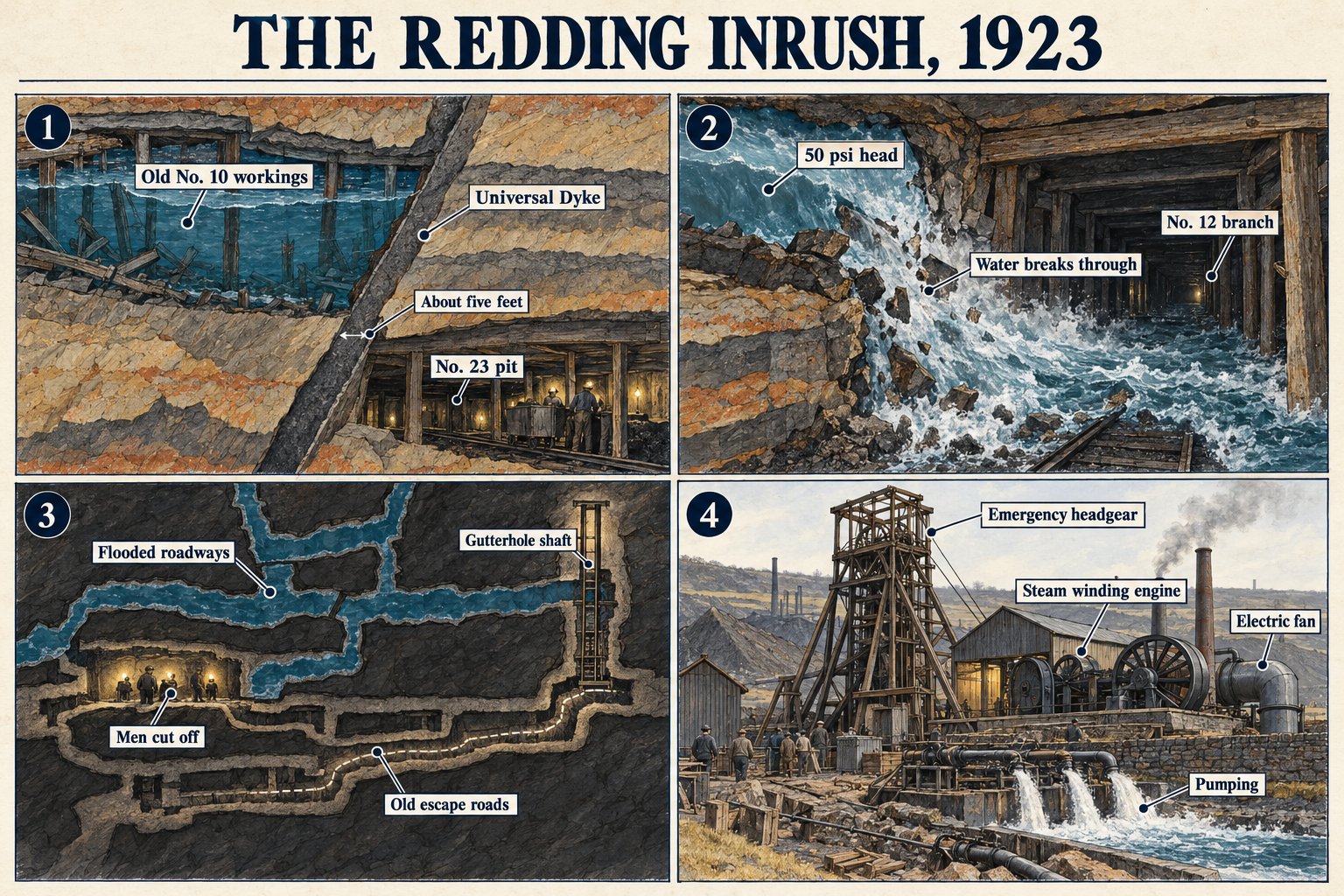
Water accumulated over roughly 50 years in the abandoned Coxrod and Splint seam workings of the old Redding No.10 pit (last worked around 1842, abandoned since 1873) broke through the Universal Dyke, a fault the colliery's management had relied on as a natural barrier, into the Dublin Section of No.23 pit's Main Coal seam workings. At the point of breakthrough the head of water above the working face was equivalent to a pressure of 50 pounds per square inch.
What happened
At 5am on 25 September 1923, water broke through the Universal Dyke into the No.12 branch of the Dublin Section at Redding Colliery, rapidly flooding the workings and trapping 66 men underground. Twenty-six escaped, most through the old Gutterhole shaft; five of them had been trapped for nine days without food in the No.3 Ball Coal section before rescue. Eleven men, led by fireman James Jarvie, tried to escape by travelling over 1,500 yards through old roads toward the Old No.1 Section off Hen Farm Section, under Middlerig Farm, but died of exhaustion before reaching safety; their bodies were recovered together on 21 November. Undermanager William Donaldson's body was recovered on 12 November. Of the 40 who died, most drowned, two died of blackdamp exposure, and eleven of cardiac failure from exhaustion.
Rescue & recovery
Rescue efforts moved with remarkable speed: within 36 hours of the disaster, the old Gutterhole shaft had been fitted with headgear, a steam winding engine and an electric fan to reach survivors. Pumping removed 350-550 gallons of water a minute as recovery operations continued for over two months; the last body was recovered on 3 December 1923.
Investigation & inquiry
Sir Thomas H. Mottram, HM Chief Inspector of Mines, held an inquiry from 5 to 13 February 1924. He found the disaster was caused by the colliery management's reliance on inaccurate plans and calculations of the old workings: they had not examined the old workings' plans closely enough, had not left a substantial coal barrier at the dyke or bored ahead from the surface to check for water, and had relied on a 1917 geological section that put the old Coxrod waste 66 feet above the Main Coal at one point, when the actual separation at the breakthrough point was only about five feet.
Memorials & commemoration
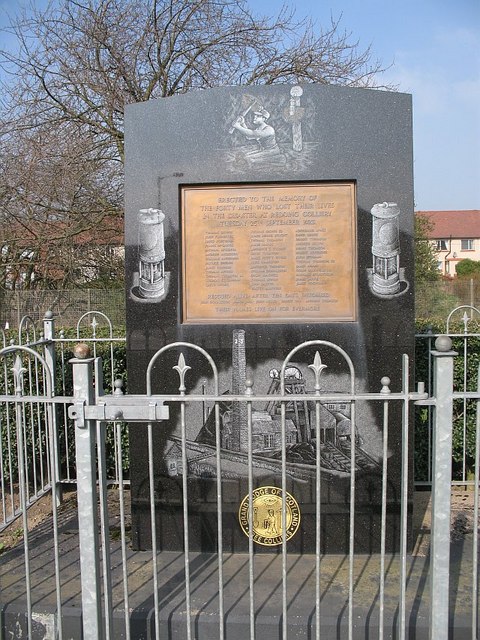
A memorial to the 40 dead was erected in 1945, 22 years after the disaster, and was later refurbished with etched mining scenes; a new memorial was unveiled by the Sir William Wallace Grand Lodge of Scotland Free Colliers for the disaster's centenary in September 2023.
Recorded claims
Individual factual claims, each attached to the source(s) that support it below. Where sources disagree, both are kept.
- Water broke through the Universal Dyke fault into Redding No.23's Dublin Section at 5am on 25 September 1923, trapping 66 men; 26 escaped and 40 died. 1,2
- Eleven men led by fireman James Jarvie died of exhaustion after travelling over 1,500 yards through old workings trying to reach safety; their bodies were recovered together on 21 November 1923. 2
- Sir Thomas H. Mottram's 1924 inquiry found the disaster was caused by the colliery management's reliance on inaccurate plans of the old flooded workings, which understated by some 60 feet how close the old waste was to the working face. 2
Related terminology
Mining terms this disaster is structurally linked to, with the nature of the relationship.
- Chokedamp (contextual relationship)
Named in this record’s narrative: “…on 12 November. Of the 40 who died, most drowned, two died of blackdamp exposure, and eleven of cardiac failure from exhaustion.” - Fireman (contextual relationship)
Named in this record’s narrative: “…food in the No.3 Ball Coal section before rescue. Eleven men, led by fireman James Jarvie, tried to escape by travelling over 1,500 yards through…” - HM Chief Inspector of Mines (contextual relationship)
Named in this record’s investigation: “Sir Thomas H. Mottram, HM Chief Inspector of Mines, held an inquiry from 5 to 13 February 1924. He found the disaster…” - Headgear (contextual relationship)
Named in this record’s rescue and recovery: “…hours of the disaster, the old Gutterhole shaft had been fitted with headgear, a steam winding engine and an electric fan to reach survivors.…” - Winding Engine (contextual relationship)
Named in this record’s rescue and recovery: “…the old Gutterhole shaft had been fitted with headgear, a steam winding engine and an electric fan to reach survivors. Pumping removed 350-550…”
Sources
- (secondary) Redding mining disaster — Wikipedia
- (secondary) Redding Colliery Inrush - Falkirk - 1923 — Northern Mine Research Society
Record created: 27 August 2026 · Last researched: 27 August 2026