 MineArchive
Polmaise Colliery suffocation, 1914
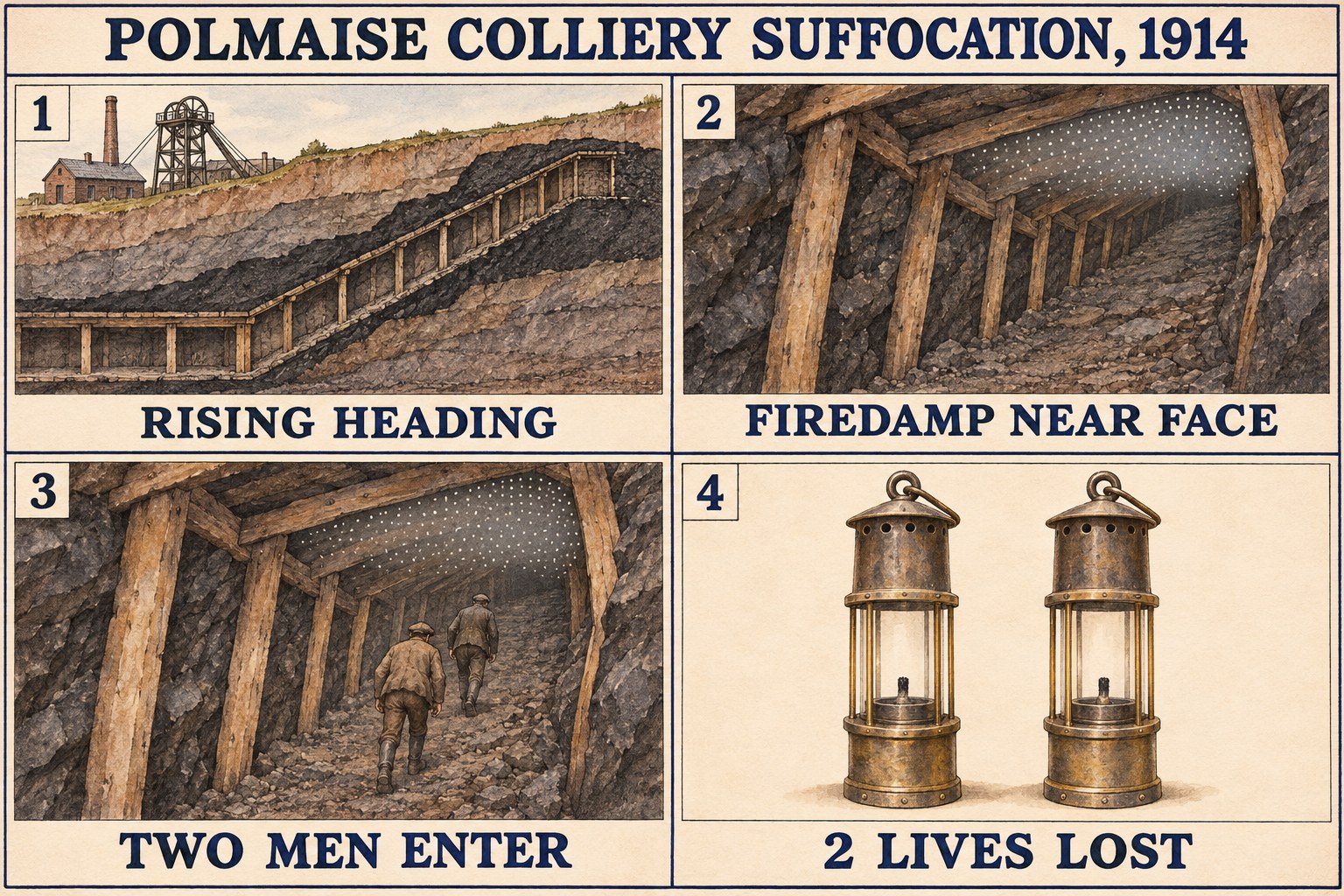
Defying the manager's order, an oversman at Polmaise sent a repairer up a gas-filled heading on a wire in March 1914; both men were suffocated.
| Date | 18 March 1914 |
|---|---|
| Mine | Polmaise Colliery |
| Region | Stirling |
| Type | Gas / Asphyxiation |
| Fatalities | 2 (David Livingstone, 38, oversman, and John Marshall, 35, repairer (a brushing contractor in the index).) |
| Context | During active mining |
Location
Plotted at Polmaise Colliery. Approximate location. The large pin is the mine; the small round markers are the nearest mines on record. Click one for its page. View on full map
Cause
The oversman, disobeying the manager and two firemen, sent a man into a heading filled with firedamp and then went in after him.
What happened
A heading in the Knott seam at Archibald Russell's Polmaise Nos. 3 and 4 pits, near Fallin, rose at 1 in 2 and was full of firedamp for 40 feet back from its face. The man who had driven it had left for another colliery and wanted his money; he asked for more than the oversman, David Livingstone, 38, was willing to pay. On 18 March 1914 Livingstone went in with two repairers and some lengths of pipe, meaning to measure the work and knock on the face to find how far it still was from the road coming to meet it. Two firemen warned him off, and the manager, hearing of it, sent a messenger ordering him out at once because the heading would not be driven any further. Livingstone replied that since he was there he would go in and knock through.
He sent a repairer, John Marshall, 35, up into the gas with signal wire tied round his waist. The messenger ran forward and pulled on the wire, and Marshall fell, groaning; his legs had caught either side of a prop and he could not be dragged back. Livingstone rushed up the heading and collapsed. The messenger, who went after him, fell too, but rolled down into fresh air half-conscious. The bodies were not recovered for some hours. The inspector noted that Livingstone had been a manager and under-manager at two other collieries and might have been expected to show more sense, quite apart from disobeying his manager.
Rescue & recovery
The bodies were recovered some hours later; the manager's messenger, overcome while trying to stop the oversman, rolled into fresh air and survived.
Investigation & inquiry
Reported in the Inspector of Mines' report for 1914.
Recorded claims
Individual factual claims, each attached to the source(s) that support it below. Where sources disagree, both are kept.
- On 18 March 1914 an oversman, David Livingstone, and a repairer, John Marshall, were suffocated by firedamp in a heading in the Knott seam at Polmaise Nos. 3 and 4 pits. 1,2
- Against two firemen's warnings and a direct order from the manager, the oversman sent Marshall up the gas-filled heading with signal wire round his waist to reach the face; Marshall collapsed and could not be pulled back, and Livingstone was overcome going after him. 1,2
- The oversman wanted to measure the heading to settle a dispute over the wages of the man who had driven it, and to find how far it was from holing. 2
Related terminology
Mining terms this disaster is structurally linked to, with the nature of the relationship.
- Firedamp (contextual relationship)
Named twice in this record, first in the cause: “…the manager and two firemen, sent a man into a heading filled with firedamp and then went in after him.” - HM Chief Inspector of Mines (contextual relationship)
Named in this record’s investigation: “Reported in the Inspector of Mines' report for 1914.” - Heading (contextual relationship)
Named 5 times in this record, first in the summary: “…order, an oversman at Polmaise sent a repairer up a gas-filled heading on a wire in March 1914; both men were suffocated.” - Overman (contextual relationship)
Named 4 times in this record, first in the summary: “Defying the manager's order, an oversman at Polmaise sent a repairer up a gas-filled heading on a wire in…” - Undermanager (contextual relationship)
Named in this record’s narrative: “…hours. The inspector noted that Livingstone had been a manager and under-manager at two other collieries and might have been expected to show more…”
Sources
- (primary) Durham Mining Museum: Polmaise Nos. 3 and 4, 18 March 1914 — Durham Mining Museum
- (secondary) Scottish Mining Website: deaths 1914 (with the Inspector of Mines' report) — Scottish Mining Website
Record created: 27 November 2026 · Last researched: 27 November 2026