 MineArchive
Pendleton Colliery floor upheaval, 1906
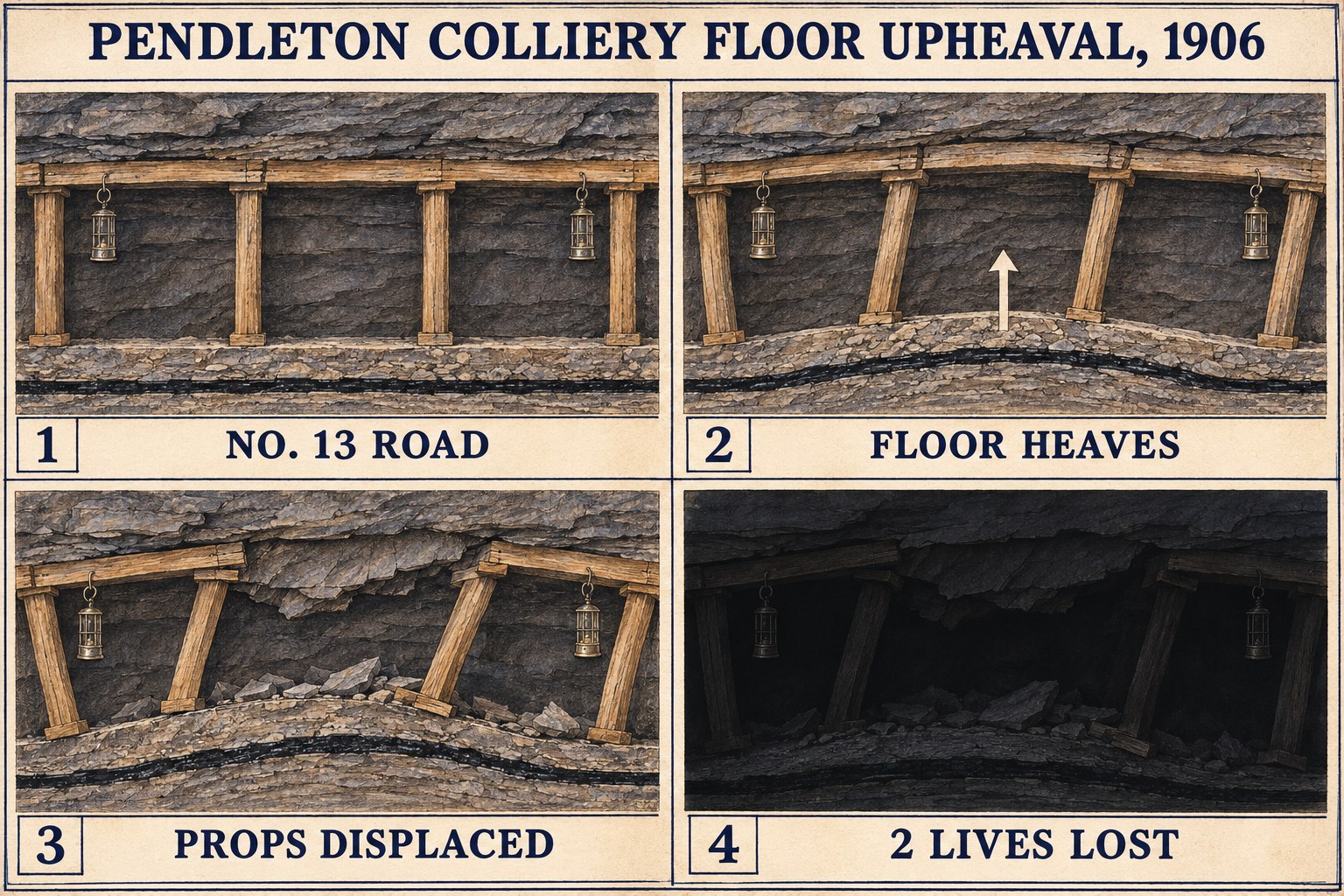
A sudden upheaval of the floor 3,300 feet down at Pendleton Colliery buried two colliers on 28 July 1906; it was reported as an explosion felt three miles off.
| Date | 28 July 1906 |
|---|---|
| Mine | Pendleton Colliery |
| Region | Greater Manchester |
| Primary type | Collapse / Roof Fall |
| Associated types | Explosion |
| Fatalities | 2 (Alfred Hall, 37 (Arthur Hill in one line of the newspaper, Hall elsewhere in it), and William White, 52, colliers.) |
| Context | During active mining |
Location
Plotted at Pendleton Colliery. Recorded location. The large pin is the mine; the small round markers are the nearest mines on record. Click one for its page. View on full map
Cause
A sudden upheaval of the floor under great weight displaced the props and let the roof settle, with gas released from a thin coal seam below; at the time it was reported as an explosion.
What happened
In the early hours of Saturday 28 July 1906 three men were working No. 13 road in the Rams mine at Andrew Knowles and Sons' Pendleton Colliery, Salford, some 3,300 feet below the surface. At about 1.45 am there was what the men took for an explosion of gas, and over 30 square yards of ground came down. Ratcliffe Darcy fought his way out through firedamp and coal dust. Alfred Hall, of Lime Street, Pendleton, and William White, of Warwick Street, Broughton, were buried. Rescue parties worked for twelve hours before they found Hall's body; White's had still not been reached when the paper went to press. Hall left a widow and six children. His father worked in the same place on the day shift and had been knocked about with eight other men in a smaller outburst the day before.
An earth tremor felt three miles away at about 2 am was at first put down to an earthquake and then traced to the pit. The colliers blamed gas from a two-foot seam lying five feet below the one they worked and suggested boring into it to let the gas escape. The inspector's account, as the museum's list records it, describes a sudden upheaval of the floor under great weight, which displaced the props and let a layer of roof settle a foot, with gas given off from the thin coal under the Rams seam.
Rescue & recovery
Rescue parties took twelve hours to reach Hall's body; White's body had not been reached by the time of the first report.
Investigation & inquiry
Mr Gerrard, H.M. Inspector of Mines for the district, went down the mine the same afternoon.
What's uncertain
Points where sources disagree or the record could not be settled; both accounts are kept. All open questions in the archive.
- The newspaper reported an explosion of gas that brought down more than 30 square yards of earth, felt as an earth tremor three miles away. (disputed) 2
Recorded claims
Individual factual claims, each attached to the source(s) that support it below. Where sources disagree, both are kept.
- At about 1.45 am on Saturday 28 July 1906 two colliers in the Rams mine at Andrew Knowles and Sons' Pendleton Colliery, Alfred Hall and William White, were buried and killed when the workings collapsed; a third man escaped. 1,2
- The museum's list, from the inspector, records a sudden upheaval of the floor that displaced the props and let the roof settle, with gas given off from thin coal beneath the Rams seam, some 3,300 feet down. 1
- The newspaper reported an explosion of gas that brought down more than 30 square yards of earth, felt as an earth tremor three miles away. (disputed) 2
Related terminology
Mining terms this disaster is structurally linked to, with the nature of the relationship.
- Coal Dust (contextual relationship)
Named in this record’s narrative: “…came down. Ratcliffe Darcy fought his way out through firedamp and coal dust. Alfred Hall, of Lime Street, Pendleton, and William White, of…” - Coal Seam (contextual relationship)
Named in this record’s cause: “…the props and let the roof settle, with gas released from a thin coal seam below; at the time it was reported as an explosion.” - Firedamp (contextual relationship)
Named in this record’s narrative: “…of ground came down. Ratcliffe Darcy fought his way out through firedamp and coal dust. Alfred Hall, of Lime Street, Pendleton, and William…” - HM Chief Inspector of Mines (contextual relationship)
Named in this record’s investigation: “Mr Gerrard, H.M. Inspector of Mines for the district, went down the mine the same afternoon.” - Outburst (contextual relationship)
Named in this record’s narrative: “…shift and had been knocked about with eight other men in a smaller outburst the day before. An earth tremor felt three miles away at about 2 am…”
Sources
- (primary) Durham Mining Museum: Pendleton, 28 July 1906 — Durham Mining Museum
- (secondary) Explosion in a Mine: Two Men Buried Alive, 4 August 1906 (Welsh Newspapers Online) — Welsh Newspapers Online, National Library of Wales
Record created: 27 November 2026 · Last researched: 27 November 2026