 MineArchive
Oaks Colliery explosion, 1847
A firedamp explosion at Oaks Colliery (then also known as Ardsley Main) killed 73 men and boys — at the time regarded as the first really serious explosion in the South Yorkshire Coalfield.
| Date | 5 March 1847 |
|---|---|
| Mine | Oaks Colliery |
| Region | South Yorkshire |
| Primary type | Explosion |
| Associated types | Rescue |
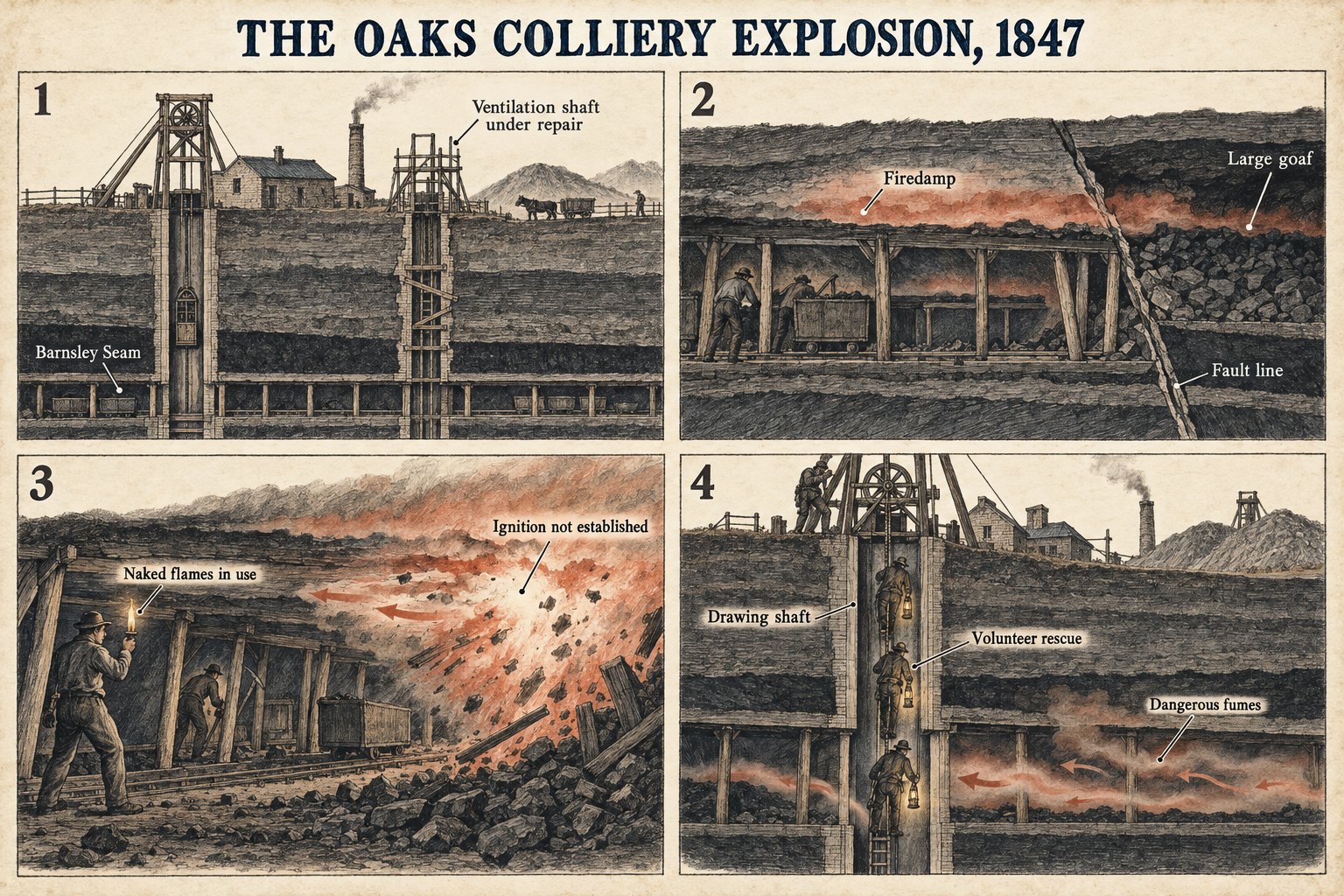
| Fatalities | 73 (73 men and boys were killed; the colliery's ventilation shaft had been undergoing repairs following an earlier fire in December 1845.) |
| Context | During active mining |
Cause
The explosion occurred in a section of the mine known to emit gas; a fireman's inspection at 3am the same day had reported finding none. A coroner's jury returned a verdict of accidental death, attributing the disaster in part to insufficient enforcement of rules against naked flames in gas-prone workings.
Contributing factors
The colliery's ventilation shaft was out of use for repairs at the time, following a fire in December 1845, which is likely to have reduced ventilation in the affected workings.
What happened
The explosion struck the mine, then owned by Firth, Barber and Company and worked for the eight-foot Barnsley Seam, with the blast apparently originating on the north-west rise side of a large goaf (worked-out area) close to a fault line running through the main level.
Rescue & recovery
Volunteers descended the drawing shaft immediately after the explosion; George Armitage and Joseph Lillewood, among others, located and helped extract survivors despite dangerous fumes, with a number of the rescued men suffering burns.
Investigation & inquiry
A coroner's inquest returned a verdict of accidental death. The jury recommended that Parliament establish comprehensive mining safety regulations and asked the coroner to notify the Home Secretary of its concerns.
Changes to practice & legislation
No specific legislative change followed directly from the 1847 inquest's recommendations, though it added to mounting pressure for stronger safety regulation across the coal industry in the following decades.
Memorials & commemoration
A memorial to those killed stands in the graveyard at Ardsley, near Barnsley, alongside memorials to the much larger 1866 disaster at the same colliery.
Recorded claims
Individual factual claims, each attached to the source(s) that support it below. Where sources disagree, both are kept.
- 73 men and boys were killed in the explosion of 5 March 1847.
- A fireman's inspection at 3am the same day reported finding no gas; the coroner's jury returned a verdict of accidental death, citing insufficient enforcement of safety rules.
Related terminology
Mining terms this disaster is structurally linked to, with the nature of the relationship.
- Firedamp (direct cause)
The explosion occurred in a section of the mine known to emit gas, in workings whose ventilation shaft was out of use for repairs at the time. - Fireman (contextual relationship)
Named in this record’s cause: “The explosion occurred in a section of the mine known to emit gas; a fireman's inspection at 3am the same day had reported finding none. A…” - Goaf (contextual relationship)
Named in this record’s narrative: “…blast apparently originating on the north-west rise side of a large goaf (worked-out area) close to a fault line running through the main…” - Level (contextual relationship)
The blast seems to have started on the rise side of a large goaf, close to a fault line running through the main level of the eight-foot Barnsley Seam workings. - Naked Light (contextual relationship)
Named in this record’s cause: “…the disaster in part to insufficient enforcement of rules against naked flames in gas-prone workings.”
Sources
- (secondary) Ardsley Main Colliery Explosion - Barnsley - 1847 — Northern Mine Research Society
- (secondary) Oaks explosion — Wikipedia
Record created: 23 August 2026 · Last researched: 23 August 2026