 MineArchive
Murton Colliery explosion, 1942
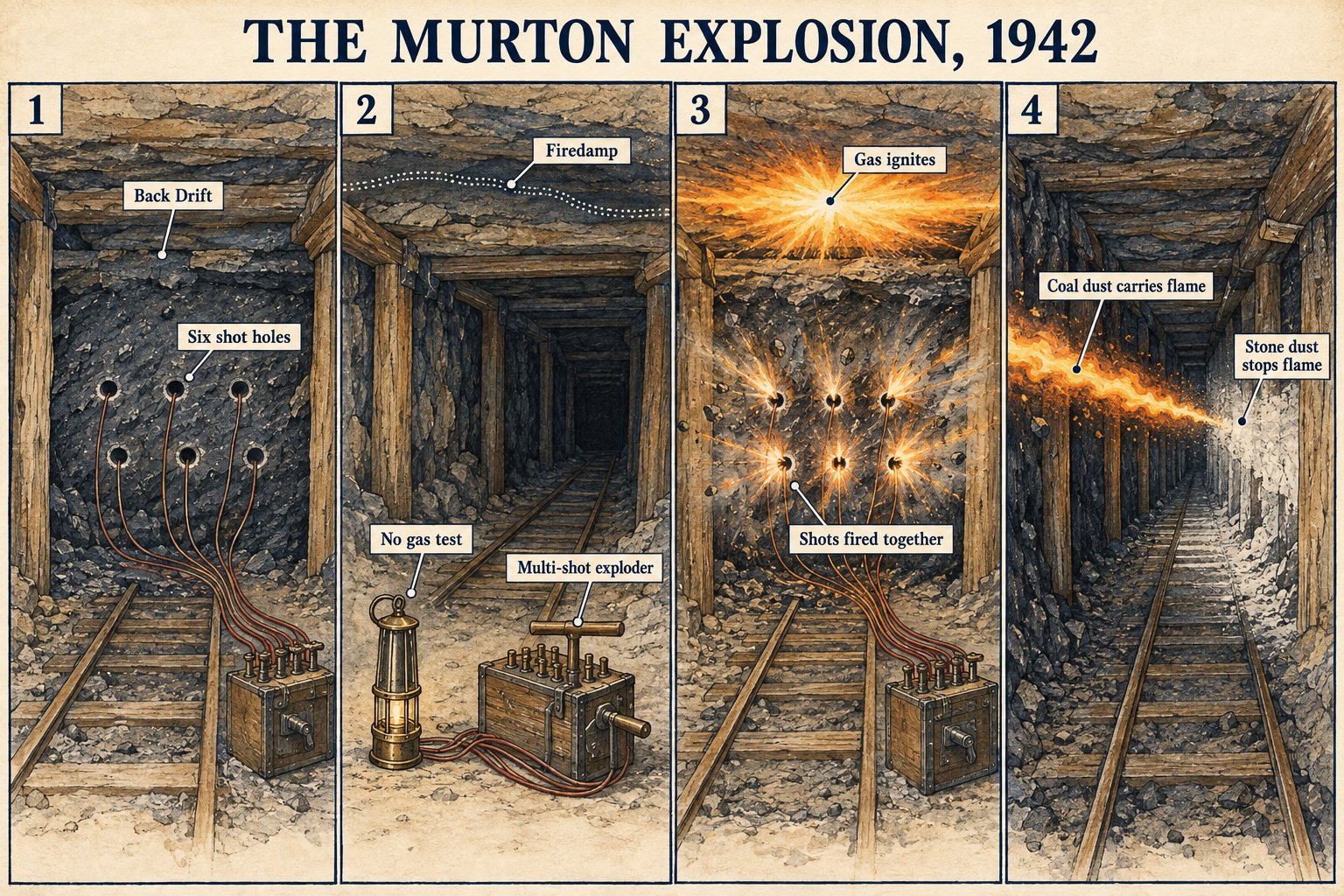
A firedamp explosion at 8pm on 26 June 1942, in the Back-over Flat district of Murton Colliery's Five Quarter seam, killed 13 of the 15 men working there when a deputy fired six shot holes simultaneously without first checking for gas.
| Date | 26 June 1942 |
|---|---|
| Mine | Murton Colliery |
| Region | County Durham |
| Type | Explosion |
| Fatalities | 13 (Confirmed at 13 by the Minister of Fuel and Power's statement to Parliament four days later. The Northern Mine Research Society's detailed account names 15 men: T. Davison, W. Walton, F. Andrews, W. Cook, E.B. Elliott, W. White, G. Jeffries, J. Terry, G. Emery (filler), J. Garrett (filler), A. Lashley (filler), F. Grimes, W. Scott, T. Daglish (brakeman) and I. Worth (deputy) — two more names than the confirmed toll, and the same source separately describes a 'T.R. Daglish' as one of three injured survivors, suffering shock rather than killed. This record states the toll as 13, per the contemporary parliamentary record, without resolving which name(s) in the longer list are the discrepancy, since the source itself does not make this clear.) |
| Injuries | Three men were seriously injured: S. Abbott, a landing lad, suffered extensive burns; the putter G.K. Smith suffered shock after helping Abbott to safety; a third man, recorded as T.R. Daglish, was also treated for shock. |
| Context | During active mining |
Cause
An inquest jury concluded that the men died in an explosion of firedamp, and that the firedamp exploded because the deputy in charge, I. Worth, fired all six shot holes in the Back Drift simultaneously using a multi-shot exploder, without first checking for an accumulation of gas. The initial firedamp explosion went on to ignite coal dust in the workings, a secondary explosion eventually halted by stone dust laid on the inbye roads.
Contributing factors
The affected district, three and a half miles from the shaft, was ventilated by its own heavily regulated split, with the last measured air quantity at the first working place only 5,670 cubic feet per minute. Coal in the Back-over Flat had to be won with explosives, and the practice in the Durham coalfield at the time was for the deputy in charge of each shift to fire all the shots in his district himself, including in the stone drift.
What happened
The explosion struck during the fifth hour of the third shift, with 15 men working inbye. The putter G.K. Smith had just reached the landing and was talking to the landing lad, S. Abbott, when he felt a rush of air and a wave of smoke and dust; despite being in shock himself, Smith carried the badly burned Abbott to safety and raised the alarm, allowing rescue operations to begin quickly. The blast travelled along the return airway, gathering force from coal dust in old, disused workings outbye, strong enough to blow out nine-inch brick stoppings in two old stentons; a cabin door on the main engine plane, 1,100 yards outbye, was blown open by the pressure wave. Most of the dead were killed by carbon monoxide poisoning from the afterdamp; several were found away from their actual workplaces, suggesting they had some warning and tried to escape before being overcome. Four men, including the filler G. Emery, were instead found under roof falls.
Rescue & recovery
Rescue teams from Houghton-le-Spring, Elswick and Crook Central stations attended; the Houghton-le-Spring team reached the colliery just 11 minutes after being called. Ventilation was quickly restored, and ten bodies were recovered by 11pm the same night; the remaining three, trapped under roof falls, were recovered by 4am the following morning.
Investigation & inquiry
An inquest before H.M. Coroner T.V. Deveny, sitting with a jury of seven, occupied two days. The jury found that the men died in a firedamp explosion caused by the deputy's simultaneous firing of six shots without checking for gas.
Memorials & commemoration
G.K. Smith, the putter who rescued the badly burned landing lad S. Abbott despite being in shock himself, was awarded a certificate and £15 by the Trustees of the Carnegie Hero Fund.
Recorded claims
Individual factual claims, each attached to the source(s) that support it below. Where sources disagree, both are kept.
- The Minister of Fuel and Power told the House of Commons on 30 June 1942 that thirteen persons were killed and three others seriously injured in the explosion. 1
- An inquest jury found that the men died in a firedamp explosion, caused when the deputy in charge fired six shot holes simultaneously without first checking for an accumulation of gas. 2
- Rescue teams from three stations attended, the first arriving 11 minutes after being called; ten bodies were recovered the same night, the remaining three by 4am the next morning. 2
- The putter G.K. Smith, who carried the badly burned landing lad S. Abbott to safety while himself in shock, was awarded a certificate and £15 by the Trustees of the Carnegie Hero Fund. 2
Related terminology
Mining terms this disaster is structurally linked to, with the nature of the relationship.
- Deputy (contextual relationship)
Named 4 times in this record, first in the summary: “…Five Quarter seam, killed 13 of the 15 men working there when a deputy fired six shot holes simultaneously without first checking for gas.” - Filler (contextual relationship)
Named in this record’s narrative: “…and tried to escape before being overcome. Four men, including the filler G. Emery, were instead found under roof falls.” - Putter (contextual relationship)
Named twice in this record, first in the narrative: “…the fifth hour of the third shift, with 15 men working inbye. The putter G.K. Smith had just reached the landing and was talking to the…” - Return Airway (contextual relationship)
Named in this record’s narrative: “…rescue operations to begin quickly. The blast travelled along the return airway, gathering force from coal dust in old, disused workings outbye,…” - Stone Drift (contextual relationship)
Named in this record’s contributing factors: “…to fire all the shots in his district himself, including in the stone drift.”
Sources
- (primary) Colliery Explosion, Murton — Hansard, UK Parliament
- (secondary) Murton Colliery Explosion - Murton - 1942 — Northern Mine Research Society
Record created: 27 August 2026 · Last researched: 27 August 2026