 MineArchive
Mauricewood Colliery fire, 1889
An underground fire at Mauricewood Colliery, near Penicuik, on 5 September 1889 killed 63 of the 70 men and boys working the pit that day, one of the worst mining disasters in Scottish history; it took over six months to recover all the bodies.
| Date | 5 September 1889 |
|---|---|
| Mine | Mauricewood Colliery |
| Region | Midlothian |
| Type | Fire |
| Fatalities | 63 (Sixty-three of the seventy men and boys underground died and seven survived. All sixty-three are named: 27 were recovered in September 1889 and 36 in March 1890.) |
| Injuries | 7 men survived from the 70 working underground that day. |
| Context | During active mining |
Location
Plotted at Mauricewood Colliery. Approximate location. The large pin is the mine; the small round markers are the nearest mines on record. Click one for its page. View on full map
Cause
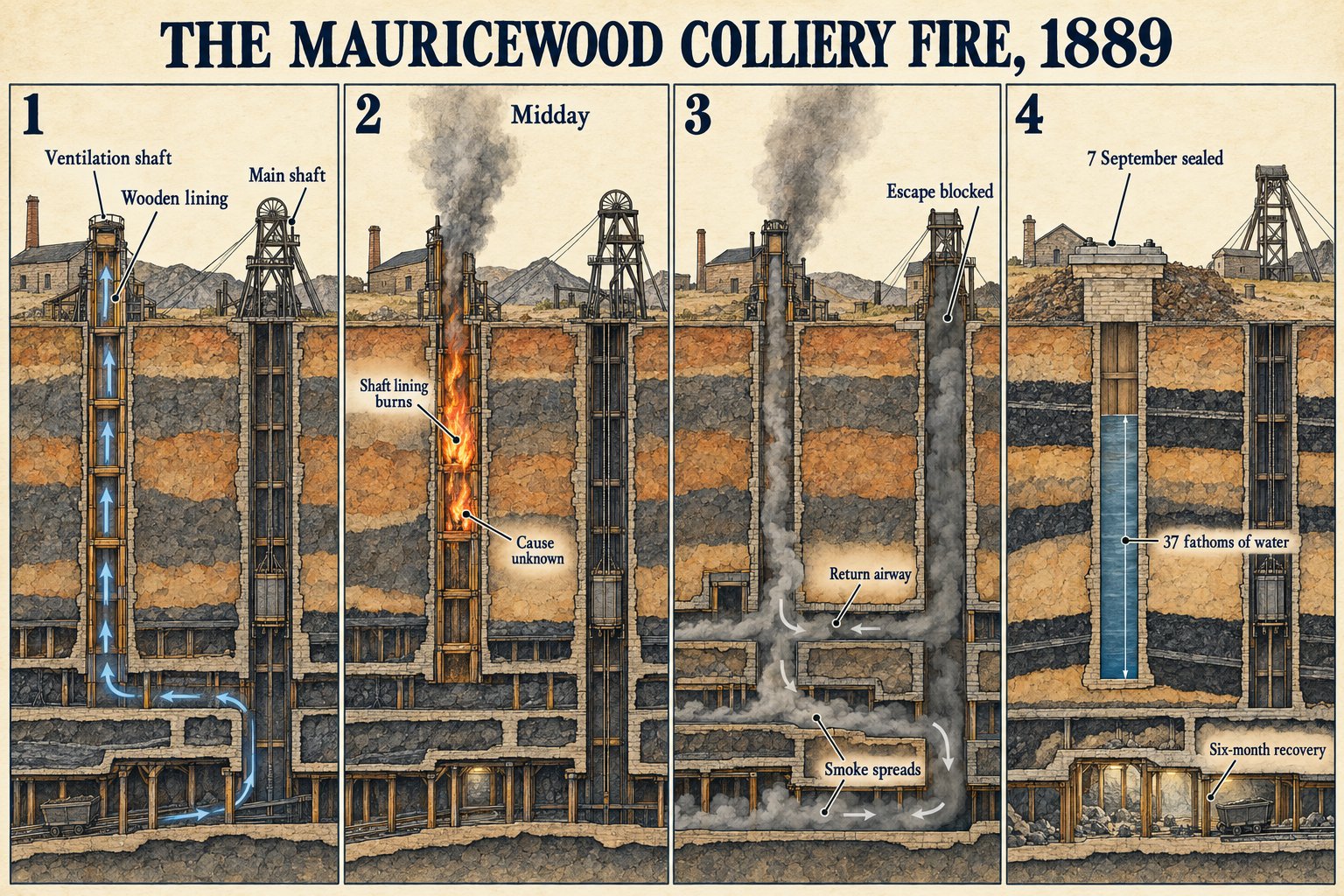
At around noon, sections of the wooden lining of a ventilation shaft caught fire. Smoke got into the return airway and spread into the working sections below, cutting off escape by the main shaft. The cause of the fire itself was never determined.
Contributing factors
An official mine inspector's report concluded that the colliery's management could not reasonably have anticipated the accident, though it also noted that similar 'ventilation paradoxes' had been documented at other collieries before.
What happened
The fire struck at midday and spread so fast that of the 70 men and boys underground, only 7 escaped. Named victims include the overman George Muir, 45; the inspector David Penman, 27; and the engineman Hugh McPherson, 60, among the sixty-three dead, all of whom are named. Initial rescue attempts that day recovered four bodies before impenetrable smoke stopped them.
Rescue & recovery
The mine was sealed on 7 September 1889 to smother the fire, then reopened on 4 October, by which point water had risen 37 fathoms in the workings. Recovery went on into 1890: 27 bodies had been brought out by September 1889, and 36 more were found in the lower levels in operations that ended on 16 March 1890, more than six months after the fire.
Investigation & inquiry
The official mine inspector's report found that the cause of the fire was never determined. It concluded that the disaster was not one the colliery's management could reasonably have anticipated, while noting that similar ventilation issues had been documented elsewhere before.
Memorials & commemoration
A memorial to the dead was erected on the centenary in 1989 and stands just off Mauricewood Road.
Recorded claims
Individual factual claims, each attached to the source(s) that support it below. Where sources disagree, both are kept.
- Of the 70 men and boys working underground that day, 63 died and 7 survived. 1,2
- The fire began in the wooden lining of a ventilation shaft and spread to the workings below; its cause was never determined. 1,2
- The mine was sealed on 7 September 1889 and reopened on 4 October; recovery of all the bodies was not completed until 16 March 1890. 1,2
- All sixty-three dead are named, 27 recovered in September 1889 and 36 in March 1890. 3
Related terminology
Mining terms this disaster is structurally linked to, with the nature of the relationship.
- Engineman (contextual relationship)
Named in this record’s narrative: “…the overman George Muir, 45; the inspector David Penman, 27; and the engineman Hugh McPherson, 60, among 62 named in total. Initial rescue attempts…” - Fathom (contextual relationship)
Named in this record’s rescue and recovery: “…fire, then reopened on 4 October, by which point water had risen 37 fathoms in the workings. Recovery operations continued into 1890: 26 bodies…” - Level (contextual relationship)
Named in this record’s rescue and recovery: “…by September 1889, and the remaining 36 were found in the lower levels during operations that concluded on 16 March 1890, over six months…” - Overman (contextual relationship)
Named in this record’s narrative: “…men and boys underground, only 7 escaped. Named victims include the overman George Muir, 45; the inspector David Penman, 27; and the engineman…” - Return Airway (contextual relationship)
Named in this record’s cause: “…lining of a ventilation shaft caught fire; smoke penetrated the return airway and spread into the working sections below, making escape via the…”
Sources
- (secondary) Mauricewood Colliery disaster — Wikipedia
- (secondary) Mauricewood Colliery Fire - Glencourse - 1889 — Northern Mine Research Society
- (primary) Colliery disaster 1889: Mauricewood, names of the dead (Durham Mining Museum) — Durham Mining Museum
Record created: 27 August 2026 · Last researched: 27 August 2026