 MineArchive
Loscoe Colliery shaft accident, 1849
On 23 May 1849 the winding rope at Loscoe Colliery in Derbyshire broke at a splice made that same morning, and a man and two boys being drawn up the shaft fell to the bottom. The manager and the engineer were tried for manslaughter at Derby Assizes and acquitted.
| Date | 23 May 1849 |
|---|---|
| Mine | Loscoe Colliery |
| Region | Derbyshire |
| Type | Winding / Shaft Accident |
| Fatalities | 3 (Three killed: John Daykin, 34, Richard Milward, given as 14 and as 16, and George Walker, 10. The assize report calls the second Thomas Millward.) |
| Context | During active mining |
Location
Plotted at Loscoe Colliery. Recorded location. The large pin is the mine; the small round markers are the nearest mines on record. Click one for its page. View on full map
Cause
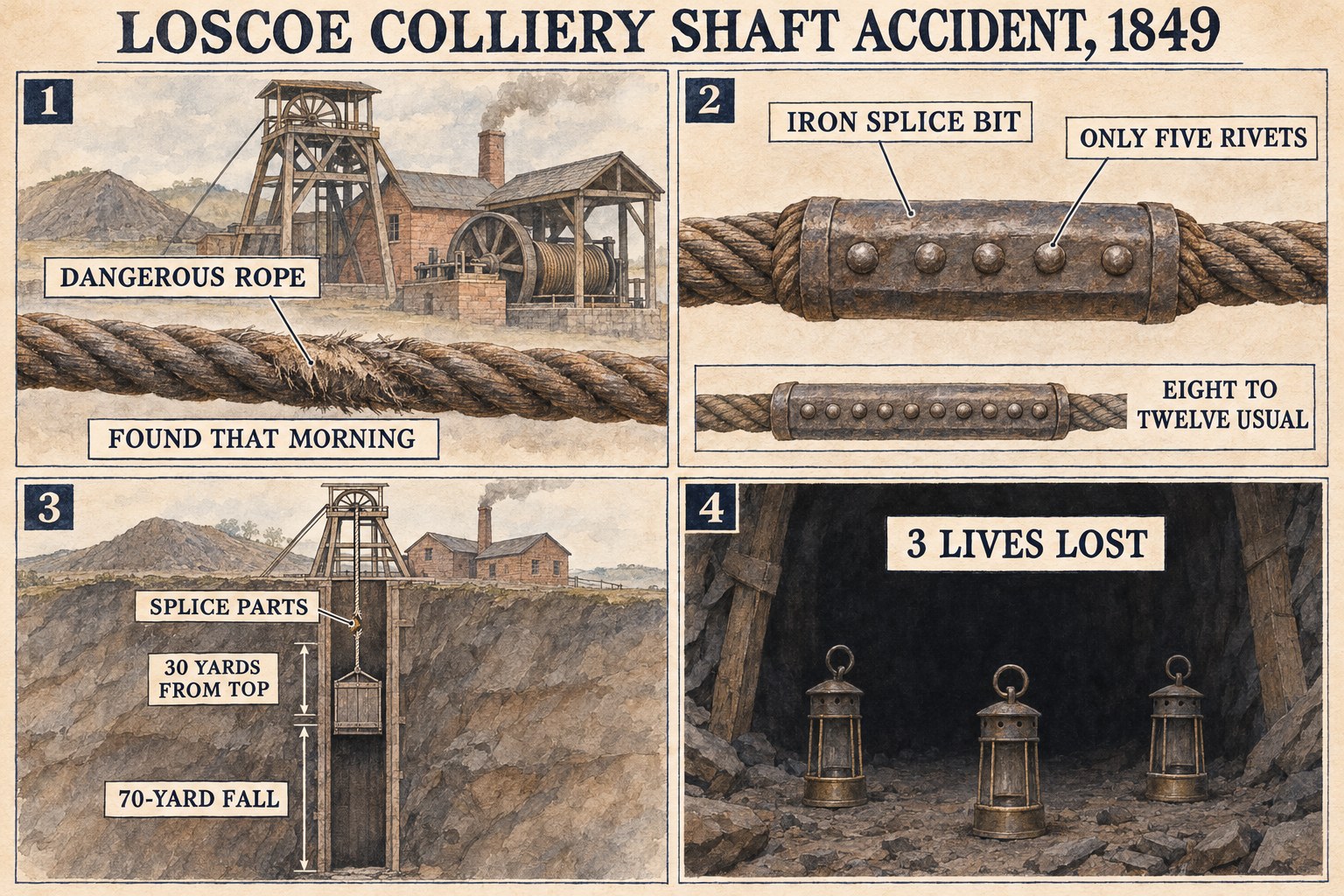
The rope parted at a splice. It had been found dangerous in one place that morning and was spliced with only five rivets through the iron splice bit, where eight to twelve were usual.
Contributing factors
The manager, the engineer and the owner had been repeatedly cautioned about the state of the rope, and the men had voiced their own concerns. The rope had been carried on splices for eight years.
What happened
On the morning of 23 May Abel Toplis, the manager or ground bailiff, examined the rope and found it dangerous in one place. He ordered the engineer, Thomas Gascoigne, to splice it and went away without looking at it again. Gascoigne made the splice.
About twelve o'clock John Daykin and two boys, Richard Milward and George Walker, were being drawn up the shaft. They were some thirty yards from the top when the rope broke at the splice, and they fell seventy yards.
Investigation & inquiry
At Derby Assizes in late July 1849 Toplis and Gascoigne were indicted for manslaughter by negligently using a rope of insufficient strength. Counsel for the Crown told the jury that Toplis's conduct was very reprehensible and the negligence culpable, but that a charge of criminal negligence could not be sustained, and offered no evidence. Mr Justice Coleridge agreed that a guilty verdict would have strained the criminal law, and the jury returned not guilty on all four indictments.
Changes to practice & legislation
The defence promised in court that more rivets would be used in future and more care taken. Orders were given to the butties not to make the lads ride out of the pit with the coal.
What's uncertain
Points where sources disagree or the record could not be settled; both accounts are kept. All open questions in the archive.
Recorded claims
Individual factual claims, each attached to the source(s) that support it below. Where sources disagree, both are kept.
- On 23 May 1849 John Daykin, Richard Milward and George Walker were killed in a shaft accident at Loscoe Colliery. 1,2,3
- They fell 70 yards down the shaft from about 30 yards from the top when the rope suddenly broke. 3
- The rope broke at a splice made that morning with only five rivets, where eight to twelve were usual. 4
- The manager Abel Toplis and the engineer Thomas Gascoigne were indicted for manslaughter at Derby Assizes and found not guilty. 4
- Daykin was 34, Milward 14 and Walker 10. (disputed) 3
- Richard Milward was 16. (disputed) 1,2
Related terminology
Mining terms this disaster is structurally linked to, with the nature of the relationship.
- Buttyman (contextual relationship)
Named in this record’s changes to practice: “…be used in future and more care taken. Orders were given to the butties not to make the lads ride out of the pit with the coal.” - Coal (contextual relationship)
Named in this record’s changes to practice: “…to the butties not to make the lads ride out of the pit with the coal.” - Colliery (contextual relationship)
Named in this record’s summary: “On 23 May 1849 the winding rope at Loscoe Colliery in Derbyshire broke at a splice made that same morning, and a man…” - Shaft (contextual relationship)
Named twice in this record, first in the summary: “…made that same morning, and a man and two boys being drawn up the shaft fell to the bottom. The manager and the engineer were tried for…” - Winding Rope (contextual relationship)
Named in this record’s summary: “On 23 May 1849 the winding rope at Loscoe Colliery in Derbyshire broke at a splice made that same…”
Further reading
This page doesn't try to reproduce everything — these are the best original sources found for this disaster.
A report of the manslaughter trial at Derby Assizes, among the paper's general news.
View sourceThe year's entry in Bob Bradley's history of the Midlands coalfield, with the ages of the three and the state of the rope.
View sourceSources
- (primary) Loscoe Colliery — Durham Mining Museum
- (primary) Loscoe Colliery, 23rd May 1849: shaft accident — Durham Mining Museum
- (secondary) A History of Mining in Nottinghamshire, Derbyshire and Leicestershire: 1849, by Bob Bradley — Healey Hero
- (secondary) Charge of Manslaughter against a Colliery Manager and Engineer (Cardiff and Merthyr Guardian, 4 August 1849) — Welsh Newspapers Online, National Library of Wales
Record created: 17 October 2026 · Last researched: 18 November 2026