 MineArchive
Holditch Colliery disaster, 1937
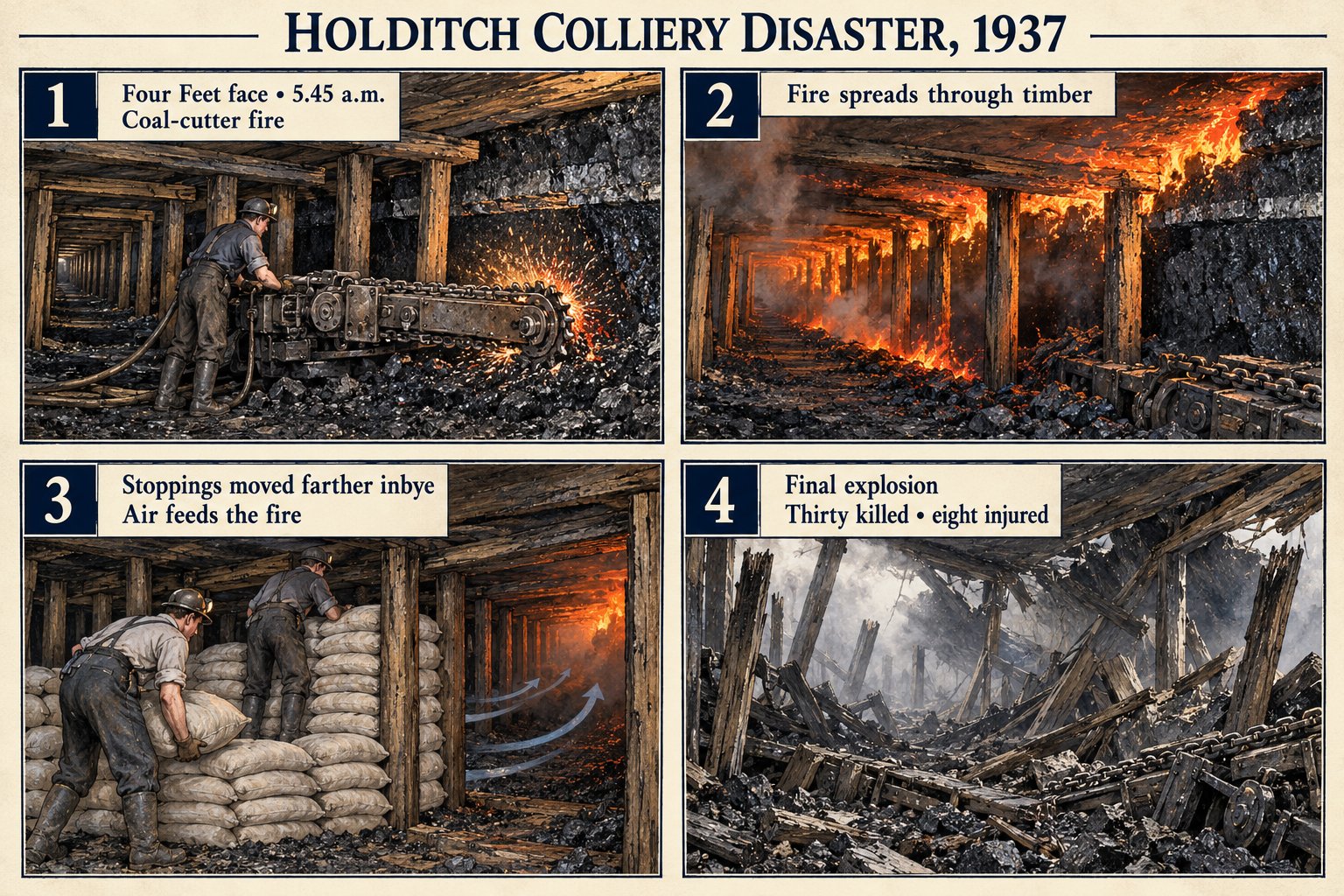
A fire that began at a coal-cutting machine on the Four Feet face at Holditch Colliery, Chesterton, at about a quarter to six on the morning of 2 July 1937, and the eight explosions that followed it. Thirty men died and eight were injured. Almost all of them were killed by the last explosion, more than four hours after the fire started, while building stoppings in a position chosen against the manager’s advice in order to save the coal seam. The dead included two of His Majesty’s Inspectors of Mines, the colliery’s joint managing director, the under-manager and four members of the Hanley Rescue Brigade.
| Date | 2 July 1937 |
|---|---|
| Mine | Holditch Colliery |
| Region | Staffordshire |
| Primary type | Explosion |
| Associated types | Fire, Gas / Asphyxiation, Rescue |
| Fatalities | 30 (Eight more were injured. Ten of the seriously injured were brought out after the final explosion; eight of them subsequently died, which is how a toll first reported as smaller reached thirty.) |
| Injuries | 8 |
| Context | During active mining (A normal night shift on the Four Feet face, about three-quarters of a mile from the pit bottom and 1,390 yards along a single straight road.) |
Cause
Fire at a coal-cutting machine, attributed to frictional heat from the picks in the cut, followed by a series of firedamp explosions.
Contributing factors
The location of the sealing stoppings was changed, on the instruction of the joint managing director and against the judgement of the manager and his team, from two dams in solid ground within 500 yards of the pit bottom to three dams in unsettled ground 1,300 yards away. The new arrangement also fed air to the fire. The stated reason for the change was to save the coal seam. The inspector who investigated found this change to be the direct cause of the large death toll.
What happened
At about 5.45 on the morning of Friday 2 July 1937, two coal-cutter men, Herman Payne and William Beardmore, were cutting along the Four Feet face when Beardmore, shovelling away the cuttings, saw a flame that seemed to run round with the picks for a moment and then extend under the cut coal. It flashed back along the holing seven or eight yards to where the cutting had begun, came out of the cut and spread up the coalface towards the roof. Beardmore described it as a wall of fire. Both men got away and survived. Fifty-five people were at or near the face. All withdrew except two packers, W. Haystead — the contemporary narrative spells it Hystead — and Arthur Stanton, who were building a pack in the middle waste; by the time they understood the danger the smoke was too thick to find either the back dip or the left-hand gate, and they were overcome. By about a quarter past six the rest had gathered at the bottom crosscut and set about fighting the fire, carrying bags of stone dust down the main dip. The overman and two deputies went forward and found the fire well established: the face timber was ablaze and crackling, and with the supports burning the roof near the face of the main dip was threatening to come in. Nobody could get close, so the stone dust was simply dumped and spread as near the fire as could be managed. When that proved futile the men withdrew again and took a roll call, and it was only then, about 6.35, that Haystead and Stanton were found to be missing. A search up the left-hand gate and the back dip met smoke and fumes too dense to pass. Day-shift officials had by now been told of the fire and were arriving. One of them, Harry Bentley, believing searchers had gone up the right-hand gate, asked a night-shift ripper, John Hassell, to take him there. At about ten to seven an explosion caught them both on its fringe. Bentley was burnt and his hair singed; he got out to the main gate dip and learned that Hassell had not. Burnt as he was, he went back with a collier named E. Beech to look for him, and did not find him. Three further small explosions followed around seven o’clock. By then nobody was left in the Four Feet workings but the three missing men. At about ten past seven the withdrawing night shift met the manager, John Owen Davies, and the under-manager coming down. The night shift went home; the day shift set to work building stoppings to seal the district. It was here that the fatal decision was taken. The manager’s plan was two dams in solid ground, less than 500 yards from the pit bottom, where materials could be got to easily. The joint managing director, John Cocks, overruled it and ordered three dams built in unsettled ground 1,300 yards away — a plan that also let air to the fire — in order to save the coal seam. Two of His Majesty’s Inspectors of Mines, Harold Finney and James Bloor, reached the pit about nine and went inbye after speaking to the manager at the pit bottom. A sixth explosion at about ten past nine did not stop the work. Shortly before ten past ten a seventh, small explosion was followed by an eighth. It threw men working a thousand yards away to the ground and reversed the ventilation. About forty people were in the district: officials, rescue teams, inspectors, and the men building the stoppings. Twenty-nine of them were killed or seriously injured; a few, notably a rescue team that happened to be in the return airway, came out unhurt. Thirty men died in all. Among them were Finney and Bloor, the two inspectors; Cocks, who had ordered the change of plan; H. L. Adkins, the under-manager; and four men of the Hanley Rescue Brigade — J. W. Forrester, Thomas Harris, W. Hough and Samuel Latham. The youngest was Frank Turner, an underground electrician of 22.
Rescue & recovery
The first rescue team was at work by about eight in the morning, searching for the missing men and preparing to seal the fire. After the final explosion further teams went down and brought out ten of the seriously injured, and located the bodies of the dead. More attempts to recover bodies were made through the afternoon, and exploration continued until about eight in the evening, when a conference of all the parties concerned concluded that nobody in the district could still be alive; that attempting to recover the bodies at that stage would expose the rescuers to serious and unwarranted danger; and that letting water into the workings would put the fire out without affecting access to the bodies lying in the main crut and the cross-crut. Flooding was put in hand that night.
Investigation & inquiry
The inquiry was conducted by F. H. Wynne. He found the fire had originated in the coal-cutting machine, from frictional heat produced by the picks in the cut, and that the explosions were of firedamp. His central finding was about the change of plan: "This change in the original plan of the manager was a vital matter, resulting, as it did, in the large death toll." He went further — that at the time the second plan was adopted, very dangerous conditions existed and were known to exist, which made attempting it a matter of imminent peril to the lives of what he called an unnecessarily large number of men.
Legal & regulatory aftermath
The disaster was raised in the House of Commons three days later, on 5 July 1937, by Colonel Josiah Wedgwood, the Member for Newcastle-under-Lyme, by private notice. The Secretary for Mines, Captain Crookshank, gave the House the sequence of events and the toll.
Memorials & commemoration
A memorial to the thirty men stands at the Apedale Heritage Centre, in Apedale Community Country Park near Chesterton, where the colliery’s own gates have also been re-erected. On 19 October 1937 the Scottish League champions, Rangers, travelled to the Victoria Ground to play Stoke City in a benefit match for the victims, raising £2,000 for the relief fund. Speaking in the Commons, Josiah Wedgwood said of the rescue men that they went down the pit to save their fellows, and that Staffordshire would never forget them.
Recorded claims
Individual factual claims, each attached to the source(s) that support it below. Where sources disagree, both are kept.
- Thirty men lost their lives and two were lying injured in hospital as a result of a fire and subsequent explosions on the morning of Friday 2 July 1937 at the Holditch or Brymbo Colliery, Staffordshire. 1
- At about 6 a.m. men were engaged on coal-cutting operations mid-way along a longwall face in the Four Foot seam, about three-quarters of a mile from the pit bottom, when a fire broke out where the coal-cutter was working. The original fire was concluded to have originated in the coal cutting machine and to have been due to frictional heat produced by the picks in the cut; the explosions were caused by firedamp. 2
- By ten o’clock there were about forty men in the district — officials, rescue teams, inspectors, and men who had gone to build the stoppings — and at that moment a far more serious explosion occurred, and twenty-nine of the men who had gone in were killed or seriously injured. A few, notably the members of a rescue team who were in the return airway, escaped unhurt. 1
- The inspector, F. H. Wynne, concluded: "This change in the original plan of the manager was a vital matter, resulting, as it did, in the large death toll." The reason given for the change of plan was to save the coal seam. 2
- At a conference held about 8 p.m. it was decided that there could not be any persons still alive in the district; that to attempt at that stage to recover the bodies would expose the rescuers to serious and unwarranted danger; and that allowing water to flow into the workings would extinguish the fire without affecting access to bodies lying in the main crut and the cross-crut. Flooding was accordingly put in hand. 1
- The dead included Harold John Finney, 41, H.M. Senior Inspector of Mines, and James Alfred Bloor, 51, H.M. Sub-Inspector of Mines; John Cocks, 57, managing director; H. L. Adkins, 35, under-manager; and four members of the Hanley Rescue Brigade — J. W. Forrester, 40, Thomas Ernest Harris, 46, W. Hough, 37, and Samuel Henry Latham, 28. 2
- Beardmore, who was shovelling away the coal cuttings, saw a flame which seemed to run round with the picks for a moment then extended under the cut coal; it flashed back along the holing seven or eight yards, then came out of the cut and spread up the coalface towards the roof. He described it as being like a wall of fire. 3
- Of the fifty-five people at or near the coalface, all withdrew except two men building a pack in the middle waste; by the time they realised their danger the smoke was so dense that they lost their way and were overcome. Their absence was not discovered until a roll call at about 6.35 a.m. 3
- On 19 October 1937 the Scottish Football League champions, Rangers, travelled to the Victoria Ground to play Stoke City in a benefit match for the victims of the disaster, raising £2,000 for the relief fund. 2
Related terminology
Mining terms this disaster is structurally linked to, with the nature of the relationship.
- Crosscut (contextual relationship)
Named in this record’s narrative: “…By about a quarter past six the rest had gathered at the bottom crosscut and set about fighting the fire, carrying bags of stone dust down…” - Gate Road (contextual relationship)
Named in this record’s narrative: “…its fringe. Bentley was burnt and his hair singed; he got out to the main gate dip and learned that Hassell had not. Burnt as he was, he went back…” - Rescue Brigade (contextual relationship)
Named 5 times in this record, first in the summary: “…managing director, the under-manager and four members of the Hanley Rescue Brigade.” - Stopping (contextual relationship)
Named 4 times in this record, first in the summary: “…more than four hours after the fire started, while building stoppings in a position chosen against the manager’s advice in order to save…” - Undermanager (contextual relationship)
Named 3 times in this record, first in the summary: “…Inspectors of Mines, the colliery’s joint managing director, the under-manager and four members of the Hanley Rescue Brigade.”
Photographs & further reading
This page doesn't try to reproduce everything — these are the best original sources found for this disaster.
The Secretary for Mines’s statement to the Commons three days after the disaster: the sequence from the fire to the final explosion, the toll, the rescue, and the decision to flood the workings.
View sourceA minute-by-minute account of the morning, from the flame running round the picks to the withdrawal of the night shift, with the layout of the workings that explains why the men were where they were.
View sourceSources
- (primary) Holditch Colliery Disaster — HC Deb 5 July 1937 vol 326 cc33-6 — Hansard, House of Commons
- (secondary) Holditch Colliery disaster — Wikipedia
- (secondary) Holditch Colliery Explosion 1937 — John Lumsdon, healeyhero.co.uk
- (secondary) Holditch Colliery — Staffordshire Past Track
Record created: 7 September 2026 · Last researched: 7 September 2026