 MineArchive
High Park Colliery explosion, 1864
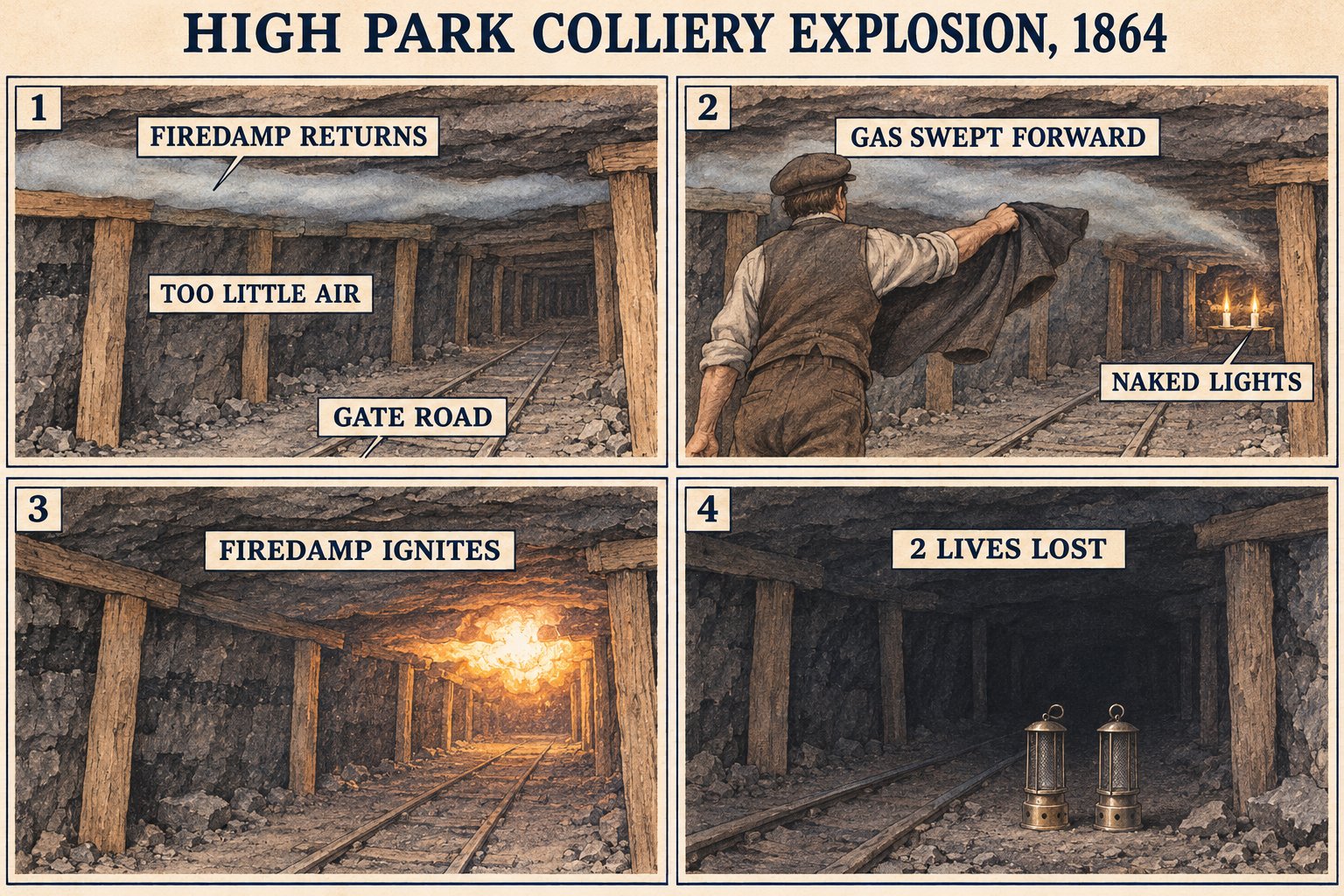
On the morning of 18 November 1864 the day deputy at High Park Colliery, Nottinghamshire, tried to clear gas from a gate road by sweeping it with his coat, and drove it onto the naked lights of men working beyond. The explosion killed two young colliers.
| Date | 18 November 1864 |
|---|---|
| Mine | High Park Colliery |
| Region | Nottinghamshire |
| Type | Explosion |
| Fatalities | 2 (Abraham Brown, 18, and Thomas Davis, 15, colliers.) |
| Context | During active mining |
Location
Plotted at High Park Colliery. Recorded location. The large pin is the mine; the small round markers are the nearest mines on record. Click one for its page. View on full map
Cause
Firedamp lying in a gate road was brushed by the day deputy onto the candles of the men at work, and fired.
Contributing factors
Too little air passed up the gate road. The night deputy left the gas in place and sent men through it in the dark rather than stopping work and telling the viewer.
What happened
During the night the deputy found gas near the roof of a gate road leading to the working places. He cleared it with a brattice, but it came back as soon as the brattice was taken away. He hung a safety lamp some way down the road as a warning and told the men to put out their candles, pass in under the gas in the dark and relight them in their working places, which they did. When the day deputy arrived at seven and heard of the gas, he went to the place, took off his coat and swept the gas towards the naked lights. It exploded at once.
Investigation & inquiry
Thomas Evans, HM Inspector of Mines, reported that the under-viewer should have had more air passing up the road, the night deputy should have removed the gas or stopped the men going in, and the day deputy should never have brushed out gas with men at work.
Legal & regulatory aftermath
At the inspector's request the manager prosecuted the under-viewer and the two deputies for breaking the special rules, and the magistrates fined each of them.
Recorded claims
Individual factual claims, each attached to the source(s) that support it below. Where sources disagree, both are kept.
- On 18 November 1864 an explosion of gas at Barber, Walker and Co.'s High Park Colliery killed the colliers Abraham Brown, 18, and Thomas Davis, 15. 1,2
- The night deputy, finding gas in a gate road, told the men to put out their naked lights, pass under the gas in the dark and relight in their places. 2
- The day deputy swept the gas with his coat onto the men's naked lights, causing the explosion. 2
- The under-viewer and both deputies were prosecuted for breaking the special rules and each was fined by the magistrates. 2
Related terminology
Mining terms this disaster is structurally linked to, with the nature of the relationship.
- Brattice (contextual relationship)
Named twice in this record, first in the narrative: “…of a gate road leading to the working places. He cleared it with a brattice, but it came back as soon as the brattice was taken away. He hung a…” - Deputy (contextual relationship)
Named 8 times in this record, first in the summary: “On the morning of 18 November 1864 the day deputy at High Park Colliery, Nottinghamshire, tried to clear gas from a…” - Gate Road (contextual relationship)
Named 4 times in this record, first in the summary: “…at High Park Colliery, Nottinghamshire, tried to clear gas from a gate road by sweeping it with his coat, and drove it onto the naked lights of…” - Naked Light (contextual relationship)
Named twice in this record, first in the summary: “…from a gate road by sweeping it with his coat, and drove it onto the naked lights of men working beyond. The explosion killed two young colliers.” - Viewer (contextual relationship)
Named 3 times in this record, first in the contributing factors: “…men through it in the dark rather than stopping work and telling the viewer.”
Sources
- (primary) High Park Colliery (Durham Mining Museum) — Durham Mining Museum
- (primary) High Park, 18 November 1864: explosion of gas (Mines Inspectors Report 1864) (Durham Mining Museum) — Durham Mining Museum
Record created: 4 November 2026 · Last researched: 6 November 2026