 MineArchive
Hebburn Colliery Explosion, 1852
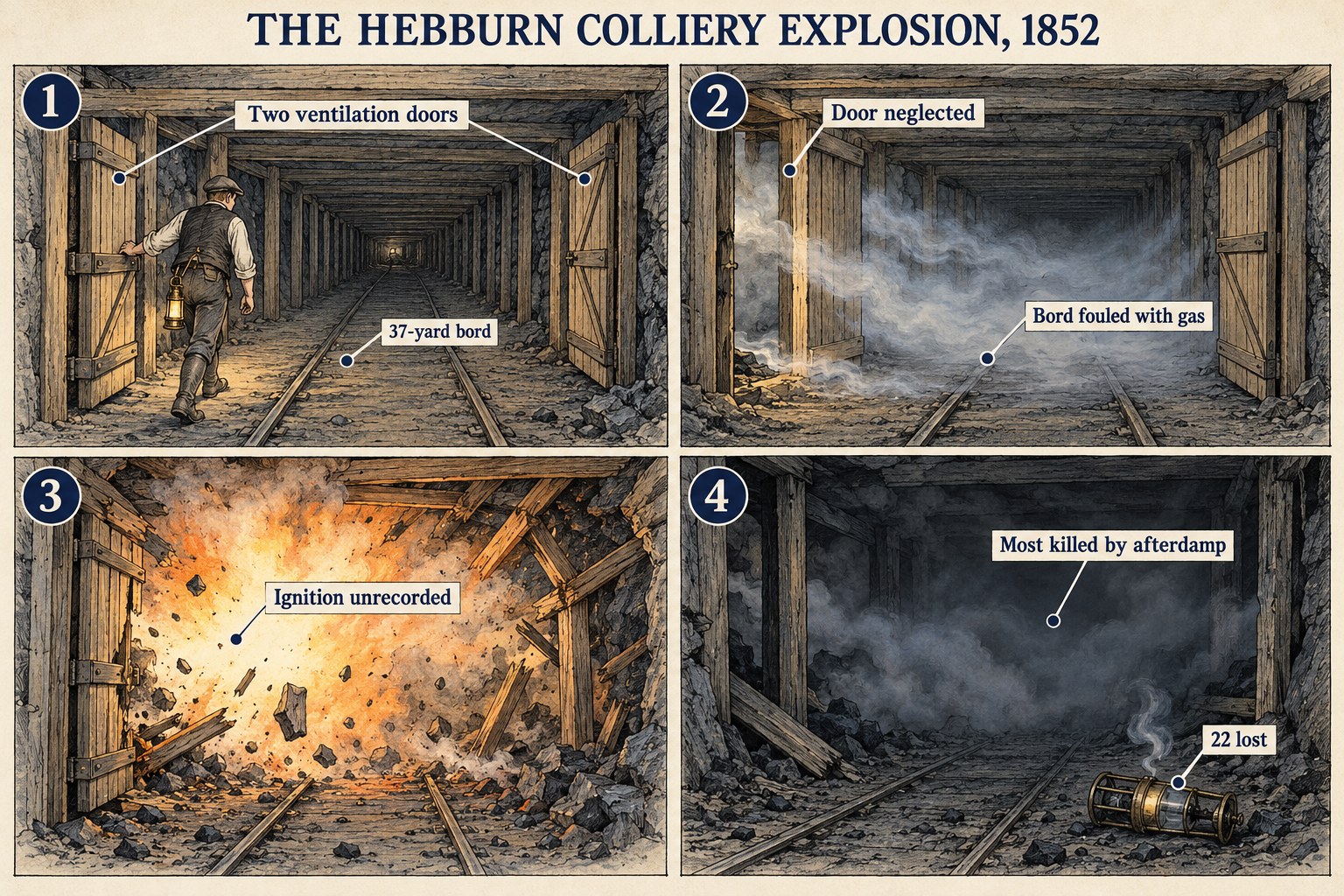
A firedamp explosion at Hebburn Colliery on 6 May 1852 killed 22 men and boys after a single 37-yard bord became fouled with gas when a ventilation door was left neglected.
| Date | 6 May 1852 |
|---|---|
| Mine | Hebburn Colliery |
| Region | Tyne and Wear |
| Type | Explosion |
| Fatalities | 22 (22 dead. Named: John Barnfather (19), Edward Johnson (18), Samuel Wardle (18), Michael Wardle (10), James English (12), John Gascoigne (34), George Pattison (29), John Pitchford (24), James Coal (39), James Orr (33), William Deans (37), John Greenwell (30), William Scott (27), George Hall (27), John Smith (33), William Wear (32), Thomas Richardson (26), Silas Philipson — deputy (23), James Parson (22), John Peel (66), and Allan Brooksbank (26).) |
| Context | During active mining |
Cause
A single bord, 37 yards long, became fouled with gas after a ventilation door was neglected; most deaths resulted from afterdamp rather than the initial blast.
What happened
On 6 May 1852, an explosion at Hebburn Colliery killed 22 men and boys. A single working place, a bord some 37 yards long, had become fouled with gas after a ventilation door — the responsibility of a boy managing two such doors — was left neglected. The colliery's ventilation was otherwise considered adequate for its day: two shafts, each 12 feet in diameter, supplied around 70,000 cubic feet of air per minute through bratticed roadways and controlled doors. The investigation concluded that human negligence in maintaining door discipline, rather than any general deficiency in the ventilation system, had directly caused the disaster. Most of the 22 dead, including deputy Silas Philipson, died from afterdamp rather than the initial explosion itself.
Investigation & inquiry
The investigation concluded that the disaster was caused by human negligence — a ventilation door left open — rather than any deficiency in the colliery's ventilation system as a whole.
Memorials & commemoration
No dedicated memorial to this specific explosion is known.
Recorded claims
Individual factual claims, each attached to the source(s) that support it below. Where sources disagree, both are kept.
- 22 men and boys were killed, named individually in NMRS's account, most dying from afterdamp rather than the initial blast. 1
- A single 37-yard bord became fouled with gas after a ventilation door was neglected; the investigation attributed the disaster to human negligence rather than a ventilation system fault. 1
- Durham Mining Museum's own colliery page independently lists this explosion on 6 May 1852 as caused by a naked light, with 22 lives lost, matching NMRS's account. 2
Related terminology
Mining terms this disaster is structurally linked to, with the nature of the relationship.
- Afterdamp (contextual relationship)
Named twice in this record, first in the cause: “…after a ventilation door was neglected; most deaths resulted from afterdamp rather than the initial blast.” - Colliery (contextual relationship)
Named 4 times in this record, first in the summary: “A firedamp explosion at Hebburn Colliery on 6 May 1852 killed 22 men and boys after a single 37-yard bord…” - Deputy (contextual relationship)
Named in this record’s narrative: “…had directly caused the disaster. Most of the 22 dead, including deputy Silas Philipson, died from afterdamp rather than the initial…” - Firedamp (direct cause)
The explosion was caused by an ignition of firedamp underground. - Shaft (contextual relationship)
Named in this record’s narrative: “…ventilation was otherwise considered adequate for its day: two shafts, each 12 feet in diameter, supplied around 70,000 cubic feet of air…”
Sources
- (primary) Hebburn Colliery Explosion — Hebburn — 1852 — Northern Mine Research Society
- (primary) Durham Mining Museum — Hebburn Colliery — Durham Mining Museum
Record created: 3 September 2026 · Last researched: 3 September 2026