 MineArchive
Haig Colliery explosion, 1928
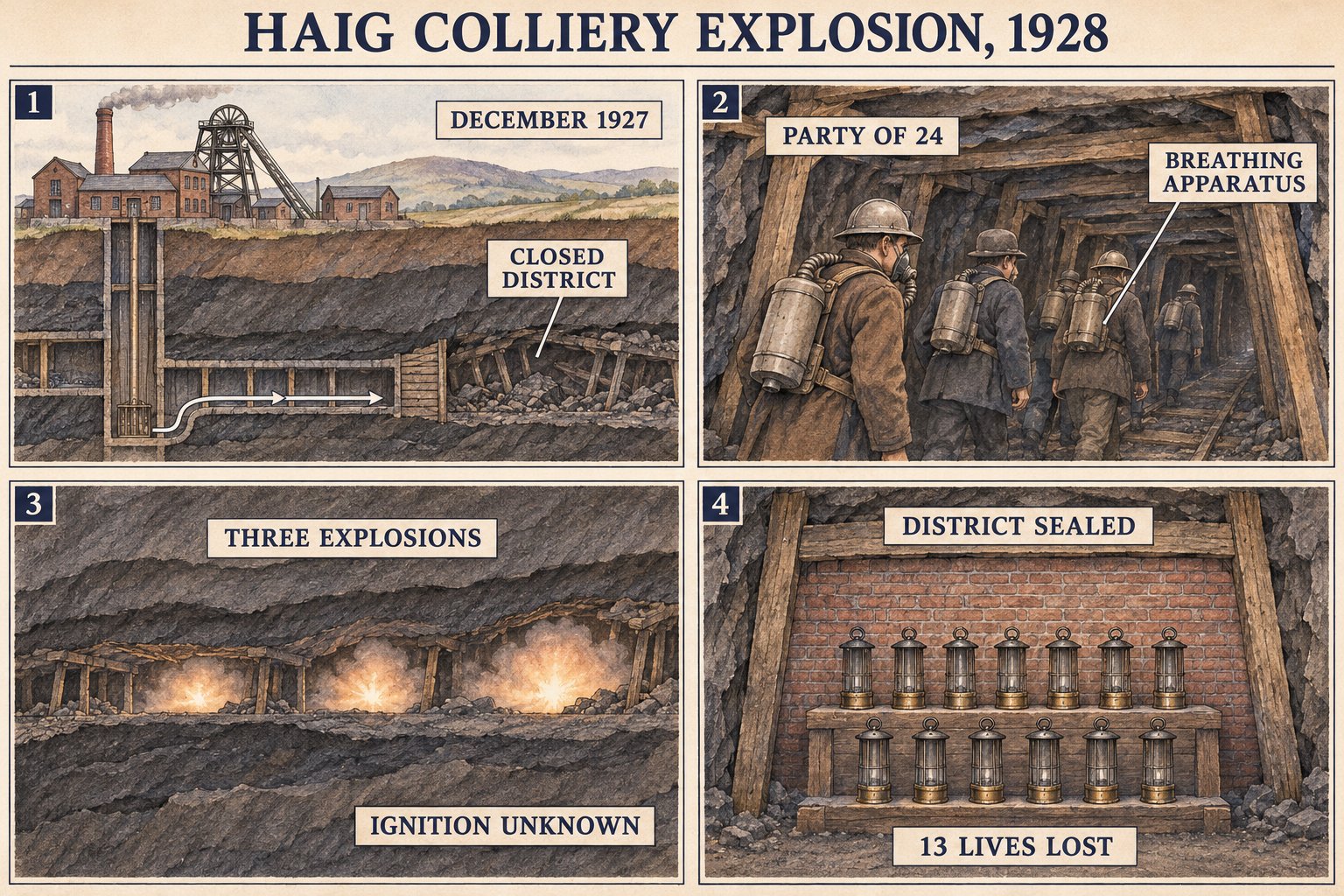
On 12 February 1928 a party of 24 colliery officials, inspectors and union men went into Haig Pit, Whitehaven, closed since an explosion in December, to assess the workings and recover a body still lying there. Three explosions caught them late at night; eleven got out, and thirteen, two of HM inspectors of mines among them, were sealed in the district where they died.
| Date | 12 February 1928 |
|---|---|
| Mine | Haig Colliery |
| Region | Cumbria |
| Primary type | Explosion |
| Associated types | Rescue |
| Fatalities | 13 (Peter Burdess, 35, HM Sub-Inspector of Mines; William Loudon, 48, HM Junior Inspector of Mines; Robert Steel, 58, agent and works manager; Robert Fell, 48, under-manager; Henry C. Hanlon, 30, agent of the Cumberland Miners' Association; John Tyson, 47, secretary of the Cumberland Colliery Officials' Association; John T. Walker, 38, overman; and the deputies Jesse Cresswell, 29, William Graham, 41, George Hodgson, 56, Hugh McKenzie, 49, James Rothery, 41, and Frank Wilkinson, 32.) |
| Context | During active mining |
Location
Plotted at Haig Colliery. Recorded location. The large pin is the mine; the small round markers are the nearest mines on record. Click one for its page. View on full map
Cause
Firedamp exploded in the district closed after the explosion of 13 December 1927; because the area was sealed, the point of ignition was never established.
Contributing factors
The Whitehaven collieries, and Haig in particular, were prone to firedamp. The party was working in a district already damaged by the December explosion, and there was evidence of fire there afterwards.
What happened
An explosion on 13 December 1927 killed four men and stopped Haig Pit. The 800 men of the connected Wellington Pit went back on 3 January, but Haig's 1,100 could not return, and the body of the timberman Harold Horrocks still lay underground. In February a party of 24 went in to check the state of the workings and to recover him, making trips back to the surface through the day and night for food and to refill their breathing apparatus.
Some time after 11 pm three explosions shook the district, each more violent than the last. Eleven of the party found their way some three miles in the dark to the shaft bottoms. The thirteen who died included the colliery's agent and works manager, Robert Steel, and its under-manager, Robert Fell; the two government inspectors Peter Burdess and William Loudon; and Henry Hanlon and John Tyson, officials of the miners' and the colliery officials' associations.
Rescue & recovery
A second party went down. The canaries it carried soon died, and where the last explosion had happened the roof had fallen completely. As there was evidence of another fire, the area was sealed off, leaving the thirteen men and Horrocks's body inside.
Investigation & inquiry
With the district sealed, neither the cause of the explosions nor their point of ignition could be established with certainty.
Legal & regulatory aftermath
In May 1929 the Whitehaven Colliery Company put to the Mines Department a provisional scheme for gradually reopening the sealed area under elaborate safeguards, with specially trained men in breathing apparatus. The department saw no objection on safety grounds, but by November nothing had been done beyond training, pending discussion with the workmen's representatives. The area has remained sealed.
What's uncertain
Points where sources disagree or the record could not be settled; both accounts are kept. All open questions in the archive.
- The thirteen deaths are recorded on 12 February 1928. (disputed) 2
- The explosion that led to the sealing of the area is dated 13 February 1928. (disputed) 3
Recorded claims
Individual factual claims, each attached to the source(s) that support it below. Where sources disagree, both are kept.
- An inspection party of 24 went into Haig Pit to assess the workings and recover the body of Harold Horrocks, lost in the explosion of 13 December 1927. 1
- Some time after 11 pm three explosions, each more violent than the last, struck the party; 11 men made their way about three miles back to the shafts. 1
- Thirteen men were killed, among them HM Sub-Inspector of Mines Peter Burdess and HM Junior Inspector William Loudon. 2
- The thirteen deaths are recorded on 12 February 1928. (disputed) 2
- The explosion that led to the sealing of the area is dated 13 February 1928. (disputed) 3
- The district was sealed with the thirteen dead and Horrocks's body inside, and they were never recovered. 1
- In 1929 the Whitehaven Colliery Company proposed reopening the sealed area under safeguards, using men trained in breathing apparatus; nothing was done beyond training while the matter went to the workmen's representatives. 3
Related terminology
Mining terms this disaster is structurally linked to, with the nature of the relationship.
- Breathing Apparatus (contextual relationship)
Named twice in this record, first in the narrative: “…the surface through the day and night for food and to refill their breathing apparatus. Some time after 11 pm three explosions shook the district, each…” - Canary (contextual relationship)
Named in this record’s rescue and recovery: “A second party went down. The canaries it carried soon died, and where the last explosion had happened the…” - HM Chief Inspector of Mines (contextual relationship)
Named in this record’s summary: “…caught them late at night; eleven got out, and thirteen, two of HM inspectors of mines among them, were sealed in the district where they died.” - Timberman (contextual relationship)
Named in this record’s narrative: “…on 3 January, but Haig's 1,100 could not return, and the body of the timberman Harold Horrocks still lay underground. In February a party of 24…” - Undermanager (contextual relationship)
Named in this record’s narrative: “…the colliery's agent and works manager, Robert Steel, and its under-manager, Robert Fell; the two government inspectors Peter Burdess and…”
Sources
- (secondary) Haig Colliery — Wikipedia
- (primary) Haig Colliery — Durham Mining Museum
- (primary) Whitehaven Colliery Company: sealed area, Haig Pit (HC Deb 7 November 1929, vol 231, cc1283-4W) — Hansard (UK Parliament)
Record created: 5 November 2026 · Last researched: 6 November 2026