 MineArchive
Ferndale Colliery explosion, 1867
Two consecutive explosions at Ferndale Colliery's No.1 pit killed 178 men and boys on 8 November 1867, after a gas accumulation the fireman had already warned the manager about ignited from a naked light — one of the worst disasters in Welsh mining history.
| Date | 8 November 1867 |
|---|---|
| Mine | Ferndale Collieries |
| Region | Rhondda Cynon Taf |
| Type | Explosion |
| Fatalities | 178 (Of the 178 dead, 145 died from burns, 25 from suffocation and 5 from the force of the blast itself; around 170 men escaped uninjured from the East Side of the pit, and a further 130 emerged with 21 among them injured.) |
| Injuries | 21 men were injured among a further 130 who emerged from the pit. |
| Context | During active mining |
Cause
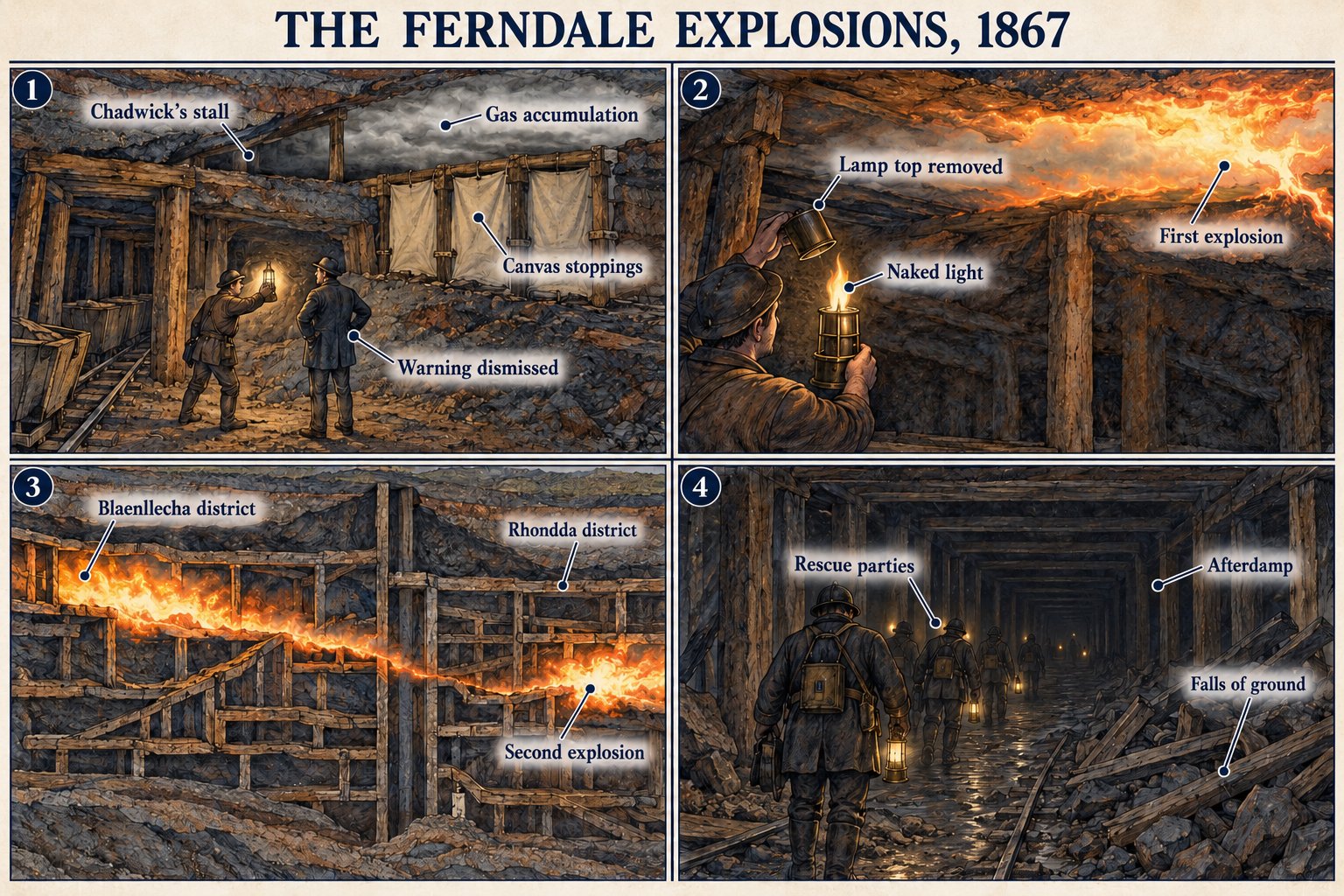
A first explosion originated in the Blaenllecha district, in a working known as Chadwick's stall, where accumulated gas ignited from a naked light after a safety lamp's top was removed; a second explosion followed shortly after in the Rhondda district, ignited in turn by the first blast. A fireman had already warned manager Williams of dangerous gas conditions before the explosion, but his concerns were dismissed.
Contributing factors
The inquiry found no daily ventilation records were kept, no register of who entered the pit, and no written fireman's reports; government inspections were inadequate and lacked proper scientific instruments for measuring air quality; canvas ventilation stoppings, used in place of the brick stoppings previously employed, were found to leak air.
What happened
At 1:20pm the first blast produced what witnesses described as the report of a cannon, sending smoke and flame almost to the top of the shaft and a concussion felt throughout the valley; after the winding engine was reversed and ventilation increased, a second explosion followed soon after.
Rescue & recovery
Rescue parties descended once conditions allowed. By Saturday evening only 3 survivors had been brought up alongside 20 recovered bodies; one 24-year-old man was found alive after rescuers heard a faint groan. Recovery continued through the weekend, with around 121 bodies recovered by the following Tuesday; rescuers faced falls of ground, toxic afterdamp and decomposition as recovery dragged on, ultimately taking about a month to complete.
Investigation & inquiry
The inquest jury concluded the explosion resulted from 'a great accumulation of gas in certain workings', attributed to the neglect of manager Williams and his subordinate officers, compounded by colliers carelessly removing lamp covers and using naked lights and by failed inspection practices. The coroner criticised South Wales mine management generally as 'insufficiently educated' and described the Mines Inspection Act as badly framed and ambiguously worded, making prosecutions difficult.
Changes to practice & legislation
The inquiry recommended monthly competent inspections, proper scientific instruments for measuring air quality, daily record-keeping of ventilation and fireman's reports, and a personnel register at every colliery.
Memorials & commemoration
A joint memorial to the dead of both the 1867 and 1869 disasters was renovated for the 150th anniversary in 2017, featuring a statue of a coal cart surrounded by four benches.
Recorded claims
Individual factual claims, each attached to the source(s) that support it below. Where sources disagree, both are kept.
- A fireman had already warned manager Williams of dangerous gas conditions before a naked light ignited accumulated gas in Chadwick's stall, causing a first explosion that triggered a second in the Rhondda district. 1
- 178 men and boys died: 145 from burns, 25 from suffocation and 5 from the force of the blast itself. 1
- The inquiry found no ventilation records, personnel register or written fireman's reports were kept, inspections were inadequate, and canvas ventilation stoppings used in place of brick were found to leak air. 1
Related terminology
Mining terms this disaster is structurally linked to, with the nature of the relationship.
- Afterdamp (contextual relationship)
Named in this record’s rescue and recovery: “…by the following Tuesday; rescuers faced falls of ground, toxic afterdamp and decomposition as recovery dragged on, ultimately taking about a…” - Fireman (contextual relationship)
Named 3 times in this record, first in the summary: “…178 men and boys on 8 November 1867, after a gas accumulation the fireman had already warned the manager about ignited from a naked light —…” - Naked Light (contextual relationship)
Named 3 times in this record, first in the summary: “…the fireman had already warned the manager about ignited from a naked light — one of the worst disasters in Welsh mining history.” - Safety Lamp (contextual relationship)
Named in this record’s cause: “…stall, where accumulated gas ignited from a naked light after a safety lamp's top was removed; a second explosion followed shortly after in the…” - Stall (contextual relationship)
Named in this record’s cause: “…in the Blaenllecha district, in a working known as Chadwick's stall, where accumulated gas ignited from a naked light after a safety…”
Sources
- (secondary) Ferndale Colliery Explosion - Porth - 1867 — Northern Mine Research Society
- (secondary) Ferndale Colliery — Wikipedia
Record created: 27 August 2026 · Last researched: 27 August 2026