 MineArchive
Fergushill Colliery explosion, 1913
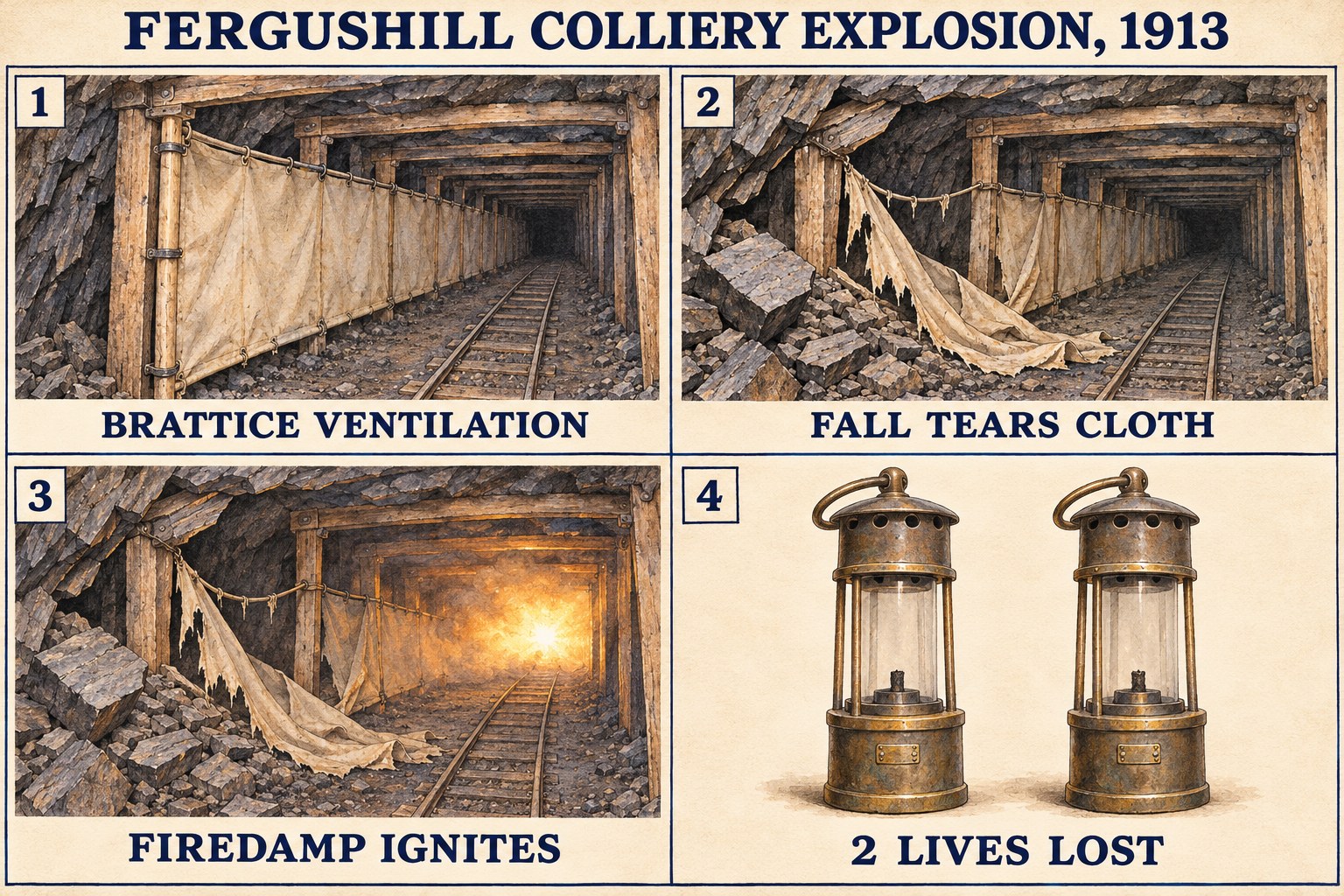
Two roadsmen at Fergushill No. 22 Pit, Ayrshire, ignited gas with naked lights in an exploration road left unventilated by a fall in August 1913.
| Date | 7 August 1913 |
|---|---|
| Mine | Fergushill Colliery |
| Region | North Ayrshire |
| Type | Explosion |
| Fatalities | 2 (Andrew Allardyce, 46, deputy fireman and roadsman, killed outright; Hugh Galone, 28, died two days later.) |
| Context | During active mining |
Location
Plotted at Fergushill Colliery. Recorded location. The large pin is the mine; the small round markers are the nearest mines on record. Click one for its page. View on full map
Cause
Firedamp accumulated in a brattice-ventilated road after a fall broke down the brattice; the men's naked lights ignited it.
What happened
At A. Finnie and Son's Fergushill No. 22 Pit a single exploration road had been driven more than 250 feet into faulted ground to prove the Lady Ha' seam, ventilated by brattice cloth. A week before the accident a fall at its entrance had broken down about 20 feet of the brattice, and the road had stood without ventilation since. On 7 August 1913 two roadsmen, Andrew Allardyce, 46, who also acted as spare fireman for the pit, and Hugh Galone, 28, were sent to finish the timbering and replace the brattice. Working with naked lights, they went for some reason into the unventilated place and ignited gas. The explosion killed Allardyce, and Galone was so badly burned that he died two days later. The inspector said they ought never to have gone in, that Allardyce at least must have had some idea of the risk, and that the fireman had failed to put up a fence to keep men out by mistake.
Investigation & inquiry
Reported in the Inspector of Mines' report for 1913.
Recorded claims
Individual factual claims, each attached to the source(s) that support it below. Where sources disagree, both are kept.
- At 7.30 am on 7 August 1913 gas exploded at a naked light in a brattice-ventilated exploration road at Fergushill No. 22 Pit, killing Andrew Allardyce, a roadsman and spare fireman, and fatally burning Hugh Galone. 1,2
- A fall a week earlier had broken down the brattice cloth, leaving the 250-foot road unventilated; the men, working with naked lights, went into it and ignited the gas. 1,2
Related terminology
Mining terms this disaster is structurally linked to, with the nature of the relationship.
- Brattice (contextual relationship)
Named 4 times in this record, first in the cause: “…in a brattice-ventilated road after a fall broke down the brattice; the men's naked lights ignited it.” - Firedamp (contextual relationship)
Named in this record’s cause: “Firedamp accumulated in a brattice-ventilated road after a fall broke down…” - Fireman (contextual relationship)
Named twice in this record, first in the narrative: “…1913 two roadsmen, Andrew Allardyce, 46, who also acted as spare fireman for the pit, and Hugh Galone, 28, were sent to finish the timbering…” - HM Chief Inspector of Mines (contextual relationship)
Named in this record’s investigation: “Reported in the Inspector of Mines' report for 1913.” - Naked Light (contextual relationship)
Named 3 times in this record, first in the summary: “Two roadsmen at Fergushill No. 22 Pit, Ayrshire, ignited gas with naked lights in an exploration road left unventilated by a fall in August 1913.”
Sources
- (secondary) Scottish Mining Website: deaths 1913 (with the Inspector of Mines' report) — Scottish Mining Website
- (primary) Durham Mining Museum: Fergushill No. 22, 7 August 1913 — Durham Mining Museum
Record created: 27 November 2026 · Last researched: 27 November 2026