 MineArchive
Exhall Colliery fire
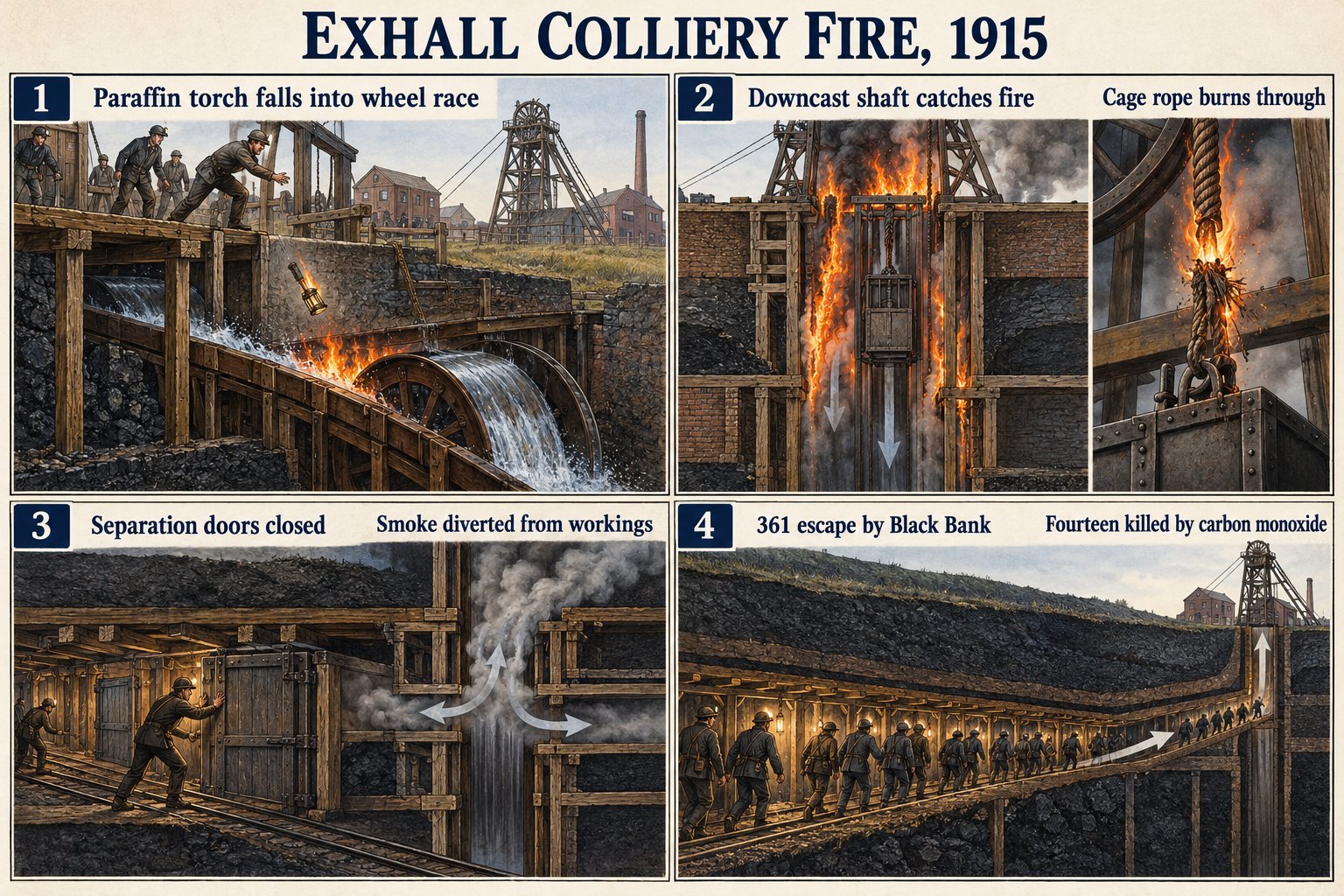
An oiler at Exhall set his paraffin torch down on a beam beside the haulage wheels at the top of the downcast shaft, and it fell five feet into the wheel race. The headgear caught fire, dense smoke went down the shaft, and fourteen of the 375 men in the workings died of carbon monoxide. The other 361 came up, many of them walking two miles underground to the emergency shaft, because one foreman remembered his fire instructions and shut the separation doors.
| Date | 21 September 1915 |
|---|---|
| Mine | Exhall Colliery |
| Region | Warwickshire |
| Type | Fire |
| Fatalities | 14 (Fourteen. The Durham Mining Museum's list of the dead gives the youngest as fourteen and the oldest as fifty-seven; Our Warwickshire says the dead were aged twenty-one to forty-seven.) |
| Injuries | Five men were overcome by fumes and survived. Nineteen were missing after the rescue, fourteen of them afterwards found dead. |
| Context | During active mining |
Cause
A paraffin torch lamp fell into the wheel race below the pit bank and set fire to the woodwork at the top of the downcast shaft.
Contributing factors
The oiler had been given no instructions as to the type of light he was to use for the task, and the haulage wheels had to be oiled during the men's meal break. The ventilation fan stood half a mile from the shaft, which let the fire take hold before it could be stopped, and the fan drew the smoke down into the workings until it was shut off.
What happened
The haulage wheels at Exhall sat just below pit bank level and were oiled during 'snap' time. In the early hours of Tuesday 21 September 1915 Charles Thomas Garner went to oil them, carrying a paraffin torch in his left hand and the oiler in his right. As he set the lamp down it fell over, though the beam he put it on had been perfectly firm, and dropped five feet into the wheel race. He could not reach it. He went out to the surface and came down in the cage to find the shaft already alight.
He threw water on the flames and then fetched the chemical extinguishers, and the fire was put out, but vast amounts of dense smoke kept going down the shaft. The cage rope burned through and fell to the bottom, putting the shaft out of use altogether. Elsewhere the heat snapped the bond holding one of the cages and severed a hauling rope bringing tubs from the face, sending a train running away to smash itself to pieces.
The discovery was made at 2.20 a.m. and the fire was out by 4.20, by which time men were being brought up the upcast at Black Bank. Three hundred and seventy-five men were in the workings. All but nineteen were recovered quickly; fourteen of those were found dead at the foot of the hill and five had been overcome by fumes. The men who died appear to have taken a different way out from their comrades, walked into the fumes and been overcome at once. The colliery manager noted that not one of them had received any actual injury to the body.
Rescue & recovery
The manager, C. F. Jackson, reached the pit head fifteen minutes after the outbreak and at once ordered the ventilation fan stopped. The foreman in charge underground, remembering the instructions the men had been given for a fire, closed the separation doors and short-circuited the air, keeping smoke in any volume out of the workings; Jackson credited that with the saving of the great number. The emergency shaft at Black Bank, half a mile off, meant some men walked two miles underground to reach safety. Once the fire was out the fan was restarted and conditions underground became practically normal, and rescue parties walked into the workings to find the men who had been suffocated.
Bringing the dead up began at about two in the afternoon and went on body by body at intervals of twenty minutes, each carried to an improvised mortuary a few yards from the shaft. In the middle of it a young lad, Bert Pearson, was found alive beneath three dead miners: their weight had knocked him down and left him unconscious below the fumes, and he woke trapped, to be heard calling by rescuers recovering a body.
Investigation & inquiry
The coroner and jury sat at Coventry County Hall. Dr H. G. Webster of Longford gave the cause of death as a combination of asphyxia and carbon monoxide poisoning. Charles Thomas Garner, the oiler, described setting the lamp on the beam and its falling into the wheel race, and said he had been given no instructions as to the type of light he was to use for that particular task. After five hours the jury found that the fourteen met their deaths by inhaling carbon monoxide, caused through the overturning of a lamp, which they considered a pure accident.
Memorials & commemoration
A memorial to the miners who died was unveiled in St Giles' Meadow, Exhall, by the High Sheriff of Warwickshire on 20 September 2015, a hundred years and a day after the fire.
What's uncertain
Points where sources disagree or the record could not be settled; both accounts are kept. All open questions in the archive.
- The Durham Mining Museum lists all fourteen with their ages and gives the youngest as Sidney John James Beasley, fourteen, of Oak's Yard, Longford Road, Foleshill, and the oldest as William Henry Smith, fifty-seven, of Windmill Lane, Foleshill, with an average of thirty-four. Our Warwickshire says the dead were aged twenty-one to forty-seven. The museum's list is itemised and the Our Warwickshire figure is not. (disputed) 1,2
Recorded claims
Individual factual claims, each attached to the source(s) that support it below. Where sources disagree, both are kept.
- The Durham Mining Museum lists all fourteen with their ages and gives the youngest as Sidney John James Beasley, fourteen, of Oak's Yard, Longford Road, Foleshill, and the oldest as William Henry Smith, fifty-seven, of Windmill Lane, Foleshill, with an average of thirty-four. Our Warwickshire says the dead were aged twenty-one to forty-seven. The museum's list is itemised and the Our Warwickshire figure is not. (disputed) 1,2
- The jury at Coventry County Hall found that the fourteen died by inhaling carbon monoxide, caused through the overturning of a lamp, which they considered a pure accident. 3
- Charles Thomas Garner, the oiler, told the inquest that he had been given no instructions as to the type of light he was to use for the task of oiling the haulage wheels. 3
- The manager ordered the ventilation fan stopped within fifteen minutes of the outbreak and the foreman underground closed the separation doors, short-circuiting the air and preventing smoke in any volume from reaching the workings. 1
Related terminology
Mining terms this disaster is structurally linked to, with the nature of the relationship.
- Cage (contextual relationship)
Named 3 times in this record, first in the narrative: “…could not reach it. He went out to the surface and came down in the cage to find the shaft already alight. He threw water on the flames and…” - Downcast Shaft and Upcast Shaft (contextual relationship)
Named twice in this record, first in the summary: “…torch down on a beam beside the haulage wheels at the top of the downcast shaft, and it fell five feet into the wheel race. The headgear caught…” - Haulage (contextual relationship)
Named 3 times in this record, first in the summary: “An oiler at Exhall set his paraffin torch down on a beam beside the haulage wheels at the top of the downcast shaft, and it fell five feet into…” - Heapstead (contextual relationship)
Named twice in this record, first in the cause: “A paraffin torch lamp fell into the wheel race below the pit bank and set fire to the woodwork at the top of the downcast shaft.” - Pithead (contextual relationship)
Named in this record’s rescue and recovery: “The manager, C. F. Jackson, reached the pit head fifteen minutes after the outbreak and at once ordered the…”
Photographs & further reading
This page doesn't try to reproduce everything — these are the best original sources found for this disaster.
Our Warwickshire's account of the night, built around the colliery manager's own statement: the fire at the headgear, the closing of the separation doors, the walk to the Black Bank shaft, and the finding of Bert Pearson alive beneath three dead men.
View sourceThe inquest at Coventry County Hall — the doctor's evidence on asphyxia and carbon monoxide, the oiler's account of dropping the torch into the wheel race, and the jury's verdict after five hours.
View sourceThe Durham Mining Museum's record of the incident, naming all fourteen men with their ages, marital status and home addresses in Bedworth, Foleshill and Longford.
View sourceSources
- (secondary) The Exhall Colliery Disaster — Our Warwickshire
- (primary) Exhall Colliery, 21 September 1915 — Durham Mining Museum
- (secondary) The Exhall Colliery Disaster - Inquest — Our Warwickshire
Record created: 11 September 2026 · Last researched: 11 September 2026