 MineArchive
Dolcoath Mine stope collapse, 1893
A timbered stope collapsed at the 412-fathom level, one of the deepest workings in Cornwall, killing eight miners and trapping a ninth for over a day and a half before he was rescued unhurt.
| Date | 20 September 1893 |
|---|---|
| Mine | Dolcoath Mine |
| Region | Cornwall |
| Type | Collapse / Roof Fall |
| Fatalities | 8 (Eight by the account of the accident; the contemporary list of the dead names seven.) |
| Context | During active mining |
Location
Plotted at Dolcoath Mine. Recorded location. The large pin is the mine; the small round markers are the nearest mines on record. Click one for its page. View on full map
Cause
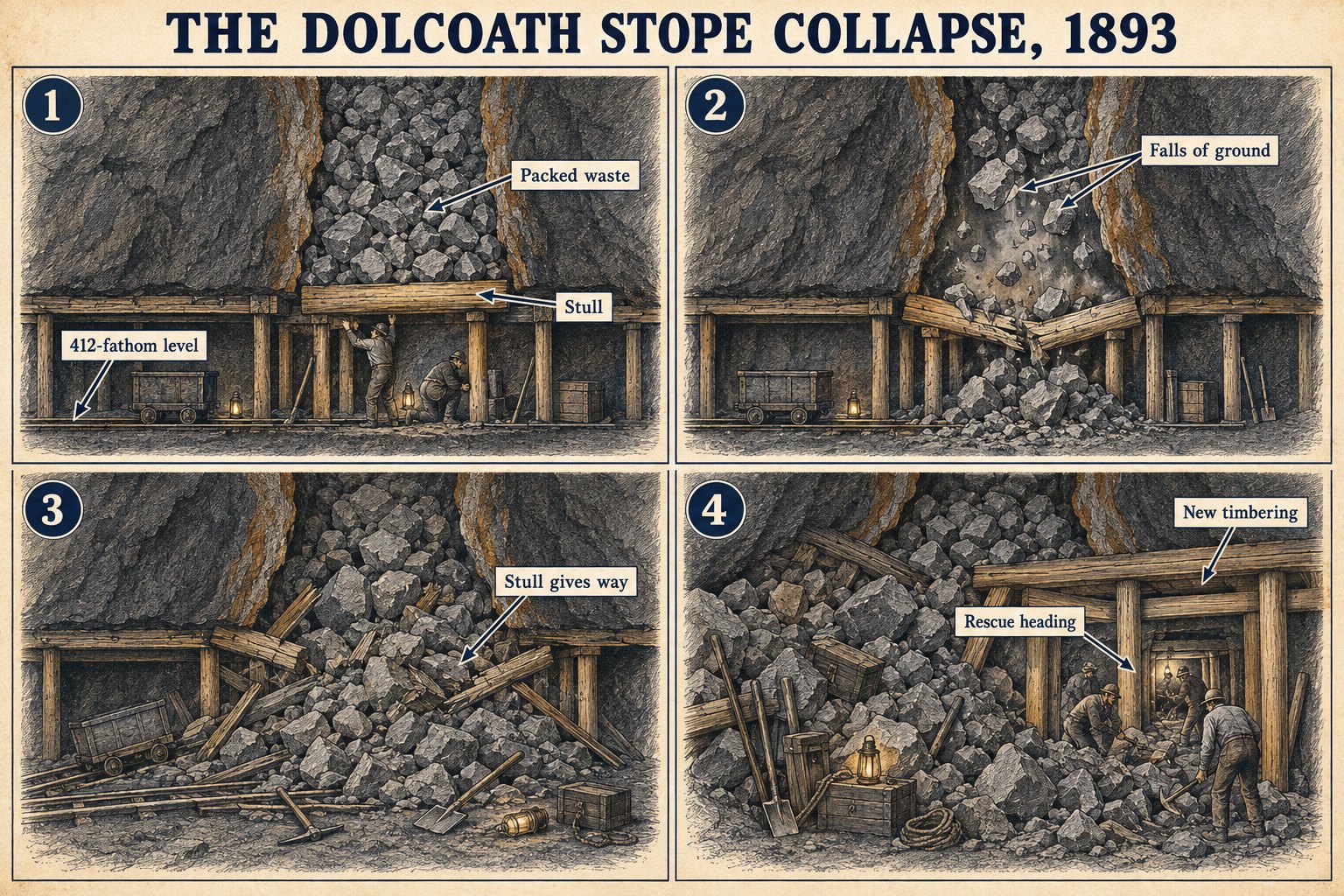
A timber support structure (a stull) gave way under a large worked-out void packed with waste rock, at one of the deepest points then reached in any Cornish mine.
Contributing factors
The lode there was 30 feet wide and rich enough in tin to be stoped out entire, leaving a cavity 35 to 40 yards long and 10 yards wide above the level, reaching to within two or three yards of the 400-fathom level and, by one account, up to 20 yards high. The stull holding the waste over the level was 21 baulks of pitch pine, 18 to 20 inches square and 30 feet long, set about 3 feet apart, with two or three fathoms of deads piled on top. Two days before, the underground agent, James Johns, had seen one piece bending and told the chief timberman, John Pollard, to strengthen the stull. The new timbers being added were about 24 feet long and 18 inches square.
What happened
On the afternoon of 20 September 1893, a party of timbermen were working at the 412-fathom level of Dolcoath, more than 900 yards below surface, strengthening a stull that turned out to sit beneath an unexpectedly massive stope. Witnesses reported two loud falls of ground immediately before the stull gave way under the weight of waste rock above it. Eight men were killed, by the account of the accident; the contemporary list of the dead names seven. A ninth, Richard Davies, was trapped for around 36 to 40 hours before he was freed, uninjured. Search parties worked without a break for three weeks, and the last body was not recovered until 11 October, twenty-one days after the collapse.
Rescue & recovery
Two men, William Osborne and Richard Davies, were found alive; Osborne died that evening. Davies, 18, of Troon, was freed after 36 to 40 hours (37, by the manager's reckoning). Shifts worked day and night through a tangle of rock and timber, blasting the rock cautiously and cutting the timbers out bit by bit.
Investigation & inquiry
The inspector, Joseph Martin, called it the worst fall of ground he had encountered under either the Metalliferous Mines or Coal Mines Regulation Acts. The coroner's jury returned a verdict of accidental death. The inquest was held at Tyack's Hotel, Camborne, before the county coroner, G. P. Grenfell. Witnesses heard two falls of ground above the stull just before it collapsed, which ruled out the first idea that the timbermen had undermined one of the baulks; the roadway of the 400-fathom level fell at the same time. The jury gave its verdict without retiring and passed a vote of sympathy with the relatives and with the mine's agents.
What's uncertain
Points where sources disagree or the record could not be settled; both accounts are kept. All open questions in the archive.
- Eight men died and a ninth, Richard Davies, was trapped for 36-40 hours before being rescued unhurt. (disputed) 1
- Seven men were killed, by the contemporary list of the dead. (disputed) 2,1
Recorded claims
Individual factual claims, each attached to the source(s) that support it below. Where sources disagree, both are kept.
- Eight men died and a ninth, Richard Davies, was trapped for 36-40 hours before being rescued unhurt. (disputed) 1
- The last body was not recovered until 11 October 1893, twenty-one days after the collapse. 1
- Seven men were killed, by the contemporary list of the dead. (disputed) 2,1
- The inquest at Tyack's Hotel, Camborne, before the coroner G. P. Grenfell, returned accidental death without the jury retiring. 1
- The stull was some 21 baulks of pitch pine about 18 inches square and over 30 feet long, holding up the waste over the 412-fathom level. 2,1
- A newspaper report of the day named eight men buried in the fall, among them J. Davies, the one man rescued alive. 3
- The stope above the stull formed a cavity 35 to 40 yards long, 10 yards wide and up to 20 yards high, and the new timbers being set were about 24 feet long and 18 inches square. 3
Related terminology
Mining terms this disaster is structurally linked to, with the nature of the relationship.
- Coal Mines Regulation Act (contextual relationship)
Named in this record’s investigation: “…of ground he had encountered under either the Metalliferous Mines or Coal Mines Regulation Acts. The coroner's jury returned a verdict of accidental death.” - Deads (contextual relationship)
Named in this record’s contributing factors: “…30 feet long, set about 3 feet apart, with two or three fathoms of deads piled on top. Two days before, the underground agent, James Johns,…” - Old Workings (contextual relationship)
Named twice in this record, first in the cause: “…(a stull) gave way under a large worked-out void packed with waste rock, at one of the deepest points then reached in any Cornish mine.” - Stope (contextual relationship)
The collapse occurred in a large worked-out stope beneath the failed timber support. - Timberman (contextual relationship)
Named in this record’s contributing factors: “…agent, James Johns, had seen one piece bending and told the chief timberman, John Pollard, to strengthen the stull.”
Sources
- (secondary) Dolcoath Mine Stope Collapse - Camborne - 1893 — Northern Mine Research Society
- (secondary) Dolcoath mine — Wikipedia
- (secondary) The Dolcoath mine disaster of 1893 — Cornish studies resources (Bernard Deacon)
Record created: 20 August 2026 · Last researched: 20 November 2026