 MineArchive
Cannock Chase No. 3 Pit rope break, 1882
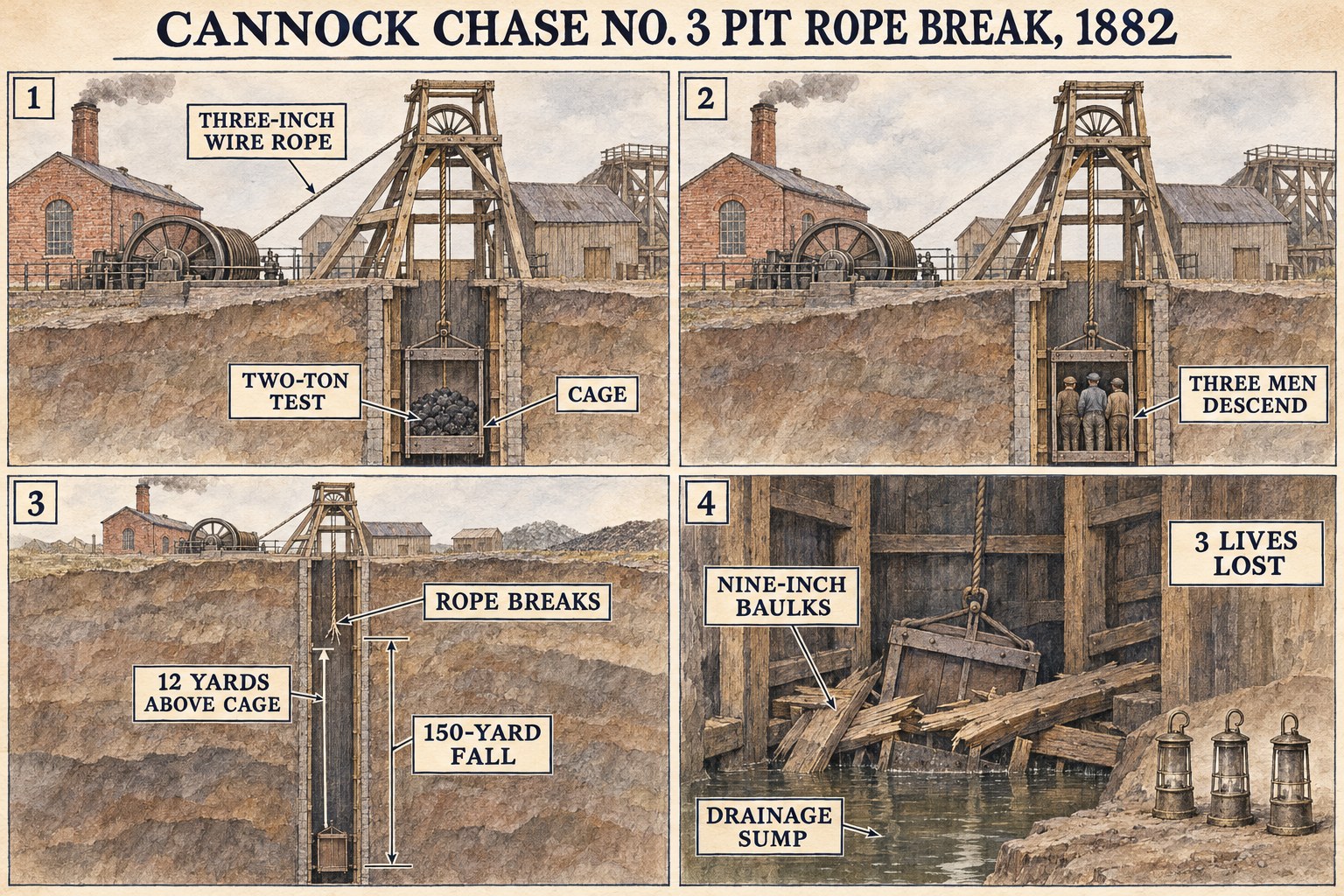
At six on the morning of Saturday 23 December 1882 the winding rope at No. 3 Pit of the Cannock Chase Colliery, Chasetown, snapped just as the cage began to lower three men going down to feed the horses. The cage fell about 150 yards, broke through the timber cover of the sump and sank into the water beneath, and all three were killed.
| Date | 23 December 1882 |
|---|---|
| Mine | Cannock Chase No. 3 Pit |
| Region | Staffordshire |
| Type | Winding / Shaft Accident |
| Fatalities | 3 (Three: George (or Thomas) Collis, 50, fireman, married with six children; Herbert Grimley, 26, pit smith, married the previous Monday; Frank (Francis) Horton, 18 or 19, striker. All were of Chasetown.) |
| Context | During active mining |
Location
Plotted at Cannock Chase No. 3 Pit. Approximate location. The large pin is the mine; the small round markers are the nearest mines on record. Click one for its page. View on full map
Cause
The three-inch wire winding rope broke about 12 yards above the cage. The rope was about five months old and had been bought from one of the best wire rope makers; why it failed was not known at the time.
What happened
About 400 men were employed at the pit. As the Mines Act required, the rope had first been tested with a load of two tons of coal, and when all seemed well the three men got into the cage to go down before the day's work began. The engineman had hardly started to lower them when the rope parted.
From the sound that came up the shaft it was plain that the cage had gone through the flooring of 9-inch baulks that covered the sump, a well of drainage water several yards deep at the shaft bottom.
Rescue & recovery
Volunteers went down by another shaft and found the flooring broken through and the iron cage and its occupants in the water. The sump was pumped out far enough for the bodies to be recovered by three in the afternoon.
Investigation & inquiry
Mr Scott, the assistant inspector of mines from Wolverhampton, was quickly at the pit.
What's uncertain
Points where sources disagree or the record could not be settled; both accounts are kept. All open questions in the archive.
- The dead were Collis, a fireman of 50, Herbert Grimley, a smith of 26, and Horton, a striker of 18 or 19; the newspapers give Thomas and Francis where the museum's list has George and Frank. (disputed) 1,2
Recorded claims
Individual factual claims, each attached to the source(s) that support it below. Where sources disagree, both are kept.
- Three men were killed at No. 3 Pit of the Cannock Chase Colliery, Chasetown, on 23 December 1882 when the winding rope broke. 1,2,3
- The cage fell about 150 yards and broke through the timber cover of the sump into the water below. 2,3
- The rope, about three inches in diameter and five months old, had been tested with two tons of coal that morning and broke about 12 yards above the cage. 2
- The dead were Collis, a fireman of 50, Herbert Grimley, a smith of 26, and Horton, a striker of 18 or 19; the newspapers give Thomas and Francis where the museum's list has George and Frank. (disputed) 1,2
Related terminology
Mining terms this disaster is structurally linked to, with the nature of the relationship.
- Cage (contextual relationship)
Named 6 times in this record, first in the summary: “…3 Pit of the Cannock Chase Colliery, Chasetown, snapped just as the cage began to lower three men going down to feed the horses. The cage…” - Engineman (contextual relationship)
Named in this record’s narrative: “…men got into the cage to go down before the day's work began. The engineman had hardly started to lower them when the rope parted. From the…” - HM Chief Inspector of Mines (contextual relationship)
Named in this record’s investigation: “Mr Scott, the assistant inspector of mines from Wolverhampton, was quickly at the pit.” - Sump (contextual relationship)
Named 3 times in this record, first in the summary: “…The cage fell about 150 yards, broke through the timber cover of the sump and sank into the water beneath, and all three were killed.” - Winding Rope (contextual relationship)
Named twice in this record, first in the summary: “At six on the morning of Saturday 23 December 1882 the winding rope at No. 3 Pit of the Cannock Chase Colliery, Chasetown, snapped just…”
Further reading
This page doesn't try to reproduce everything — these are the best original sources found for this disaster.
An agency report of the accident, with the rope test, the fall into the sump and the recovery of the bodies.
View sourceSources
- (primary) Durham Mining Museum: Cannock Chase Colliery — Durham Mining Museum
- (secondary) Breaking of a pit cage rope: three lives lost (Welsh Newspapers Online, 26 December 1882) — National Library of Wales (Welsh Newspapers Online)
- (secondary) Terrible colliery accident, Chasetown (Welsh Newspapers Online, 28 December 1882) — National Library of Wales (Welsh Newspapers Online)
Record created: 19 November 2026 · Last researched: 19 November 2026