 MineArchive
Burradon Colliery Explosion
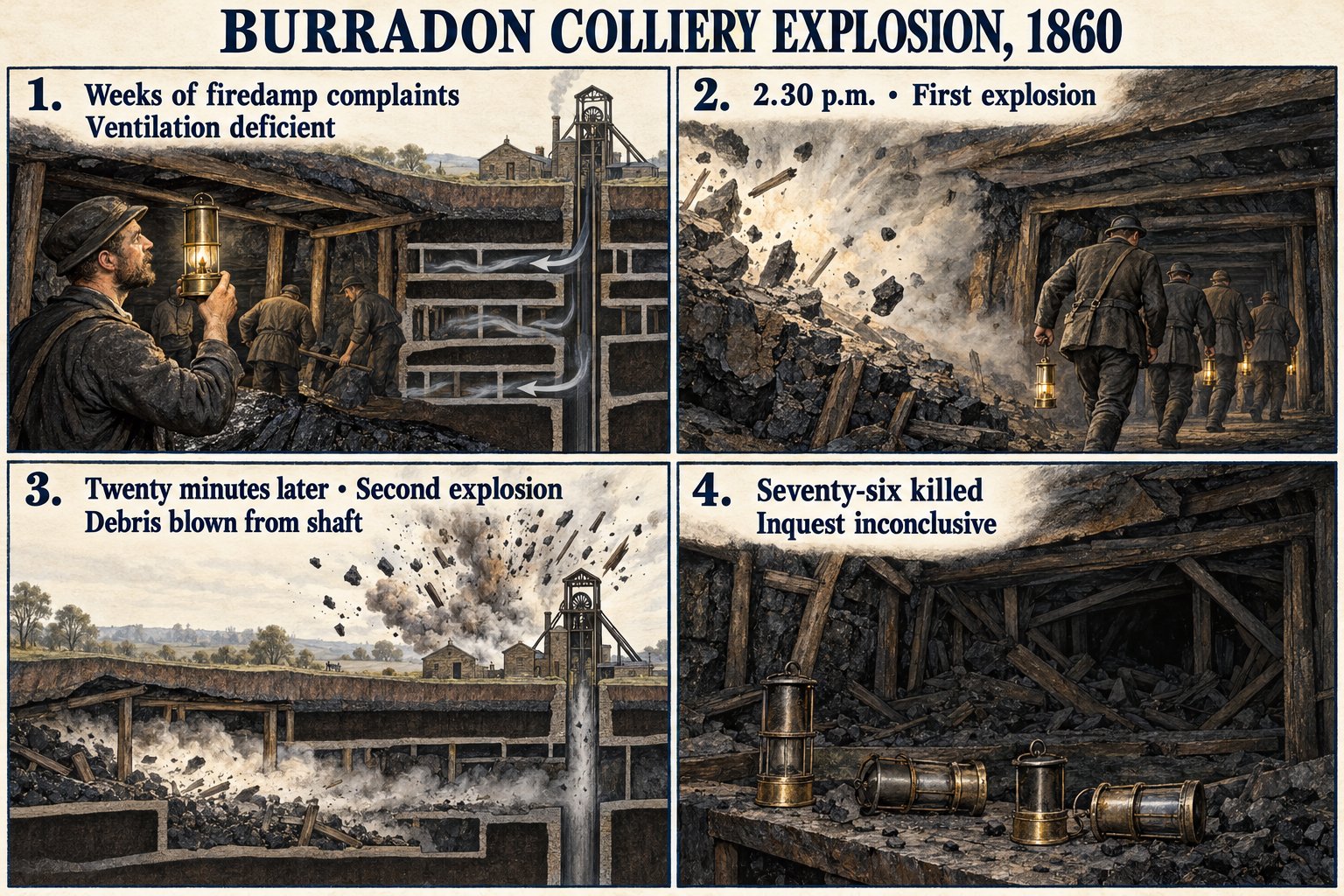
Seventy-six men and boys were killed at Burradon Colliery on the afternoon of Friday 2 March 1860. A first, smaller explosion in the southern workings sent the boys running for the shaft; twenty minutes later, as the overman William Kirkley led a party back in, a far larger one blew debris clean out of the shaft. Twenty-five men and boys were found together three hundred yards in, thirteen of them hand in hand, all dead of suffocation. The inquest ran to 18 April and failed to reach a conclusive verdict.
| Date | 2 March 1860 |
|---|---|
| Mine | Burradon Colliery |
| Region | Northumberland |
| Primary type | Explosion |
| Associated types | Gas / Asphyxiation |
| Fatalities | 76 (The last body, that of Thomas Wilkinson, was not recovered until 20 March, eighteen days after the explosion.) |
| Injuries | Men and boys from the northern workings escaped with minor injuries. William Kirkley, the overman who led the first party back in, reached the surface almost insensible from the air in the pit. |
| Context | During active mining |
Cause
An explosion of firedamp, recorded by the Durham Mining Museum as ignited by a naked light in conditions of deficient ventilation.
Contributing factors
The colliery had been connected to Seghill and shared its ventilation until the two were sold to different owners in July 1858 and separated; from then it was pressed hard for output, and the men had been complaining of firedamp for weeks. Scientific evidence given at the inquest was that the mine was not adequately ventilated and that the safety measures available had not all been employed.
What happened
At about half past two William Urwin, a boy of fourteen, was working in the southern part of the pit — gaseous enough to require safety lamps — assisting Benjamin Nicholson, a deputy overman of forty-three. Their ears popped at a sudden change of air pressure and they heard a small explosion. "She’s fired," Nicholson said. Urwin ran for the shaft, and other boys nearby ran too, having seen coal, props and dust blown away; the air was becoming unbreathable and the horses were badly agitated.
At the shaft bottom the boys met the overman William Alderson going the other way to see what had happened; he tried, sometimes forcibly, to turn them back. On the surface the men had begun to notice the change in air coming up the shaft, and word reached William Kirkley, a senior overman, in the colliery office where he was making up wages. He went straight down, gathered the boys at the shaft bottom and started back into the workings.
About twenty minutes after the first explosion, and a hundred yards in, the second came. Debris was blown out of the top of the shaft, bratticing fell around the men and every Davy lamp was put out. Kirkley got the boys back to the shaft in the dark, meeting men and boys coming out of the northern workings, which were largely unaffected. By the time he was wound to the surface he was almost insensible.
Rescue & recovery
At one o’clock on the Saturday, about three hundred yards into the southern workings, the searchers broke through to twenty-five people who had tried to get out after the first explosion and found their way blocked by debris. Thirteen were found hand in hand; some were huddled together in a capsized tub; two boys lay facing each other in a crouch with a dead mouse between them. All twenty-five had suffocated. About fifty-six bodies had been brought up by late that evening. John Fryer, manager of Seghill Colliery, opened the door between the two collieries to help recover bodies on that side.
On the Wednesday it was judged safe to light the furnace at the bottom of the upcast shaft and restore ventilation, and the colliery was put back to work that evening with a shift sent down at eight — three bodies still missing. The Bishop of Durham visited on 20 March, spending over two hours with the sick and bereaved in their cottages; the last body, Thomas Wilkinson’s, was recovered the same day and buried at Longbenton the day after.
Investigation & inquiry
A coroner’s inquest was established at once. Baxter Langley and Joseph Cowen of the Newcastle Chronicle engaged a London barrister to represent the mineworkers. It sat until 18 April and was often bad-tempered and sometimes farcical: the coroner, Stephen Reed, struggled to keep order, particularly when trying to stop Langley feeding questions to the miners’ barrister.
The jury heard scientific evidence that the mine was not adequately ventilated, that the safety measures available had not all been employed, and that the manager Charles Carr had misled them. A verdict of accidental death was nonetheless recorded, and the inquest reached no conclusive finding on the cause. Reed was heavily criticised in the press afterwards, and felt compelled to have a constable summon the jury to certify that he had conducted the inquest impartially. They refused. Langley made that refusal public.
Legal & regulatory aftermath
A relief fund was set up, its committee dominated by coal owners and the well-to-do although most of the money had come from working men. The miners campaigned unsuccessfully for Langley to be given a seat on it; when that was refused, working men sent their donations to Langley and the Newcastle Chronicle directly for distribution to the victims’ families instead.
Recorded claims
Individual factual claims, each attached to the source(s) that support it below. Where sources disagree, both are kept.
- Seventy-six men and boys were killed. 1,2
- A first, smaller explosion was felt in the southern workings at about 2.30 p.m. A second, far larger one came about twenty minutes later as a party led by the overman William Kirkley made its way back in, blowing debris out of the shaft, bringing down bratticing and extinguishing every Davy lamp. 1
- At one o’clock on the Saturday, about three hundred yards into the southern workings, twenty-five people were found who had tried to escape after the first explosion and been blocked by debris. Thirteen of them were hand in hand; two boys were found facing each other in a crouch with a dead mouse between them. All twenty-five had died by suffocation. 1
- Despite scientific evidence that the mine was not adequately ventilated, that all available safety measures had not been employed, and that the manager Charles Carr had misled the jury, a verdict of accidental death was recorded. The inquest, which sat until 18 April, reached no conclusive finding on the cause. 1
- T. Fordyce’s Local Records, published in 1867, records that "a long and searching inquiry took place as to the cause of the accident, but without any satisfactory result". 2
- After criticism in the newspapers, the coroner Stephen Reed had a constable of the county police summon the jury to give him a certificate stating that he had conducted the inquest with impartiality. They refused. 1
- The relief fund committee was dominated by coal owners and the well-to-do despite most of the donated money having come from working men. The miners campaigned unsuccessfully for Baxter Langley to sit on it, and afterwards working men donated to Langley and the Newcastle Chronicle directly for distribution to the victims. 1
- John Fryer, the manager of Seghill Colliery, opened the door between Burradon and Seghill collieries to aid the recovery of bodies in that district. 1
Related terminology
Mining terms this disaster is structurally linked to, with the nature of the relationship.
- Deputy (contextual relationship)
Named in this record’s narrative: “…enough to require safety lamps — assisting Benjamin Nicholson, a deputy overman of forty-three. Their ears popped at a sudden change of air…” - Firedamp (contextual relationship)
Named twice in this record, first in the cause: “An explosion of firedamp, recorded by the Durham Mining Museum as ignited by a naked light in…” - Naked Light (contextual relationship)
Named in this record’s cause: “…of firedamp, recorded by the Durham Mining Museum as ignited by a naked light in conditions of deficient ventilation.” - Overman (contextual relationship)
Named 4 times in this record, first in the summary: “…sent the boys running for the shaft; twenty minutes later, as the overman William Kirkley led a party back in, a far larger one blew debris…” - Safety Lamp (contextual relationship)
Named twice in this record, first in the narrative: “…working in the southern part of the pit — gaseous enough to require safety lamps — assisting Benjamin Nicholson, a deputy overman of forty-three.…”
Photographs & further reading
This page doesn't try to reproduce everything — these are the best original sources found for this disaster.
The casualty record for all seventy-six who died, with the contemporary account from T. Fordyce’s Local Records of 1867.
View sourceSources
- (secondary) Burradon Pit Disaster 1860 — Burradon History
- (primary) Colliery Disaster 1860 — Burradon — Durham Mining Museum, reproducing T. Fordyce’s Local Records (1867)
Record created: 8 September 2026 · Last researched: 8 September 2026