 MineArchive
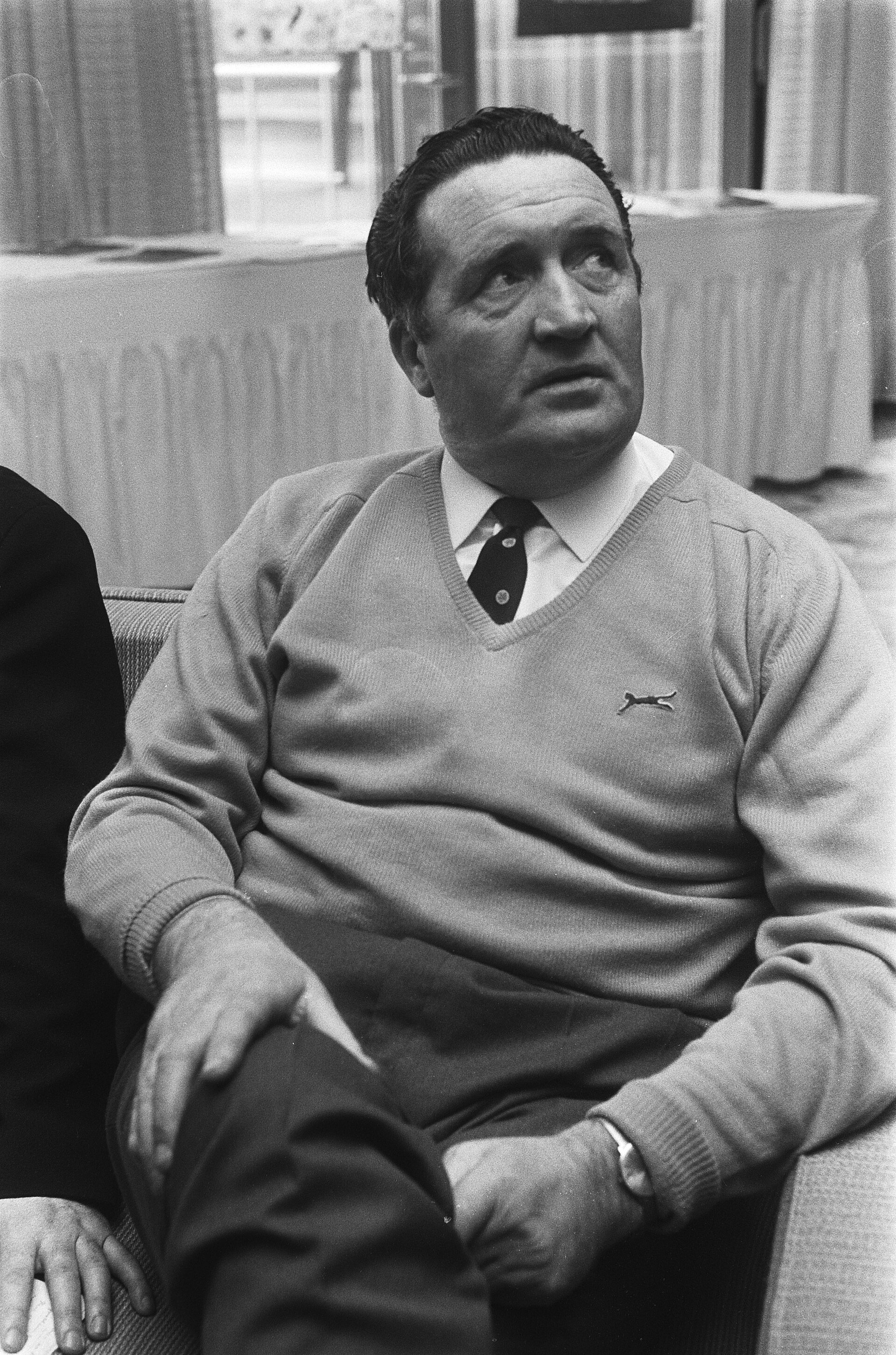
Jock Stein
| Category | Sports |
|---|---|
| Also known as | Big Jock (His nickname.) |
| Dates | Born 5 Oct 1922; down the pit 1937; Albion Rovers 1942; left mining for Llanelli 1950; Celtic manager 1965; European Cup 1967; died 10 Sep 1985 |
Jock Stein (1922–1985), the Celtic manager who in 1967 became the first British manager to win the European Cup, was a coal miner for more than a decade before he played football full-time. He went down the pit at Bothwell Castle Colliery, near his birthplace in Burnbank, Hamilton, and worked there while playing part-time for Blantyre Victoria and Albion Rovers; the pit stayed part of how he saw himself for the rest of his life.
The mining history in this record
John Stein was born on 5 October 1922 at 339 Glasgow Road, Burnbank, the only son of George Stein, a coal miner. He left Greenfield school in 1937 and, after a short time in a carpet factory, followed his father down the pit at Bothwell Castle Colliery, the Priory pit at Blantyre. He agreed to sign for Burnbank Athletic in 1940, but his father objected and he joined the junior club Blantyre Victoria instead; in 1942 he signed part-time for Albion Rovers, still working underground in the week. Mining was a reserved occupation in the Second World War, which kept him at home and in the side while other players were in the forces. Kevin McCarra, drawing on Ken Gallacher's biography, tells how during a wartime strike Stein handed the couple of pounds Albion Rovers paid him to the union official so that he would be no better off than the men he worked with.
He left the pit in 1950 to play full-time for Llanelli, in Wales, and when the club ran into trouble he told its manager he would probably give up football and go back to the pits; instead Celtic signed him in 1951. How long he was underground is given differently: McCarra says twelve years at Bothwell Castle, the Irish Times eleven years from the age of sixteen.
People
Jock Stein (1922–1985). His father George Stein, a coal miner, whose work he followed at Bothwell Castle. Mick McGahey, named by McCarra as the union official he gave his football pay to during a wartime strike. Hugh McIlvanney, the journalist to whom he described the darkness underground.
Legacy today
As Celtic manager from 1965 Stein won the European Cup in 1967, with a side all born within thirty miles of Glasgow, and nine successive league championships; he later managed Scotland and died at Ninian Park, Cardiff, at the end of a World Cup qualifier on 10 September 1985. Writers on him return to the pit. McCarra records his description to Hugh McIlvanney of the complete darkness underground when a lamp went out, and his view that everyone should go down a pit once to learn what darkness is, and that more than forty years after the wartime strike, as Scotland manager, he was seen pushing money into the NUM collection can during the 1984–85 miners' strike. The Irish Times credits the pit with the sense of teamwork he brought to football, where no man came up until his colleagues' work was done. A statue of him holding the European Cup stands outside Celtic Park.
Recorded claims
Individual factual claims, each tagged with how solidly it's grounded and attached to the source(s) that support it. Where sources disagree, both are kept.
- Stein left school in 1937 and followed his father down the pit at Bothwell Castle Colliery. (documented fact) 1,2
- Stein worked twelve years as a miner at Bothwell Castle pit. (later recollection, disputed) 2
- Stein followed his father and grandfather down the pits at sixteen and spent eleven years as a miner. (later recollection, disputed) 3
- Stein was born on 5 October 1922 at 339 Glasgow Road, Burnbank, Hamilton, the son of George Stein, a coal miner. (documented fact) 4,5
- Stein played part-time for Blantyre Victoria and Albion Rovers while working as a miner; mining was a reserved occupation in the Second World War. (documented fact) 4,6,5
- During a wartime strike Stein handed his Albion Rovers pay to the union official Mick McGahey so as to be no better off than his workmates. (later recollection, uncertain) 2
- Stein left mining in 1950 to play full-time for Llanelli, and when the club struggled said he would probably go back to the pits. (documented fact) 4,3
- During the 1984–85 miners' strike Stein was seen putting money into an NUM collection can. (later recollection) 2
- Stein was the first British manager to win the European Cup, with Celtic in 1967. (documented fact) 4,6
Mines
- Bothwell Castle Colliery — South Lanarkshire
Stein worked here as a miner from 1937 until he turned full-time footballer in 1950.
Regions
Sources
- (secondary) Jock Stein: the man who inspired The Celtic Rising — The Celtic Star
- (secondary) Jock Stein – The Man with the Minneola (Kevin McCarra) — The Celtic Star
- (secondary) Jock Stein: From miner to European champion — The Irish Times
- (secondary) Jock Stein — Wikipedia
- (secondary) Stein, Jock — The Celtic Wiki
- (secondary) Jock Stein — Scottish Football Museum
Record created: 18 September 2026 · Last researched: 18 September 2026