 MineArchive
Durham Miners' Gala
| Category | Labour |
|---|---|
| Also known as | The Big Meeting (The local name.) |
| Dates | DMA founded 1869; first Gala 12 Aug 1871; Cathedral service from 1896; cancelled 1915–18, 1921, 1922, 1926, 1940–45, 1984, 2020–21 |
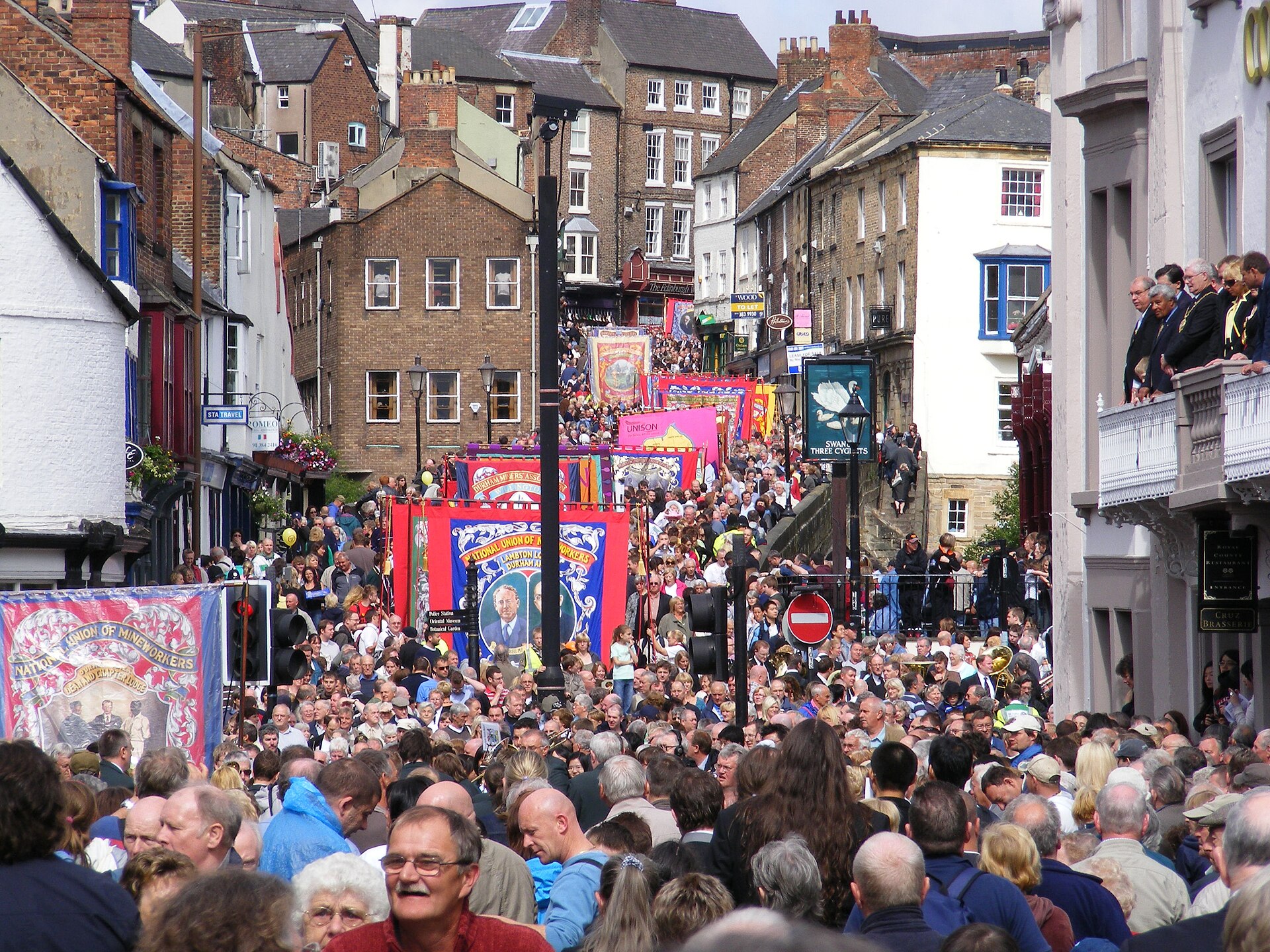
The annual gathering of the Durham coalfield's miners in Durham City, known locally as the Big Meeting, first held by the Durham Miners' Association in 1871. The colliery lodges march into the city behind their silk banners and brass bands, speeches are made on the Racecourse, and new banners are blessed at a service in the Cathedral. It has outlived every pit in the county.
The mining history in this record
The Durham Miners' Association was formed in 1869, the first union for the county's pitmen, and its first act was to commit to a yearly demonstration. The first was held on 12 August 1871 in Wharton Park, then on the edge of the city; after that the gatherings moved to the Racecourse, below the Cathedral. John Tomaney's history of the Gala describes a city of cathedral and university that met the prospect of thousands of miners arriving from the villages with trepidation, and a union led by Primitive Methodists. Durham Cathedral describes the first Gala as a show of solidarity, to let the employers see the men were united.
Each colliery's union branch, or lodge, paraded its own banner: a large painted silk flag bearing the name of the pit and the lodge, with portraits of union leaders and politicians, Biblical scenes and mottoes. Sacriston's quoted Matthew, 'Do ye unto all men as ye would they should do unto ye'; Chopwell's 1955 banner, from the village called Little Moscow, carries both Marx and Lenin; Blackhall's reads 'Need before greed'. A memoir of the 1960s quoted by Tomaney recalls banners draped in black crepe, meaning a man had been killed at that lodge's pit during the year. Since 1896 a Miners' Festival Service has been held in the Cathedral on the afternoon of Gala day, where new banners are dedicated and blessed by the Bishop of Durham.
The Gala was a serious political gathering for most of its history, and Labour leaders and miners' leaders spoke from the Racecourse platform. At its peak in the 1950s and 1960s it drew more than 300,000 people. It was not held during the two world wars, in 1921, 1922 and 1926 because of strikes, or in 1984 during the miners' strike. By 1994 every coal mine in County Durham had closed.
People
Organised by the Durham Miners' Association. The 1893 Haswell banner in the Cathedral carries portraits of Tommy Ramsay, William Crawford and Alexander Macdonald on the front, and of William Patterson, John Foreman, John Wilson and John Johnson on the back. Speakers have included Aneurin Bevan (1952), Neil Kinnock (1989), Ed Miliband (2012) and Jeremy Corbyn (2015). Norman Cornish and Tom McGuinness, miner-artists, painted it.
Legacy today
The Gala has survived the industry. Attendance fell as the pits closed, but by the 2010s it had recovered to tens of thousands, and Wikipedia gives an estimate of around 100,000 in the 2000s; the 135th Gala was held in 2019. Former pit villages have restored or remade their banners, some standing for a group of closed collieries rather than one, and banners from other unions and other coalfields now march too. The 1893 Haswell Colliery Lodge banner hangs permanently in the Cathedral's South Transept. The Gala has also been a subject for the coalfield's own artists: Norman Cornish's mural of Gala day on the Racecourse was commissioned for the new Durham County Hall in 1962, and Tom McGuinness painted the Gala in 1968 and 1976. The Labour leader Ed Miliband spoke in 2012, the first Labour leader to do so since Neil Kinnock in 1989, and a documentary, The Big Meeting, was released in 2019.
Recorded claims
Individual factual claims, each tagged with how solidly it's grounded and attached to the source(s) that support it. Where sources disagree, both are kept.
- The Durham Miners' Association, formed in 1869, held the first Gala on 12 August 1871 in Wharton Park, Durham. (documented fact) 1,2,3
- After the first Gala in Wharton Park, the gatherings were held on the Racecourse in Durham, where the speeches are made. (documented fact) 1,3
- Since 1896 a Miners' Festival Service has been held in Durham Cathedral on the afternoon of Gala day, at which new lodge banners are blessed. (documented fact) 1,2
- At its peak in the 1950s and 1960s the Gala attracted more than 300,000 people. (documented fact) 1,3
- The Gala was not held in 1915–18, 1921, 1922, 1926, 1940–45, 1984, 2020 or 2021. (documented fact) 1
- The 1893 Haswell Colliery Lodge banner is on permanent display in the South Transept of Durham Cathedral. (documented fact) 2
- Chopwell's 1955 banner is the only one to carry images of both Marx and Lenin. (documented fact) 1
- Banners were draped in black crepe when a man had been killed at that lodge's pit during the past year. (later recollection) 3
- All the coal mines in County Durham had closed by 1994, but the Gala has continued and in 2019 held its 135th meeting. (documented fact) 2,3
- Norman Cornish was commissioned in 1962 to paint a mural of the Gala for the new Durham County Hall. (documented fact) 3
Mines
- Blackhall Colliery — County Durham
Blackhall Lodge's banner carries the motto 'Need before greed'. - Chopwell Colliery — Tyne and Wear
Chopwell's 1955 lodge banner, carrying Marx and Lenin, is the best-known political banner of the Gala. - Haswell Colliery — County Durham
The Haswell Colliery Lodge banner of 1893 hangs permanently in Durham Cathedral. - Sacriston Colliery — County Durham
Sacriston Lodge's banner quoted Matthew 7:12, one of the Biblical banners of the Gala.
Regions
Commodities
Related Culture records
- Norman Cornish
Cornish painted the Gala mural commissioned for Durham County Hall in 1962. - The Gresford Disaster
Robert Saint's hymn tune Gresford is played at the Gala every year. - Wheatley Hill Colliery Band
The Wheatley Hill band played at the Gala; a photograph of it at the 1932 Gala survives.
Sources
- (secondary) Durham Miners' Gala — Wikipedia
- (secondary) The Miners' Banner — Durham Cathedral
- (secondary) After Coal: Meanings of the Durham Miners' Gala (John Tomaney, Frontiers in Sociology, 2020) — Frontiers in Sociology, via PubMed Central
Record created: 18 September 2026 · Last researched: 18 September 2026