 MineArchive
Fuller's Earth
| Also known as | Fulling Earth (The older English form, as in the 'Fulling Earth Field' recorded at Nutfield in 1583), Bentonite (The commercially interchangeable modern material; mineralogically a distinct clay) |
|---|---|
| Category | Commodities |
| Commodity page | Fuller's Earth → |
Not a single mineral but a functional category: clays that absorb, filter and bleach, usually palygorskite (attapulgite) or bentonite — hydrous aluminium silicates of varying composition. What defines a fuller's earth is what it will take out of a liquid, not what it is made of.
Historical usage
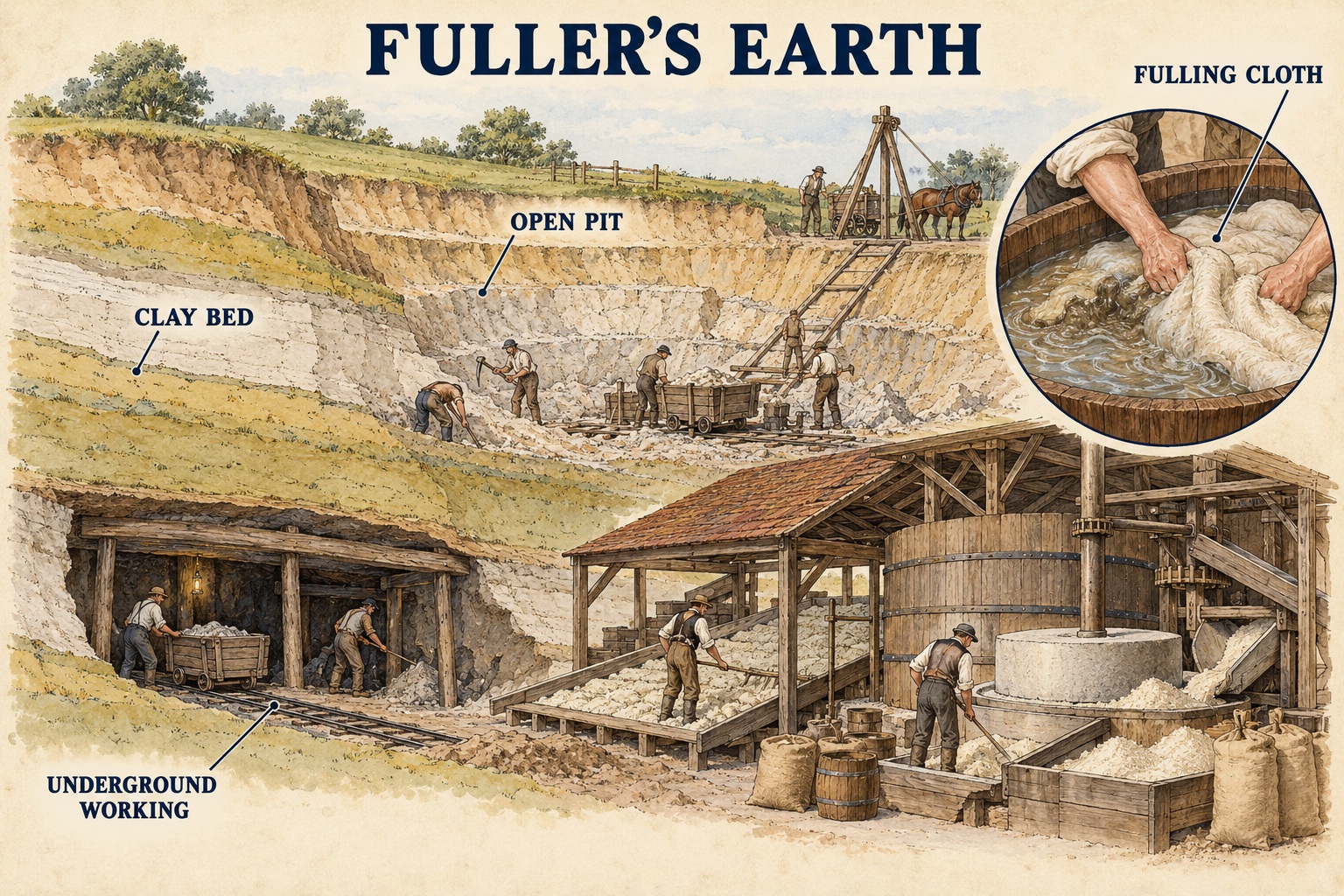
The name records the trade it was made for. Fullers — cloth workers — kneaded the clay and water into woollen cloth to absorb lanolin, oil and grease during finishing, a process old enough to appear in Mesopotamian cuneiform and universal enough that fulling mills were working across the medieval world. In Britain the material means Surrey above all: the 'Fulling Earth Field' at Nutfield is recorded in 1583, and the Nutfield Ridge beds were by far the largest British resource and historically responsible for most national production. The Fuller's Earth Union of 1890 brought the Surrey workings together with others around Bath.
How it worked
The fuller's earth at Nutfield occurs as a bed within the Lower Greensand, so it was worked by open pit where it lay near the surface and by underground mining where the best beds lay under thicker cover — an unusual combination that gives the district both quarries and mines on the same seam. The clay is dried and milled rather than chemically processed; its usefulness is physical, a matter of surface area and structure.
Why it was used
Because it will pull grease, colour and impurity out of something else and then be thrown away cheaply. That is a durable proposition, and it is why the material survived the collapse of the industry it was named for: the woollen trade stopped needing it, but oil refining, chemical manufacture, pesticide carriers, cat litter from the 1940s, cosmetics, film-set dust and CBRN decontamination all wanted the same property.
Value over time
Fuller's earth outlived its own name by three centuries and then lost to imports. Its first market was the woollen industry, and the Copyhold Works near Redhill — established around 1860-70 and the most successful of the local quarries — shows the transition clearly: its customers shifted through the 20th century from the woollen trade to oil refining and chemical manufacture. That was enough to keep the Surrey field working until 1996, when the last works closed. Production had by then moved decisively overseas: by 2005 the United States held almost a 70% share of world output, its deposits derived from Cretaceous volcanic ash, with Japan and Mexico following.
Hazards & challenges
No hazard specific to fuller's earth is documented, and the honest position is that the risks are those of clay working generally: unstable wet faces in open pit, roof collapse in the shallow underground workings driven under thicker cover, and respirable dust from drying and milling the material once it is out of the ground. Where the clay carries free silica the ordinary silicosis risk applies to that dry end of the process.
Risks & limitations
It is a commodity absorbent competing on price against other absorbents, with no premium to protect it. Bentonite from larger and cheaper deposits abroad is functionally interchangeable for most uses, which is what eventually closed the British workings — the Surrey beds were the largest in Britain but small by world standards.
Regional variation
Surrey — Nutfield and Redhill — and the Bath area are the British sources, and the 1890 union of the two says how closely they were tied. 'Fulling earth' is the older form and survives in field names long after the trade left.
Mines associated with this term
Included only where MineArchive's own research gives a reasonable evidential basis — not every mine where this might plausibly apply.
- Nutfield and Redhill Fuller's Earth Mines — Surrey (well documented example)
Nutfield and Redhill are the archive's record of the largest fuller's earth deposit in Britain, worked for over four centuries and closed in 1996.
See every mine that worked fuller's earth →
Sources
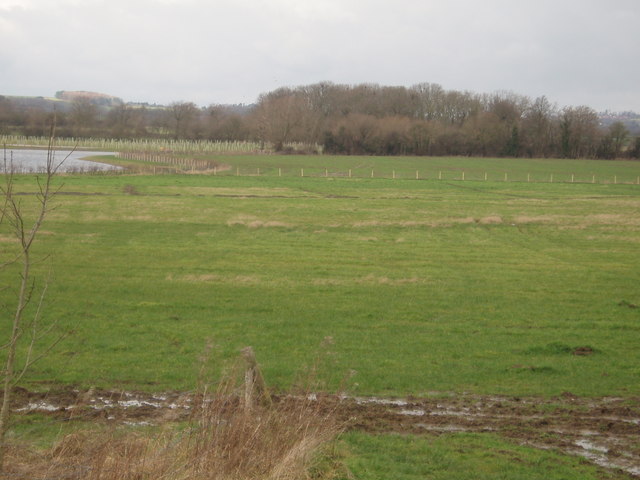
- (observational) Old fullers earth works (Copyhold Works) — Geograph Britain and Ireland
- (secondary) Fuller's earth — Wikipedia
- (secondary) Fullers Earth Union — Grace's Guide
Record created: 25 August 2026 · Last researched: 26 August 2026