 MineArchive
Diatomite
| Category | Commodities |
|---|---|
| Commodity page | Diatomite → |
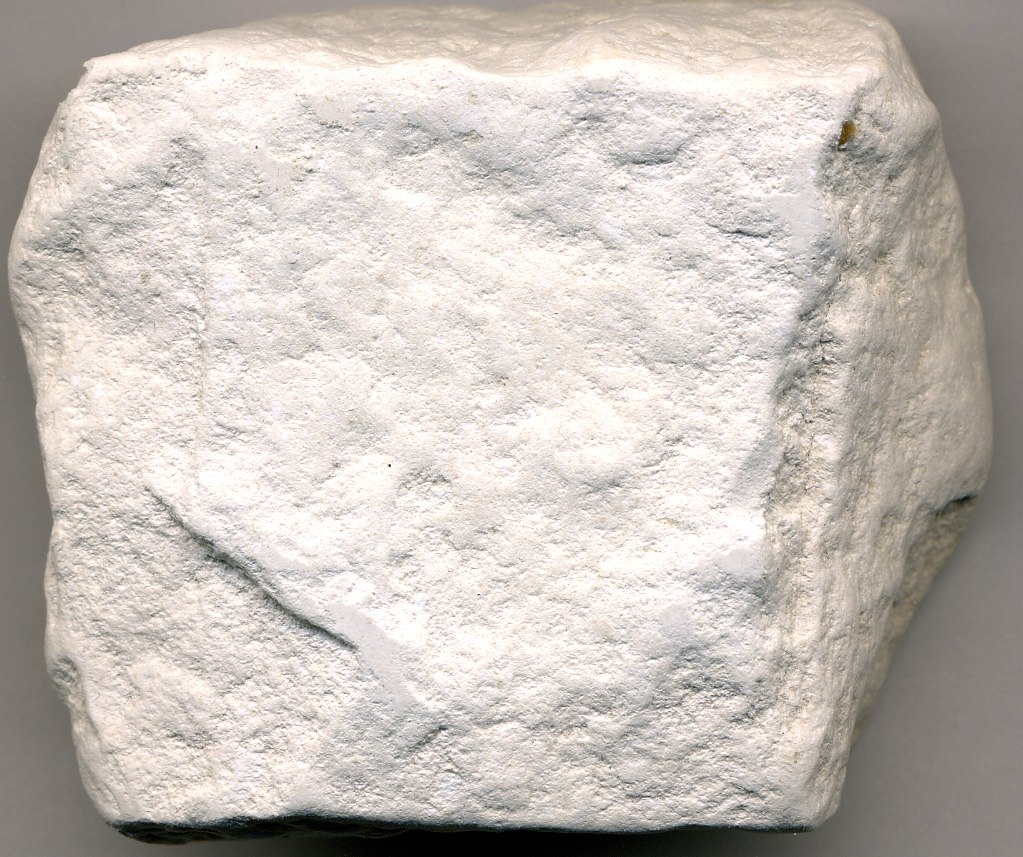
A soft, powdery sedimentary rock built up from the fossilised silica shells of microscopic algae called diatoms.
Historical usage
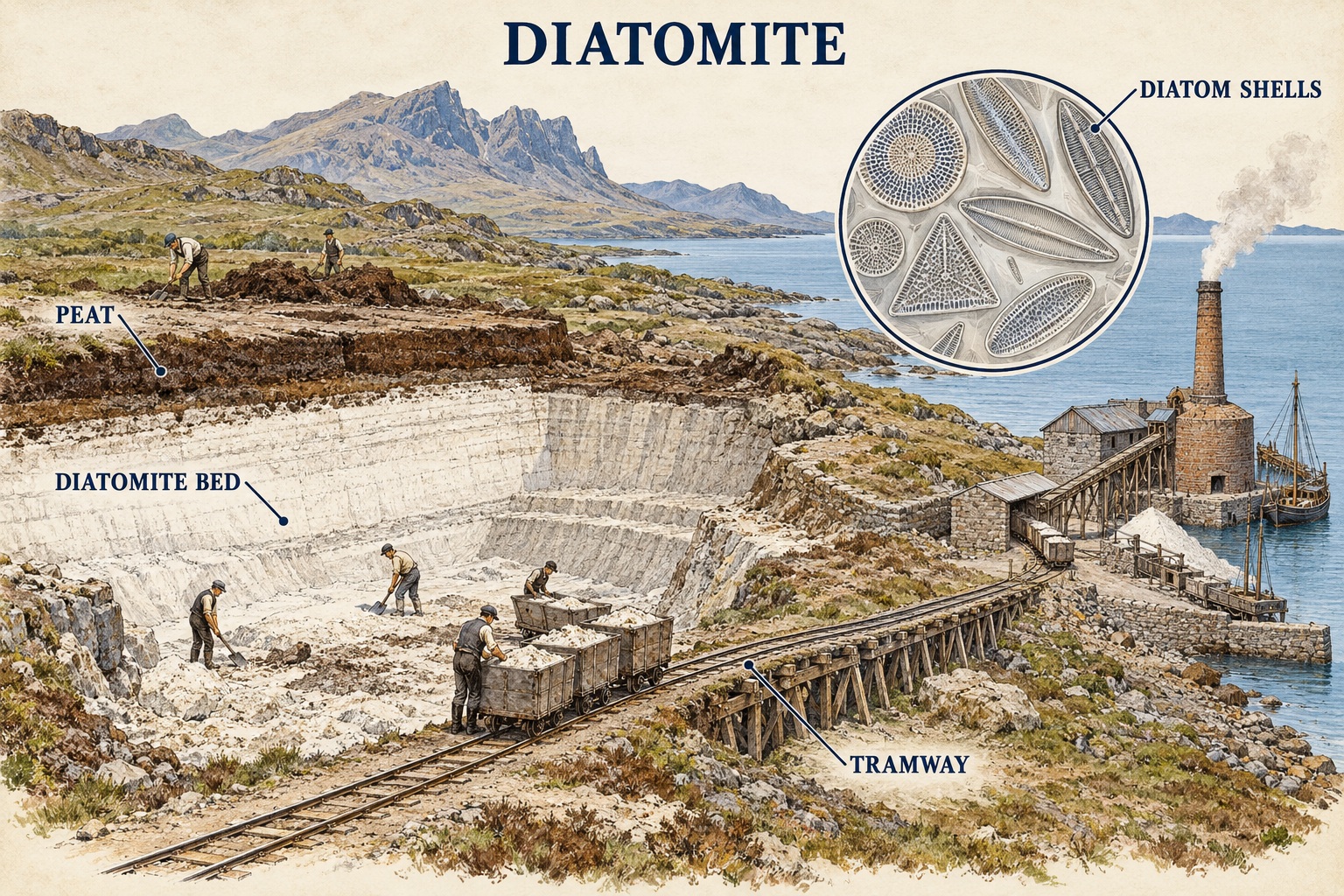
Britain's only commercially worked diatomite deposit was at Loch Cuithir on Skye, where extraction began in 1899 and continued, on and off, until 1960. The loch itself was drained through a man-made outlet to expose the diatomite horizon beneath, and the remoteness of the site was significant enough to justify building the narrow-gauge Lealt Valley Diatomite Railway to move raw material down to the coast for shipping.
How it worked
At Loch Cuithir, around a metre of peat was stripped from the surface to reach a diatomite bed 3 to 6 metres thick, very pure and largely free of interlayered silt or mud. The raw material was tramwayed to the coast and calcined — heated to drive off moisture and organic matter — before being sold on for industrial use.
Why it was used
Diatomite's fine particle size, high porosity and huge surface area give it strong filtering and absorbent properties, while its chemically inert, low-density silica composition makes it useful as a light filler and insulator. It became, among much else, the material Alfred Nobel used to stabilise nitroglycerin into dynamite.
Value over time
As a bulk industrial mineral, diatomite's value is set almost entirely by how much processing it has had rather than by rarity: unprocessed diatomite sold for a few dollars a ton, while calcined and further-refined grades can fetch well over a hundred times that. Loch Cuithir's marginal grade and shipping costs meant it was never able to compete on this basis with larger, higher-grade world producers, and the operation closed for good in 1960.
Hazards & challenges
Calcining diatomite converts some of its naturally amorphous silica into crystalline cristobalite — UK safety guidance rates calcined diatomite as containing 25-65% respirable crystalline silica by weight, a proportion comparable to sand or tile dust, with prolonged inhalation carrying a real risk of silicosis, chronic obstructive pulmonary disease and, in workers who develop silicosis, an increased risk of lung cancer.
Risks & limitations
Quality is measured partly by absorptive capacity: a good diatomite has an absorptive value above 4.0, and Loch Cuithir's deposit, at 3.56, fell short of the premium grade, limiting its competitiveness against larger overseas producers even before its remote island location was taken into account.
Regional variation
Loch Cuithir, on Skye, was Britain's only significant worked deposit; diatomite mining elsewhere in the world is concentrated in the United States and other large sedimentary basins.
Mines associated with this term
Included only where MineArchive's own research gives a reasonable evidential basis — not every mine where this might plausibly apply.
- Loch Cuithir Diatomite Works — Highland (well documented example)
Named 10 times in this record, first in the summary: “…Skye industry that drained a small Trotternish loch to extract diatomite — fossil diatom shells known locally as cailc — carrying it down to…”
See every mine that worked diatomite →
Sources
- (primary) CR0: COSHH essentials in ceramics: Silica - Advice for managers — Health and Safety Executive
- (primary) The Loch Cuithir diatomite deposits, Skye - an excursion — British Geological Survey (Earthwise)
- (secondary) Diatomite — Geology.com
Record created: 27 August 2026 · Last researched: 27 August 2026