 MineArchive
Loch Cuithir Diatomite Works
| Location | Loch Cuithir, Trotternish, near Lealt, Isle of Skye, Highland — 57.5559, -6.2194 (exact) |
|---|---|
| Commodity | Diatomite |
| Type | Mineral |
| Worked | 1886/1890–1915 |
Overview
A remote Skye industry that drained a small Trotternish loch to extract diatomite — fossil diatom shells known locally as cailc — carrying it down to the coast by a purpose-built narrow-gauge tramway for use in matches, filtering, paint, toothpaste and, via Nobel Industries, the manufacture of dynamite.
History
Diatomite was first extracted at Loch Cuithir, a small loch on Skye's Trotternish peninsula, from around 1886, with organised commercial working following from 1890. To reach the deposit the loch itself — originally around 60 hectares in extent — was drained through a system of perimeter ditches and a purpose-cut outlet, and the overlying peat stripped away to expose the diatomite beneath. A 2¾-mile, 2ft-gauge tramway, the Lealt Valley Diatomite Railway, was laid from the loch down to the coast at Invertote, work beginning in March 1889; it ran at first on gravity and manpower alone on its falling gradient, with a steam locomotive introduced in 1906. At Invertote, cliff-top warehouses and a factory building at the base of the cliff dried, ground and calcined the diatomite before it was taken out by skiff and puffer boat across the Sound of Raasay to the mainland. There it was processed further by Nobel Industries into kieselguhr, the absorbent base material Alfred Nobel had used decades earlier to stabilise nitroglycerin into dynamite — one of several industrial uses for Skye's diatomite alongside matches, alcohol filtering, paint, cosmetics, toothpaste, polish and insulation. Total output across this first phase of working amounted to only around 2,000 tons. The railway and works closed in 1915, largely because so many of the workforce had left for the First World War.
The industry lay dormant for over three decades before being revived between 1950 and 1961, this time using road transport rather than the old tramway, with a new drying and processing factory built at Uig on the other side of the Trotternish peninsula. The revived industry became a significant post-war employer for men from Staffin, Kilmuir and Uig, but ceased for good at the start of the 1960s.
Geology
The Loch Cuithir diatomite is Quaternary in age, accumulated on the bed of a loch that once covered around 60 hectares, sealed beneath roughly a metre of peat. The diatomite itself forms a 3-6m-thick horizon of exceptional purity, resting on landslipped material that in turn overlies Upper Jurassic sedimentary rocks, with the plateau lavas of the Beinn Edra Group forming the skyline ridge above. Calcined analyses of the material have recorded silica contents as high as 96-99% SiO2, though its absorptive value fell just short of the very top commercial grade.
Workings
Diatomite was won by draining the loch and removing the overlying peat to expose the deposit beneath, then dried on wire nets before onward transport; the material was carried down to the coast at Invertote by the Lealt Valley Diatomite Railway for kiln-drying, grinding and calcination ahead of shipment.
Closure
The original works and its tramway closed in 1915 as the workforce left for the First World War; a revived industry using road transport and a new factory at Uig operated from 1950 to 1961.
What remains
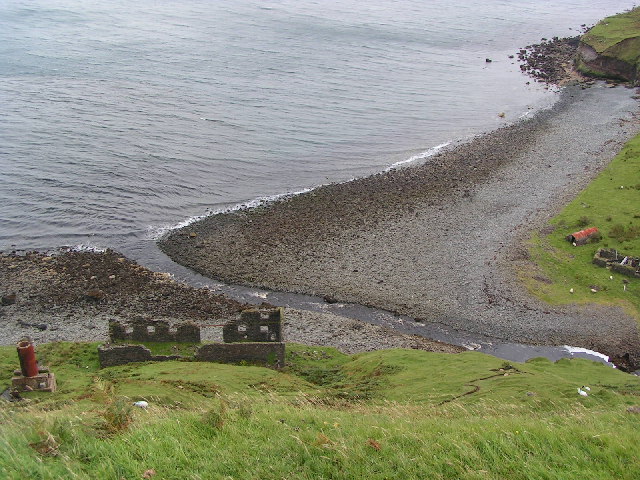
The Ordnance Survey recorded the Invertote works as already demolished when visited in 1961, with the tramway itself dismantled well before that; earlier documentation by O.F. Swire in 1952 noted the original industry had been 'allowed to die' before its brief revival. The principal surviving structure at Invertote is a large, roofless, rubble-built factory building, with a cast-iron flywheel and wall-mounted bearing box from its steam engine still visible inside; the trace of the old tramway trackbed up to Loch Cuithir remains walkable.
The gutted factory shell at Invertote, cast-iron machinery fragments, and the traceable line of the old tramway between the coast and Loch Cuithir survive, alongside spoil heaps of plateau-lava boulders and brick structures at the loch itself.
Recorded claims
Individual factual claims, each attached to the source(s) that support it below. Where sources disagree, both are kept.
- The loch, originally around 60 hectares, was drained through perimeter ditches and a man-made outlet, with peat removed to expose a 3-6m-thick horizon of diatomite beneath. 1,2
- The Lealt Valley Diatomite Railway, a 2ft-gauge, 2¾-mile tramway, was built from March 1889 from Loch Cuithir to Invertote on the coast, worked at first by gravity and manpower and from 1906 by steam locomotive; it closed in 1915. 3
- Processed diatomite from Loch Cuithir was shipped to the mainland where Nobel Industries converted it to kieselguhr for use in dynamite manufacture. 3
- The industry was revived between 1950 and 1961 using road transport and a new factory at Uig, becoming a significant employer for men from Staffin, Kilmuir and Uig before ceasing at the start of the 1960s. 1
Sources
- (primary) MHG5104 - Diatomite quarry and works - Loch Cuithir — Highland Historic Environment Record
- (primary) The Loch Cuithir diatomite deposits, Skye - an excursion — British Geological Survey (Earthwise)
- (secondary) Lealt Valley Diatomite Railway — Wikipedia
Record created: 26 August 2026 · Last researched: 26 August 2026