 MineArchive
Stirling Hill Quarry
| Location | Stirling Hill, near Boddam, south of Peterhead, Aberdeenshire — 57.4647, -1.7869 (approximate) |
|---|---|
| Commodity | Granite |
| Type | Stone |
| Worked | 1815–1956 |
| Operators | The Admiralty (1888–1956) |
Overview
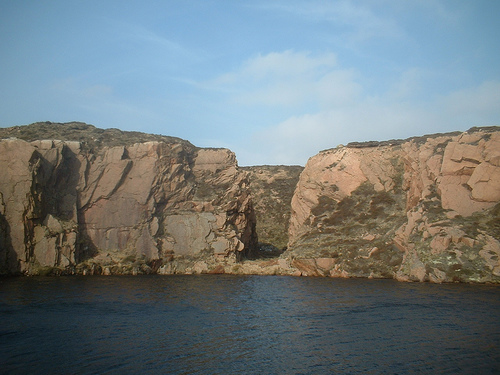
A red-granite quarry on the Buchan coast worked from 1815 to 1956, best known for the convict labour that broke its stone by hand for seventy years to build Peterhead's Harbour of Refuge breakwater — carried daily from the prison to the quarry face on Scotland's only state-owned convict railway.
History
The coastal stretch between Boddam and Cruden Bay held more than twenty granite quarries, and Stirling Hill, immediately south of Peterhead, was the most extensively worked of them all — the first quarry there opened in 1815, and eleven separate quarries were eventually cut into the hill. Its distinctive red granite, quarried commercially through the 18th and 19th centuries, became known simply as 'Peterhead granite' and was valued as a decorative and monumental stone; it was recorded in use as far afield as London, in the pillars of Blackfriars and Southwark Bridges, the Foreign Office and the British Museum, and Wikipedia's own account of Barry's 1840s design for Trafalgar Square records that 'all the stonework was of granite from Aberdeen' — the same red Aberdeenshire granite Stirling Hill was famous for supplying, though this record has not independently confirmed Stirling Hill by name as the specific source of the square's fountains. Stirling Hill's most distinctive chapter began in 1886, when Parliament authorised a new Harbour of Refuge for Peterhead Bay, and the Admiralty decided the huge quantities of granite the breakwater would need should be broken by convict labour from the newly built Peterhead convict prison. From 1888, prisoners were marched out to trains before dawn and carried the short distance to the quarry on a dedicated line — the only state-owned, passenger-carrying railway in Scotland at the time, its first locomotive, Victoria, delivered in 1889. Convicts travelled shackled in windowless compartments, around a hundred at a time, to spend the day breaking granite by hand with sledgehammers under armed guard; rifles, bayonets and cutlasses were standard issue for the warders who watched over them, and in one documented case in the 1930s a prisoner attempting to escape from the quarry was shot and killed — the only such fatality recorded across the scheme's history, though published sources do not give the prisoner's name or exact date. Convict labour at the quarry ended with the Criminal Justice Act 1949, which abolished penal hard labour; prisoners were reassigned to workshops inside the prison, and the breakwater project — reduced to civilian labour alone for its final years — was not finally completed until 1956, seventy years after the enabling Act, against an original twenty-five-year estimate. Stirling Hill's quarries closed the same year, unable to compete at the scale modern commercial granite working required.
Geology
Stirling Hill forms part of the Peterhead granite pluton, one of several distinct granite intrusions studding the Aberdeenshire coast, prized commercially for its warm pink-to-red colour — a product of potassium feldspar crystallising within the cooling magma — and for taking a fine polish, which made it valuable for decorative and monumental work rather than just plain building stone.
Workings
Eleven separate open quarries were cut into Stirling Hill over the site's working life, linked by tramways to cranes and masons' work buildings recorded in the Aberdeenshire Historic Environment Record survey; three granite-walled, concrete-roofed magazines for quarrying explosives also survive on site. From 1888 the Admiralty-run section of the quarry was worked specifically to supply the Peterhead breakwater, its stone broken largely by hand by convict labour supplied from HM Prison Peterhead and hauled out by the dedicated quarry railway to the Admiralty Yard and breakwater works.
Closure
Commercial quarrying at Stirling Hill ended in 1956, the same year the Peterhead breakwater project it had supplied was finally completed, unable to compete at the scale required by later 20th-century commercial building work. Convict labour itself had already ended seven years earlier, with the abolition of penal hard labour under the Criminal Justice Act 1949.
What remains
Several of Stirling Hill's former quarry pits survive flooded, and the Aberdeenshire Historic Environment Record's 2014 and 2022 coastal surveys recorded surviving tramway embankments, crane foundations, masons' buildings and the explosives magazines, alongside the remains of workers' cottages.
Flooded quarry pits, tramway embankments and stone-built magazine and mason's buildings are visible across the hill, walkable via the Boddam Castle and Stirling Hill Quarries circular route.
The flooded quarry pits are deep and unfenced — this entry describes history and general location only, not an access guide.
What's uncertain
Points where sources disagree or the record could not be settled; both accounts are kept. All open questions in the archive.
- A prisoner attempting to escape from the quarry was shot and killed in the 1930s — the only such fatality recorded in the scheme's history — though no name or exact date is recorded. (uncertain) 2
Recorded claims
Individual factual claims, each attached to the source(s) that support it below. Where sources disagree, both are kept.
- The first quarry on Stirling Hill opened in 1815; eleven separate quarries were eventually worked on the hill, extracting red granite used decoratively as far afield as London. 1
- From 1888, convicts from HM Prison Peterhead were carried daily to Stirling Hill on a dedicated, state-owned railway to break granite by hand under armed guard for the Peterhead breakwater project, ending in 1949 with the abolition of penal hard labour. 1,2,3
- A prisoner attempting to escape from the quarry was shot and killed in the 1930s — the only such fatality recorded in the scheme's history — though no name or exact date is recorded. (uncertain) 2
- The Peterhead breakwater project was completed in 1956, seventy years after the enabling Act of 1886, against an original 25-year estimate; commercial quarrying at Stirling Hill ended the same year. 1,2
Sources
- (primary) STIRLING HILL (Building record MAB30752) — Aberdeenshire Council Historic Environment Record
- (secondary) Blade 23: HM Convict Prison Peterhead — The Peterhead Trail
- (secondary) HM Prison Peterhead — Wikipedia
Record created: 26 August 2026 · Last researched: 26 August 2026