 MineArchive
Shotts Iron Works
| Location | Shotts, North Lanarkshire — 55.8195, -3.7975 (approximate) |
|---|---|
| Commodity | Iron |
| Type | Iron |
| Worked | 16 April 1801 (lease)–1951 |
| Operators | Shotts Iron Company (1801–1951) |
Overview
A Lanarkshire ironworks founded in 1801 on the strength of local coal, ironstone and lime, which grew famous under the slogan 'Shotts lights the world' for the decorative gas lamp standards it exported across the British Empire — many still standing in Edinburgh's New Town — before closing in 1951.
History
Robert and Hugh Baird, engineers already operating works at the Applecross basin of the Forth and Clyde Canal, took out a mineral lease on land beside the South Calder Water in north-east Lanarkshire on 16 April 1801. With George Munro, Walter Logan and John Baird joining as partners, the Shotts Iron Company was formed the same year to exploit the area's abundant coal, ironstone and lime; John Baird took the lead in supervising construction of the works' first blast furnace, blown in during 1802. Ownership changed hands in 1824, when a group led by John Horrocks won control and a new contract of co-partnery was drawn up under the name of the Shotts Iron Joint Stock Company, with partners including Walter Logan (continuing from the original company), William Waddell, William Wilson Duffin, William Crawford, Francis Cameron, William Dun, James Reoch and George Crichton.
The works grew steadily through the 19th century: in 1831 the company acquired the Caledonian Foundry at Leith to expand its castings production, and in 1837 it built further blast furnaces at Castlehill, near Carluke, where ample local coal and ironstone supported four pits by 1838. Annual pig-iron output at Shotts eventually peaked at around 75,000 tons, and the works built a genuine worldwide reputation for the quality of its foundry castings — above all its decorative cast-iron lamp standards, exported across the British Empire under the proud slogan 'Shotts lights the world'; ironwork from Shotts can still be seen decorating streets across Edinburgh's New Town. The company was incorporated by act of Parliament in 1871 and reconstructed and re-registered in October 1897; it remained the dominant employer in Shotts for more than 150 years. Coal mining interests were nationalised on 1 January 1947, and the blast furnaces themselves were blown out only three months later; the remaining iron and foundry business finally wound up in 1951.
Geology
Shotts drew its raw materials from the productive Coal Measures of the Lanarkshire coalfield, where workable seams of coal, blackband and clayband ironstone and limestone occur together in the same Carboniferous sequence — the combination of fuel, ore and flux in close proximity that made the district, and Lanarkshire more widely, one of the great centres of the Scottish iron industry.
Workings
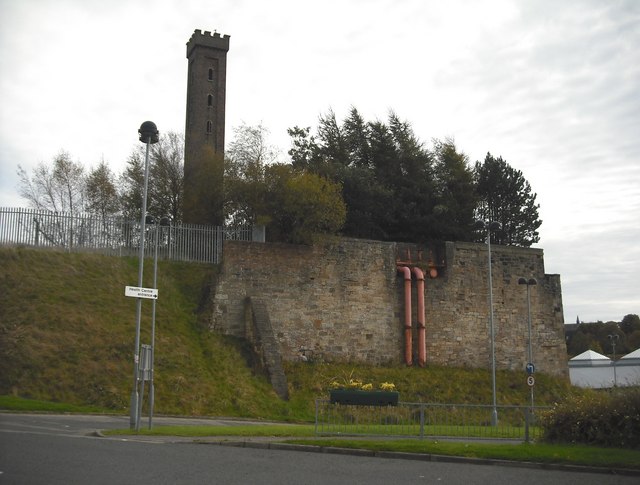
Iron was smelted from locally mined ironstone in a growing bank of blast furnaces, using coal and lime also worked from the company's own leases; a distinctive seven-storey, red brick, castellated hot-blast tower — apparently unique to Shotts — held a header tank that supplied cooling water to the tuyeres through which air was blasted into the furnaces.
Closure
The Shotts Iron Company's coal interests were nationalised on 1 January 1947, and its blast furnaces were blown out just three months later; the remaining foundry and iron business was wound up by shareholder resolution in 1951/52.
What remains
The furnace bank — a tall retaining wall of snecked cream sandstone rubble, heightened and extended since its original 1801 construction — and the distinctive hot-blast tower both survive and are Category B listed by Historic Environment Scotland; both are also entered on Scotland's Buildings at Risk Register, with inspections noting deteriorating pointing and internal fabric. Most of the wider works site was demolished in the 1980s.
The listed furnace bank and hot-blast tower are the principal survivals from a works that was otherwise largely cleared in the 1980s.
Nearby mines
- Northfield Colliery — 0.5 miles (0.8 km) E
- Hillhouserigg Colliery — 0.8 miles (1.2 km) NW
- Calderhead Colliery — 0.9 miles (1.5 km) N
- Hassockrigg Colliery — 1.9 miles (3.0 km) N
- Kingshill No. 3 Colliery — 2.0 miles (3.2 km) SW, South Lanarkshire
Straight-line distance, within 9 miles (15 km). Show on the map.
Recorded claims
Individual factual claims, each attached to the source(s) that support it below. Where sources disagree, both are kept.
- Robert and Hugh Baird took a mineral lease on 16 April 1801 and formed the Shotts Iron Company the same year with partners George Munro, Walter Logan and John Baird; the first blast furnace blew in during 1802. 1
- A group led by John Horrocks took control in 1824, forming the Shotts Iron Joint Stock Company with partners including Walter Logan, William Waddell, William Wilson Duffin, William Crawford, Francis Cameron, William Dun, James Reoch and George Crichton. 1
- Annual pig-iron output peaked at around 75,000 tons, and the works became famous for decorative cast-iron products, especially gas lamp standards exported across the British Empire under the slogan 'Shotts lights the world'. 1
- The company was incorporated by act of Parliament in 1871 and reconstructed in October 1897; its coal interests were nationalised on 1 January 1947, the blast furnaces were blown out three months later, and the remaining business wound up in 1951. 1,2
- The Mining Remediation Authority holds Shotts Iron Company plans for ironstone workings including Kingshaw and the Fortissat estate's slatyband ironstone. 3
Sources
- (secondary) Shotts Iron Works — Wikipedia
- (secondary) Shotts Iron Co — Grace's Guide to British Industrial History
- (primary) BGS/Mining Remediation Authority mine plans — Shotts Iron Company ironstone workings — British Geological Survey / Mining Remediation Authority
Record created: 26 August 2026 · Last researched: 26 August 2026