 MineArchive
Roughten Gill Mine
| Location | Caldbeck Fells, Cumbria, Cumbria — 54.7228, -3.0511 (approximate) |
|---|---|
| Commodities | Barite, Copper, Lead, Silver, Zinc |
| Type | Metal |
| Worked | possibly 14th century–late 19th century |
| Maximum depth | unrecorded |
| Operators | Company of Mines Royal |
| Status | Researched |
Overview
One of the richest and largest mines in the Caldbeck Fells, worked for copper, lead, silver and later barite from possibly the 14th century, and likely the principal working of the Elizabethan Company of Mines Royal.
History
Workings at Roughten Gill may date back some 700 years, but the mine's best-documented era began in 1563, when the Company of Mines Royal brought skilled German miners from Austria and Bavaria to the Caldbeck Fells — the first well-documented large-scale copper mining and smelting operation in the British Isles. Mining began in June 1566, paused, and resumed in 1568; the Hochstetter family supervised operations until around 1630, after which the mine lay largely idle until about 1695. Roughten Gill is thought to have been the principal Elizabethan working in the fells. One of the operation's overseers, Robert Bowes, died in a mining accident in 1610. Work continued intermittently through the 18th and 19th centuries, raising copper, lead and increasingly zinc, before later operators turned to barite and 'umber', a soft iron-manganese ochre, as the metal veins were worked out; sources differ on the exact closure date, variously given as 1878 or 1894.
Geology
The mine worked mineralised faults at the junction of the Ordovician Eycott Volcanic Group and the Carrock Fell Intrusive Complex, following at least four roughly parallel north-east/south-west veins — more complex than early accounts recognised. The Roughtongill South Vein was the most productive, up to 9m wide where it ran against a granophyre footwall, and the site is well known among mineral collectors for abundant, well-formed supergene minerals including pyromorphite, cerussite and malachite.
Workings
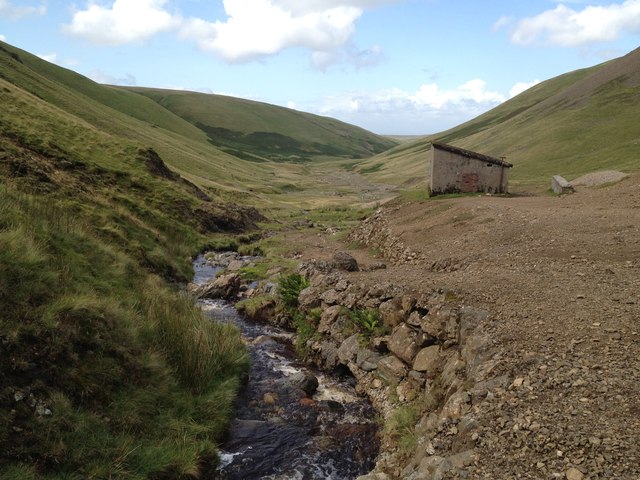
Extensive workings followed the veins across the fells, with mine buildings, dressing floors and spoil heaps spread over a very large area — remains of past operations can be found throughout the gill.
What remains
No underground access to the old vein workings survives today; one former working, Barstow's Trench, has been backfilled. Extensive spoil heaps remain, still containing mineralised material despite generations of collecting. Mineral collecting on the site requires a Lake District National Park Authority permit.
Ruined mine buildings and spoil heaps survive across a wide area of the gill; a sealed building near the head of the gill is a notable surviving structure.
Abandoned workings can be dangerous — unstable ground, uncapped shafts, flooding and bad air are common even where a site looks safe from the surface. This entry describes history and general location only; it is not an access guide.
Recorded claims
Individual factual claims, each attached to the source(s) that support it below. Where sources disagree, both are kept.
- Sources disagree on the exact closure date: one account gives 1878, another 1894. 1
Images
Sources
- (secondary) Roughten Gill Mine
- (primary) Roughton Gill Mine and Silver Gill Mine, Cumbria. Survey Report — Historic England
- (secondary) German mines at Caldbeck — Wikipedia
Record created: 22 August 2026 · Last researched: 22 August 2026