 MineArchive
Raasay Iron Mine
| Also known as | Inverarish Ironstone Mine, Raasay No. 1 Mine |
|---|---|
| Location | Inverarish, Isle of Raasay, Highland — 57.3505, -6.0519 (exact) |
| Commodity | Iron |
| Type | Ironstone |
| Worked | From 1913–1919 |
| Operators | William Baird & Company (1911–1919) |
Overview
A Hebridean island iron mine sunk on the eve of the First World War and kept working through it almost entirely by conscripted local men and, from 1916, 260 German prisoners of war housed in a fenced compound of their own — an episode islanders still remember as having produced remarkably little ill-feeling between the two groups.
History
William Baird & Co Ltd of Coatbridge, an established Scottish coal and iron company, bought the island of Raasay from the Wood family in May 1911 and surveyed it for iron ore before the First World War. The mine was ready to open by the summer of 1914, but the outbreak of war and the conscription of local men left it short of labour, and production only really got under way once Bairds, needing a secure ore supply with Spanish imports difficult to obtain during the war, pressed the mine into full operation. Twenty-two of the thirty-six Raasay men conscripted were killed in the war, and by the summer of 1916 the labour shortage was severe enough that Baird's applied to the Ministry of Munitions for prisoner-of-war labour; around 260 German prisoners arrived and were housed in a fenced compound, separated by barbed wire and watchtowers from the roughly ninety British workers and local men, though islanders' accounts describe remarkably little hostility between the two groups, with local families sometimes smuggling food to the prisoners, who were kept on half-rations. A pay dispute added its own tension: when the Labour Department granted Cumberland miners a rise from 7s 6d to 9s 6d a shift with no equivalent increase for Raasay's workers, the Raasay miners went on strike from December 1917 into January 1918. The mine worked until the end of the war and closed in 1919, iron ore production ceasing on the island for good.
Geology
Raasay's ore is a sedimentary ironstone, part of the same Jurassic ironstone sequence worked at Brora on the Scottish mainland, here forming a workable seam beneath the island's basalt cap.
Workings
A stoop-and-room (pillar-and-stall) mine reached by a drift entrance at about 330 feet above sea level, developing into roughly five miles of interconnected underground roadways. Ore was lowered by an incline railway a mile and a quarter to a 4,000-ton bin at Suisnish pier, crossing the Inverarish Burn on an iron viaduct, for loading onto steamers bound for the Baird smelting works at Glasgow. Between 1914 and 1918 the mine produced about 140,000 tons underground and a further 12,000 tons from opencast working.
Closure
The mine closed in 1919 once the wartime demand and labour situation that had sustained it ended; no iron ore has been worked on Raasay since.
What remains
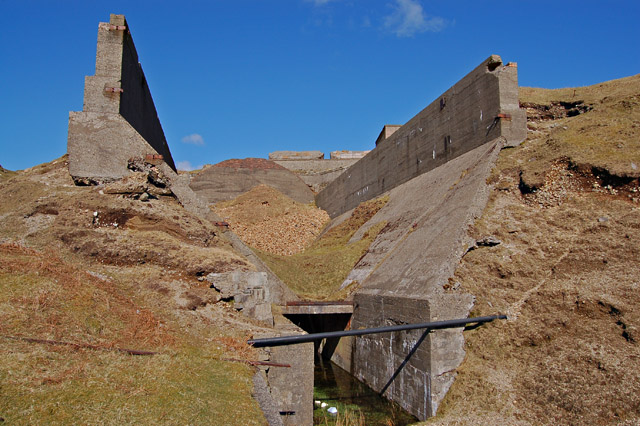
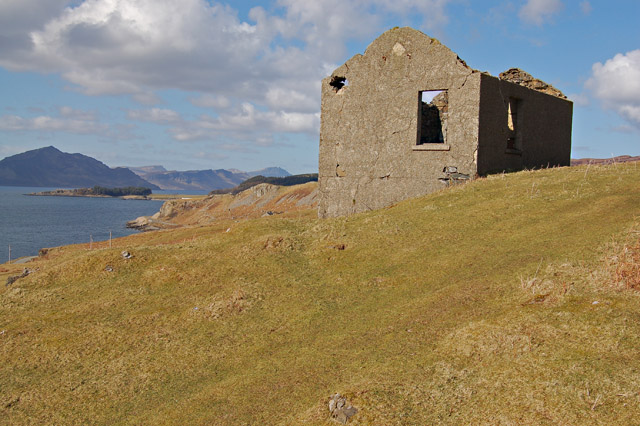
The site survives substantially intact and is protected as a scheduled monument. Surface remains include mine buildings, a power house, kiln bases, and the route of the incline railway down to Suisnish, with a hopper and viaduct remnants along the way; one underground heading was reported still open at the time the monument was last surveyed. Much loose scrap metal, including railway ironwork, was salvaged for the war effort in 1941.
Mine buildings, a power house, kiln bases, the incline railway trackbed to Suisnish pier, a surviving ore hopper, and a viaduct crossing the Inverarish Burn.
Redevelopment
None — the site remains a scheduled ancient monument on open ground.
Recorded claims
Individual factual claims, each attached to the source(s) that support it below. Where sources disagree, both are kept.
- William Baird & Co Ltd bought Raasay in 1911 and had the mine ready to operate by summer 1914, though wartime conscription initially left it short of labour. 1
- From summer 1916 around 260 German prisoners of war were brought in to work the mine, housed in a fenced compound separate from the roughly ninety British and local workers. 1
- A pay dispute — Cumberland miners receiving a rise Raasay's workers did not — led to a miners' strike from December 1917 to January 1918. 1
- The mine worked by stoop-and-room methods from a drift at about 330 ft, developing roughly five miles of roadways, and produced about 140,000 tons underground and 12,000 tons opencast between 1914 and 1918, moved by incline railway to a 4,000-ton bin at Suisnish pier. 1
- The mine closed in 1919; the site survives substantially intact as a scheduled monument. 1
Sources
- (primary) Inverarish Ironstone Mine — Scottish Cave and Mine Database — Grampian Speleological Group / Scottish Cave and Mine Database
- (observational) The Ironstone Mines and the Burma Road — Walkhighlands
Record created: 24 August 2026 · Last researched: 24 August 2026