 MineArchive
Luing Slate Quarries
| Also known as | Toberonochy Slate Quarries, Cullipool Slate Quarries |
|---|---|
| Location | Toberonochy and Cullipool, Isle of Luing, Argyll and Bute — 56.2283, -5.6412 (approximate) |
| Commodity | Slate |
| Type | Quarry |
| Worked | Worked from the mid-18th century–1965 |
| Operators | Marble and Slate Company of Netherlorn (1745–1866) |
Overview
One of the four Slate Islands that together roofed a good part of the world, worked from villages purpose-built for the trade, and the last of Scotland's historic slate islands still working when quarrying finally stopped here in 1965.
History
Slate quarrying on Luing began under the same enterprise that developed the more famous workings on neighbouring Easdale: the Marble and Slate Company of Netherlorn, established by the Earl of Breadalbane in 1745, expanded its operations from Easdale to Ellenabeich, Balvicar and Luing as demand grew through the later 18th and 19th centuries. Purpose-built quarrying villages grew up on Luing itself at Toberonochy and Cullipool from around 1820 to house the workforce, and when the Netherlorn company was dissolved in 1866 the Luing quarries passed into separate ownership from Easdale and Balvicar. At its height the industry on Luing employed around 170 men and extracted some three-quarters of a million slates a year. Slate continued to be worked from the quarries at the north end of Cullipool right up to 1965, by which point Luing was one of the last of the Slate Islands still active — Easdale's own main quarry had already been lost to a catastrophic flood in 1881, and by the 1960s import competition and artificial roofing materials had displaced Scottish slate almost everywhere else.
Geology
Luing shares the same Dalradian slate belt worked at Easdale, Belnahua and Ellenabeich — metamorphosed mudstone that splits cleanly along parallel planes into thin, durable roofing slates, the whole group long marketed together as Easdale slate regardless of which island actually supplied a given batch.
Workings
Quarries at both Toberonochy and Cullipool worked the slate belt by conventional pit quarrying, with piers built at both villages, and at Balvicar and Easdale, to ship the finished slates out by sea — the only practical way to move heavy roofing stone off a small island.
Closure
Quarrying at Cullipool's northern workings continued until 1965, among the last slate extraction anywhere in the Slate Islands; when it ended, more than two dozen remaining workers had to find employment elsewhere.
What remains
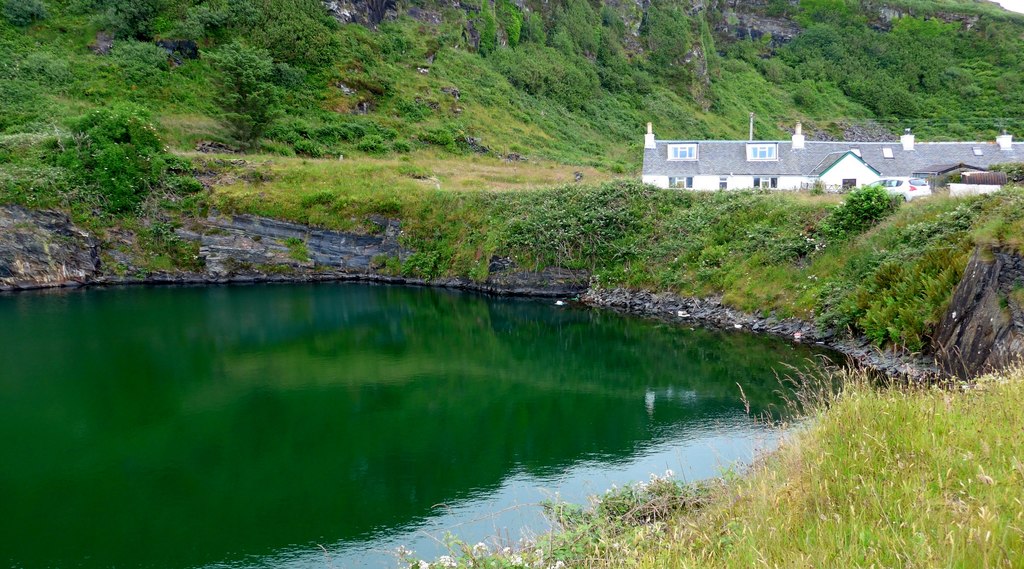
The quarries at Cullipool survive as flooded pits, among the most visually striking remains anywhere in the Slate Islands, with Toberonochy's harbour and quarrying-era cottages also still standing. Luing's population, over 600 at the industry's Victorian peak, is now a little over 200.
Flooded quarry pits at Cullipool, the harbours and piers at both Cullipool and Toberonochy, and rows of quarry workers' cottages in both villages.
Redevelopment
None — the villages remain inhabited, now sustained by tourism, fishing and farming rather than quarrying.
Related mines
- Belnahua Slate Quarries — Luing supplied Belnahua with water and provisions, its Shaw family later held the lease, and Belnahua's families moved there in 1914.
- Easdale Slate Quarries — Neighbouring Slate Islands quarries worked by the same company, the Earl of Breadalbane's Marble and Slate Company of Netherlorn, and counted together in the output that was said to have roofed the world.
Nearby mines
- Belnahua Slate Quarries — 2.5 miles (4.1 km) NW
- Easdale Slate Quarries — 4.5 miles (7.2 km) N
Straight-line distance, within 9 miles (15 km). Show on the map.
Recorded claims
Individual factual claims, each attached to the source(s) that support it below. Where sources disagree, both are kept.
- The Marble and Slate Company of Netherlorn, founded 1745, expanded slate quarrying from Easdale to Luing and the other Slate Islands; purpose-built quarrying villages grew up at Toberonochy and Cullipool from around 1820. 1,2
- The company's 1866 dissolution left the Luing quarries under separate ownership from Easdale and Balvicar. 3
- At its height the Luing industry employed around 170 men, extracting about three-quarters of a million slates a year. 2
- Quarrying continued at the north end of Cullipool until 1965, among the last slate extraction anywhere in the Slate Islands. 2
Sources
- (secondary) The Slate Islands—The islands that roofed the world — Southern Hebrides
- (secondary) Luing — Undiscovered Scotland
- (secondary) Slate Industry — Easdale Island Folk Museum
Record created: 24 August 2026 · Last researched: 24 August 2026