 MineArchive
Foss Mine
| Location | Duntanlich, near Aberfeldy, Perth and Kinross — 56.6670, -3.9340 (approximate) |
|---|---|
| Commodity | Barite |
| Type | Metal |
| Worked | 1984–2021 |
| Maximum depth | Unknown. |
| Operators | M-I SWACO (1984–2021) |
Overview
Foss Mine, high on the hillside above Aberfeldy, was for four decades the United Kingdom's principal source of baryte — and, by some measures, the largest single accumulation of barium ore anywhere in the world.
History
The baryte deposit at Foss was discovered in the 1970s by the British Geological Survey (then the Institute of Geological Sciences) — in 1973, according to BGS's own Minerals in Britain profile, though other accounts give 1975 or the late 1970s — hosted in Dalradian schist and quartzite within a tightly folded structure known as the Stron Mhor Synform. Production began in the early 1980s, from 1984 by BGS's account, as an underground mine working baryte beds that average about 3 metres thick but swell locally to more than 15, and by the mid-1980s the mine was raising around 50,000 tons of baryte a year, supplying roughly a quarter of the needs of Scotland's North Sea offshore oil industry. Rock was won by drilling and blasting, then hauled to the surface for grading and blending to the density required before onward transport to Aberdeen for processing. The mine was operated in its later years by M-I SWACO, a Schlumberger oilfield-services company. Before its closure in 2021, Foss had produced more than a million tons of baryte over its working life, with a broadly similar tonnage still believed to remain at depth in the deposit's structurally complex, folded and stretched orebody. In 2026 BGS released more than 700 rock samples collected at Foss in the 1980s to the National Geological Repository, where they are available for renewed study.
Geology
The deposit is a syn-sedimentary, exhalative hydrothermal baryte deposit laid down within a late Precambrian back-arc basin, formed across at least seven distinct episodes of vigorous but short-lived hydrothermal exhalation — a fundamentally different origin from the granite-related hydrothermal vein deposits worked at most metal mines in this archive.
Geological setting: Hydrothermal Deposits (well documented example)
Workings
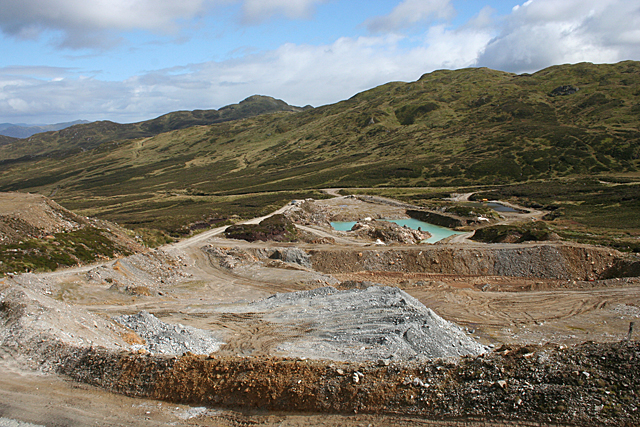
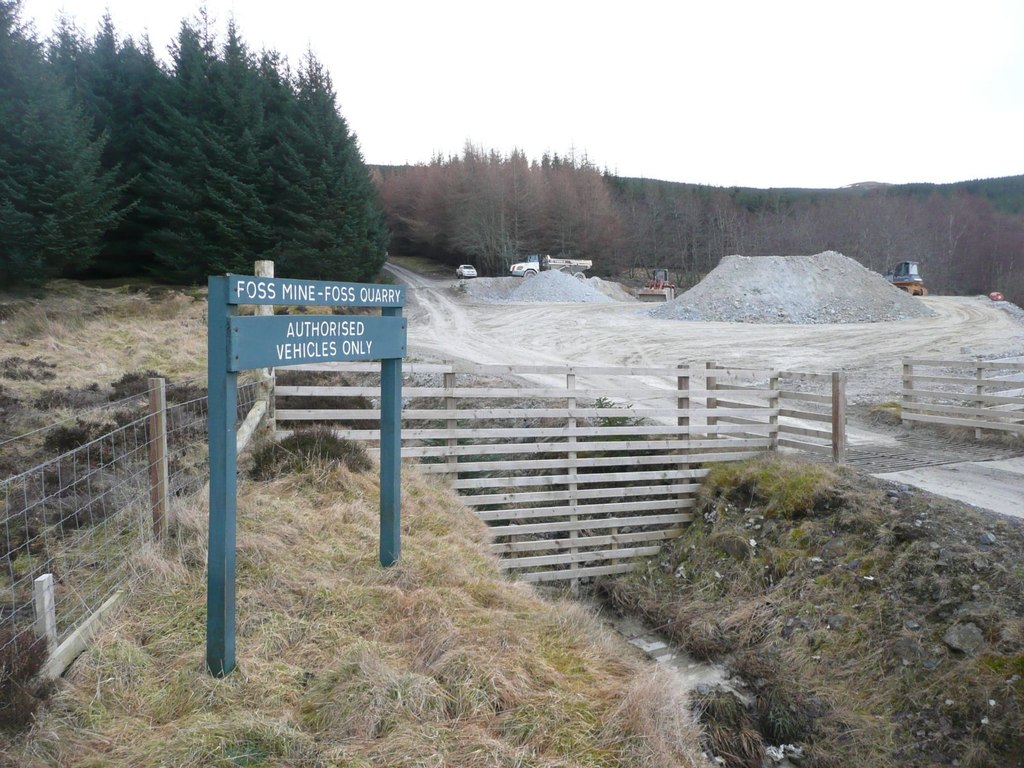
Baryte was extracted from Foss West by drilling and blasting, with material graded and blended on site to the density specification required before transport to Aberdeen; a similar deposit at neighbouring Foss East was identified but never worked. The mine was underground, working from an original mineable resource of 0.9 million tonnes, and a photograph of 2012 also shows spoil and a settling pond in an open-cast part of the site; ore was stockpiled beside the main road before larger lorries took it on.
Closure
The mine closed in 2021 after more than four decades of continuous production, having supplied a substantial share of UK offshore drilling demand throughout its working life.
What remains
Production ceased in 2021, and BGS described Foss as a former mine in 2026.
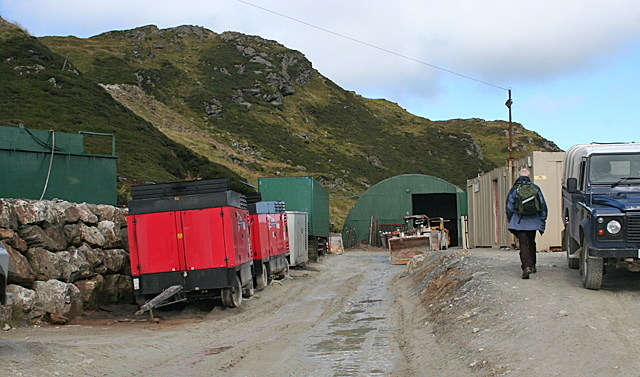
Mine buildings, including processing and storage structures, survive at the site entrance, and in 2012 spoil and a settling pond marked the open-cast area.
Related mines
- Duntanlich Mine — Duntanlich was developed by the same operator, M-I SWACO, specifically as Foss's baryte reserves ran down.
Nearby mines
- Duntanlich Mine — 3.6 miles (5.8 km) NE
Straight-line distance, within 9 miles (15 km). Show on the map.
What's uncertain
Points where sources disagree or the record could not be settled; both accounts are kept. All open questions in the archive.
- Accounts differ on when the deposit was found: BGS's Minerals in Britain profile says the Mineral Reconnaissance Programme discovered baryte in the Aberfeldy area in 1973, a 2012 description of the mine gives 1975, and the Gazetteer for Scotland says the mine opened in the late 1970s. (disputed) 2,3,4
- The Foss baryte shows evidence of at least five episodes of folding, which makes following it underground far from easy. (uncertain) 4
Recorded claims
Individual factual claims, each attached to the source(s) that support it below. Where sources disagree, both are kept.
- By the mid-1980s the mine produced around 50,000 tons of baryte a year, supplying roughly a quarter of the needs of Scotland's North Sea offshore oil industry; by its 2021 closure it had produced more than a million tons in total, with a similar tonnage believed to remain at depth. 1,2
- The deposit formed across at least seven distinct episodes of vigorous, short-lived hydrothermal exhalation within a late Precambrian back-arc basin. 2
- Accounts differ on when the deposit was found: BGS's Minerals in Britain profile says the Mineral Reconnaissance Programme discovered baryte in the Aberfeldy area in 1973, a 2012 description of the mine gives 1975, and the Gazetteer for Scotland says the mine opened in the late 1970s. (disputed) 2,3,4
- The Foss deposit has been in operation since 1984: an underground mine producing 50,000 tonnes a year of direct-shipping-grade baryte from an original mineable resource of 0.9 million tonnes. 2
- The baryte beds average 3 metres thick but range from under a metre to locally over 15 metres of pure baryte, within a mineralised zone that runs intermittently for 7 km, is up to 110 metres thick and extends at least 500 metres deep, in two largely fault-bounded deposits either side of Farragon Hill. 2
- BGS describes Foss as the UK's main source of baryte from the early 1980s until its closure in 2021; in 2026 more than 700 samples collected at Foss in the 1980s were released at the National Geological Repository for renewed study, including of the area's critical-mineral potential. 5
- The Foss baryte shows evidence of at least five episodes of folding, which makes following it underground far from easy. (uncertain) 4
Photographs & further reading
A 2012 illustrated description of the mine, how the barite was won and where it went, with nine photographs.
View sourceBGS news on the release of more than 700 Foss samples to the National Geological Repository, with a summary of the mine's role until 2021.
View sourceBGS's profile of British baryte, describing the Aberfeldy deposits, the Foss mine's output and its orebody.
View sourceSources
- (secondary) Foss Mine, Aberfeldy, Perth and Kinross, Scotland, UK — Mindat
- (primary) Minerals in Britain: Baryte — British Geological Survey
- (secondary) Foss Mine — The Gazetteer for Scotland
- (observational) Barite and the Foss Mine (Geograph shared description, Anne Burgess, 2012) — Geograph Britain and Ireland
- (primary) Newly released core could hold clues on potential mineral prospectivity in Perthshire — British Geological Survey
- (observational) Foss Mine (Geograph photo 3128093, Anne Burgess, 2012) — Geograph Britain and Ireland
Record created: 23 August 2026 · Last researched: 18 September 2026