 MineArchive
Eccleston Quarry
| Also known as | Eccleston Delph, Eccy Delph, Hurst House Delph, Marsden's Quarry |
|---|---|
| Location | A mile south of Eccleston, near Chorley, Lancashire — 53.6291, -2.7291 (exact) |
| Commodity | Sandstone |
| Type | Quarry |
| Worked | to after 1945 |
| Maximum depth | Unknown. |
| Operators | Mr Hurst |
Overview
Eccleston Quarry, a mile south of Eccleston in Lancashire and known locally as Eccleston Delph or Eccy Delph, was a stone quarry employing twelve men under a Mr Hurst. Its stone went to Blackpool Promenade, and thin split stone from it roofed buildings locally. It flooded after the war when the pump that had kept it dry stopped being paid for, and it is now a commercial scuba-diving site.
History
The quarry was formerly run as a stone quarry by a Mr Hurst, who employed twelve men. From it came stone for Blackpool Promenade, and thin split stone used as slates for roofing in the area. It has been known by several names besides Eccleston Delph and Eccy Delph — Hurst House Delph, from its operator, and Marsden's Quarry.
Its end came through an administrative gap rather than an exhausted face. According to a local account, during the Second World War a Ministry paid a local man to run a pump at intervals to keep the quarry empty while its owner and staff were away; after the war an official reorganisation stopped the payments, so the man stopped running the pump, and over time the quarry flooded.
Once abandoned and filled by seeping groundwater it became an unofficial diving site for a long time. The back of the quarry was a cliff standing straight out of the water, and there were no buildings except a stone hut near the entrance and a machinery shed which was submerged when the quarry flooded; over the years the shed's sheet-metal walls and roof rusted away, leaving its metal skeleton standing underwater.
On 14 October 1979 divers found a body in the quarry. It was that of the narcotics dealer Marty Johnstone, killed on the orders of his associate Terry Clark, and the discovery led to an international police investigation and the breaking up of the so-called Mr Asia narcotics gang. The find has nothing to do with quarrying, but it is what the quarry is best known for outside Lancashire.
Around the year 2000 the quarry was pumped dry, more than 250 cars and a quantity of other rubbish were taken out of it, and the site was landscaped, re-flooded and fitted out as a diving centre with objects sunk deliberately for divers to explore.
Geology
The quarry works sandstone of the sort that splits thin enough to roof a building — a flaggy, well-bedded stone, which is what made it useful both as promenade stone and as local roofing slate. A photograph of a new rock exposure cut for a path at the quarry is described as probably New Red Sandstone. Nothing on record names the formation with confidence, and none is asserted here.
Geological setting: Sedimentary Beds and Seams (historical documentary reference)
Workings
A stone quarry with a cliff face at its back standing straight out of what is now water. There were no buildings on the site beyond a stone hut near the entrance and a machinery shed, the latter submerged when the quarry flooded. Twelve men were employed under Mr Hurst. A pump kept the workings dry, which is the detail that settled the quarry's fate when it stopped.
Closure
The quarry was abandoned and allowed to flood by groundwater seeping in, after the wartime arrangement that paid a local man to run the pump was ended in a post-war reorganisation. No source gives a date for the abandonment itself, only the mechanism.
What remains
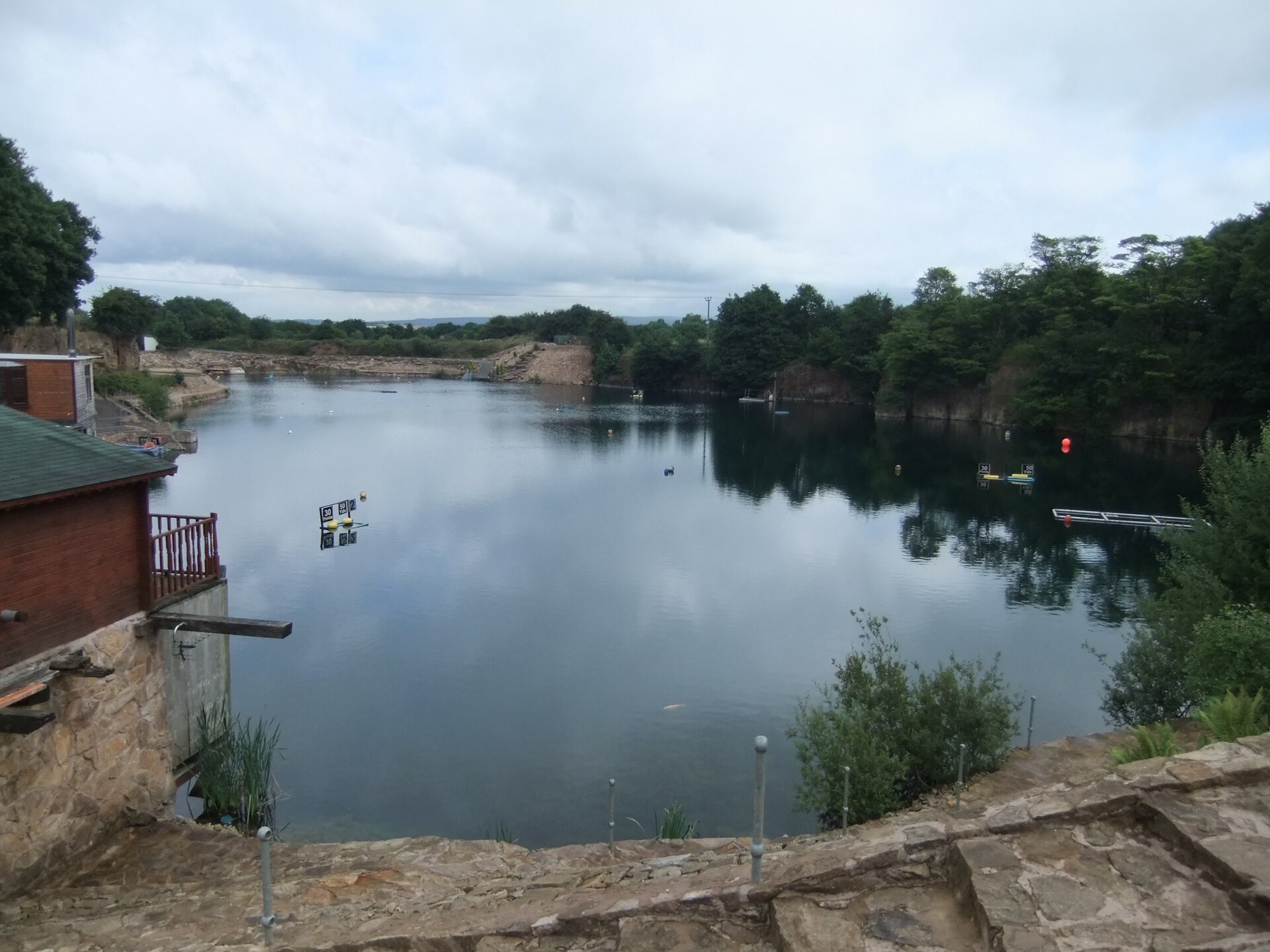
A commercial inland dive site. The quarry was pumped dry around 2000, cleared of more than 250 cars and other rubbish, landscaped, re-flooded and provided with buildings; objects were submerged for divers to dive on. Visibility is generally very poor and ropes have been strung between the underwater features to aid navigation, traditional compass methods being all but impossible in the murky water, though much work has been done and by 2010 visibility was much improved. The site has a cafe, shop, changing facilities, swimming pool, training room, equipment hire and an air filling station.
The quarry faces above the waterline, and the modern dive-centre buildings. Underwater, the rusted metal skeleton of the machinery shed submerged when the quarry flooded, together with the objects deliberately sunk for divers.
Nearby mines
- Chisnall Hall Colliery — 2.5 miles (4.0 km) SE
- Coppull Colliery — 2.9 miles (4.6 km) E
- Blainscough Colliery — 2.9 miles (4.7 km) E
- Birkacre Colliery — 3.2 miles (5.2 km) E
- Broomfield Colliery — 3.6 miles (5.8 km) SE, Greater Manchester
Straight-line distance, within 9 miles (15 km). Show on the map.
What's uncertain
Points where sources disagree or the record could not be settled; both accounts are kept. All open questions in the archive.
- A local resident said that during the Second World War a Ministry paid a local man to run a pump at intervals to keep the quarry empty while its owner and staff were away, and that after the war an official reorganisation stopped the payments, so the man stopped running the pump and the quarry flooded. (uncertain) 1
Recorded claims
Individual factual claims, each attached to the source(s) that support it below. Where sources disagree, both are kept.
- Formerly a Mr. Hurst ran Eccleston Quarry as a stone quarry and employed 12 men; from it came stone for Blackpool Promenade, and thin split stone used as slates for roofing in the area. 1
- A local resident said that during the Second World War a Ministry paid a local man to run a pump at intervals to keep the quarry empty while its owner and staff were away, and that after the war an official reorganisation stopped the payments, so the man stopped running the pump and the quarry flooded. (uncertain) 1
- There were no buildings except a stone hut near the entrance and a machinery shed which was submerged when the quarry flooded; over the years the shed's sheet-metal walls and roof rusted away, leaving its metal skeleton. 1
- On 14 October 1979 the body of the narcotics dealer Marty Johnstone was discovered in the quarry by local divers; he had been murdered on the orders of his associate Terry Clark, and the discovery led to an international police investigation and the breakup of the Mr Asia narcotics gang. 1
- Around the year 2000 the quarry was pumped dry, over 250 cars and much rubbish were removed from it, and it was landscaped, re-flooded, scuba diving centre buildings were built by it, and objects were submerged for divers to dive on. 1
- The flooded quarry is a popular scuba diving site with a cafe, shop, changing facilities, swimming pool, training room, equipment hire and an air filling station; visibility is generally very poor and ropes have been strung between underwater features to aid navigation, though by 2010 it was much improved. 1,2
Photographs & further reading
The fullest available account of the quarry: Hurst's twelve men and the Blackpool Promenade stone, the pump that stopped, and the flooded pit's later life as a dive site.
View sourceSources
- (secondary) Eccleston Quarry — Wikipedia
- (observational) Eccleston Quarry, view along length of quarry from car park (photograph) — Wikimedia Commons

Record created: 4 September 2026 · Last researched: 5 September 2026